What is the Fence Estimate Calculator?
The Fence Estimate Calculator gives you a quick materials budget for a straight run of fence. By entering the total fence length, how far apart your posts will sit, the width of each panel, and the unit prices, you instantly see how many posts and panels you need and what they will cost. It is ideal for homeowners planning a backyard project and for contractors preparing a fast quote.
How to use it
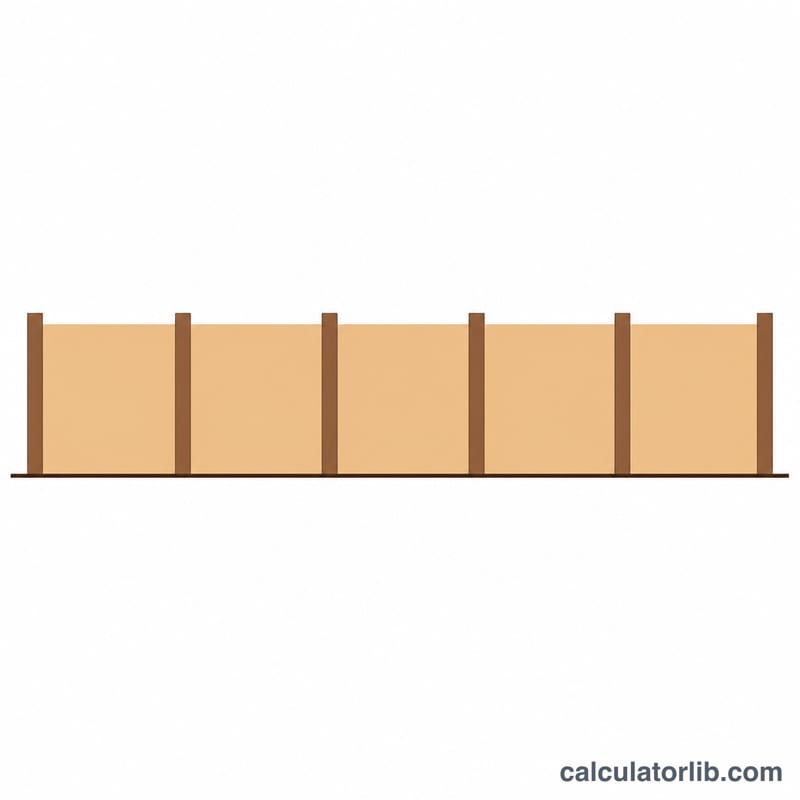
Enter the fence length in feet, the post spacing (commonly 6–8 ft), and the panel width that matches the spacing for most pre-built panels. Then add the cost per post and cost per panel. The calculator returns the post count, panel count, and a combined total. Add a buffer of 5–10% for waste, gates, and corner hardware not covered by this estimate.
The formula explained
Posts are calculated as the length divided by spacing, rounded up, plus one extra post to close the final section: \( N_{post} = \left\lceil \frac{\text{Length (ft)}}{\text{Spacing (ft)}} \right\rceil + 1 \). Panels fill the gaps between posts: \( N_{panel} = \left\lceil \frac{\text{Length (ft)}}{\text{Panel Width (ft)}} \right\rceil \). The total cost simply multiplies each quantity by its unit price:
$$ \text{Cost} = N_{post}\cdot\text{Cost/Post} + N_{panel}\cdot\text{Cost/Panel} $$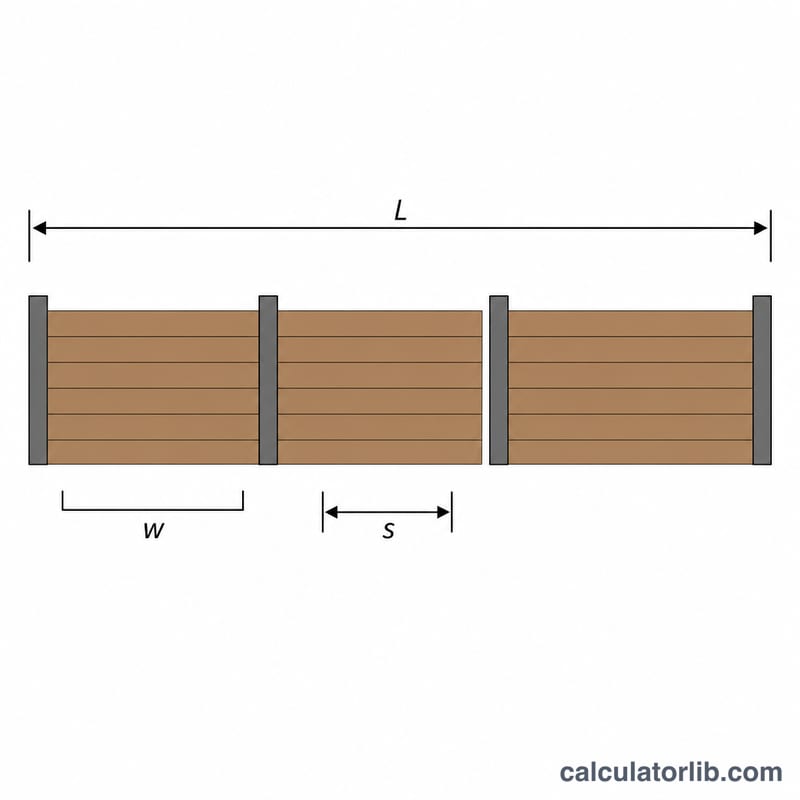
Worked example
For a 100 ft fence with 8 ft spacing and 8 ft panels at $15 per post and $45 per panel:
$$ N_{post} = \left\lceil \frac{100}{8} \right\rceil + 1 = 13 + 1 = 14 $$ $$ N_{panel} = \left\lceil \frac{100}{8} \right\rceil = 13 $$ $$ \text{Cost} = 14 \times \$15 + 13 \times \$45 = \$210 + \$585 = \$795 $$Fence Cost Comparison for Common Scenarios
The table below compares a fixed 100 ft straight run using the calculator's formulas: posts = ⌈L/s⌉ + 1 and panels = ⌈L/w⌉. Panel width is set equal to post spacing (6 ft panels on 6 ft spacing, 8 ft panels on 8 ft spacing). Prices are illustrative assumptions, not market quotes: budget = $15 per post and $45 per panel; premium = $35 per post and $90 per panel. The same unit prices are used for both panel widths to isolate the effect of spacing. In reality, wider panels usually cost more each.
| Spacing / Panel width | Price level | Posts | Panels | Total cost |
|---|---|---|---|---|
| 6 ft / 6 ft | Budget | \(\lceil 100/6 \rceil + 1 = 18\) | \(\lceil 100/6 \rceil = 17\) | 18×$15 + 17×$45 = $1035 |
| 6 ft / 6 ft | Premium | 18 | 17 | 18×$35 + 17×$90 = $2,160 |
| 8 ft / 8 ft | Budget | \(\lceil 100/8 \rceil + 1 = 14\) | \(\lceil 100/8 \rceil = 13\) | 14×$15 + 13×$45 = $795 |
| 8 ft / 8 ft | Premium | 14 | 13 | 14×$35 + 13×$90 = $1660 |
Takeaway: moving from 6 ft to 8 ft spacing saves 4 posts and 4 panels on this run, about $240 at the budget level and $500 at the premium level, before concrete, hardware, gates, and labor. Because 100 ÷ 8 = 12.5, the 13th panel is only half used, so it would be cut to fit.
Typical Post Spacing and Panel Sizes
These are general ranges. Actual panel width and post spacing vary by manufacturer and product line, so always use the dimensions printed on the product you plan to buy.
| Fence type | Typical post spacing / panel width | Common heights |
|---|---|---|
| Wood privacy (panelized) | 6–8 ft | 6 ft is most common; 4 ft and 8 ft are also seen |
| Vinyl (privacy or picket panels) | 6–8 ft | 4 ft and 6 ft are common; some systems offer taller |
| Chain link | Line posts up to about 10 ft apart | 4 ft residential; 6 ft and 8 ft for privacy or commercial use |
| Split rail | 8–10 ft (set by rail length) | Usually lower than 4 ft |
Local building codes, zoning rules, and homeowner association guidelines may limit fence height (often lower in front yards) and sometimes post spacing or footing requirements. Check the rules for your area before choosing a design.
Practical Tips for Ordering Fence Materials
- Order 5–10% extra. Allow for cutting waste, damaged pieces, and mistakes, especially for panels that must be trimmed to fit.
- Round up to whole units. Posts and panels are sold whole, which is why the calculator uses the ceiling function. Never round down.
- Add extra posts where needed. The formula assumes one straight run. Corners, gate openings, and end or terminal posts often require additional or heavier posts, so add them to the count.
- Account for sloped ground. Slopes may require stepped or racked installation, shorter spans, or additional posts, and they can change how many panels you need.
- Confirm center spacing against the actual panel width. Post spacing is measured center to center, and the real panel width plus post thickness and gaps can differ from the nominal size. Check the manufacturer's installation guide.
- Check property lines and permits first. Verify boundaries, easements, utility locations, and any permit or HOA requirements before you buy.
- Budget separately for other items. This estimate covers only posts and panels. Add concrete or gravel for footings, brackets, screws or nails, gates and gate hardware, caps, stain or sealant, and delivery or labor.
This is general information for planning, not professional advice. Get local supplier quotes and consult a licensed contractor for specific projects.
FAQ
Why is there one extra post? Every fence run needs a post at both ends, so the number of posts is always one more than the number of sections.
Does this include gates or concrete? No. This estimate covers posts and panels only. Add gates, post concrete, screws, and labor separately.
What units should I use? Use consistent units (feet here). Keep length, spacing, and panel width in the same unit and the math stays correct.