
What is a Punnett Square?
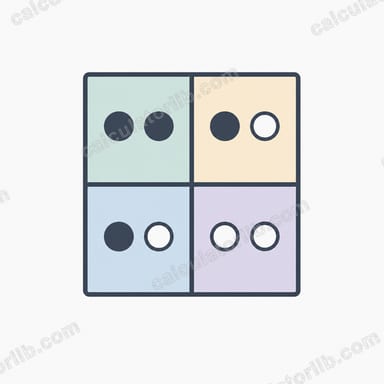
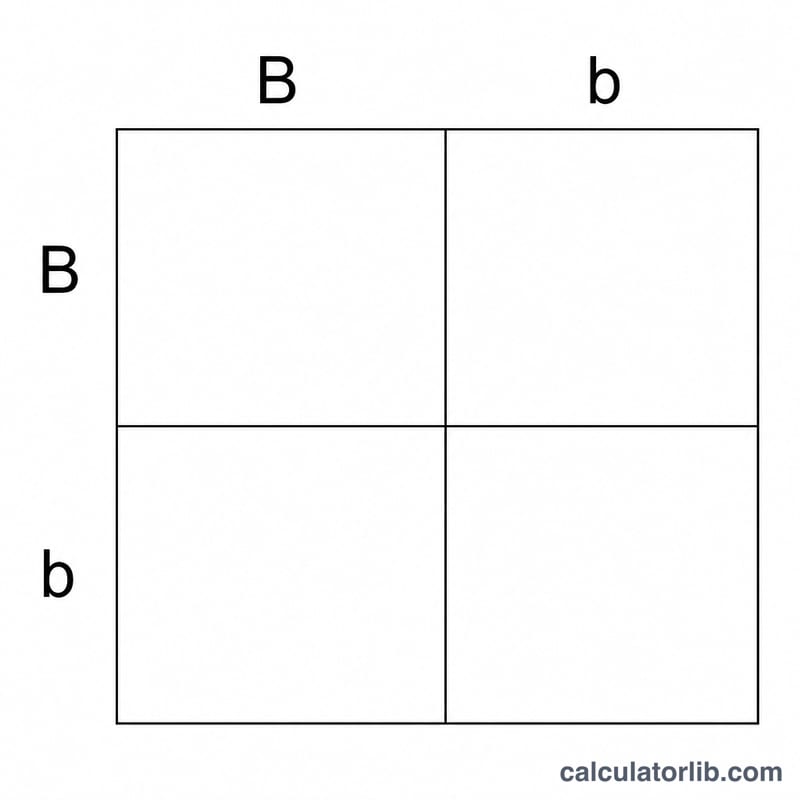
A Punnett square is a simple grid used in genetics to predict the possible genotypes of offspring from a cross between two parents. Named after Reginald Punnett, it lists one parent's gametes along the top and the other's down the side, then fills each cell with the combined alleles. This calculator handles a monohybrid cross — a single gene with two alleles, a dominant one (A) and a recessive one (a).
How to Use It
Choose the two alleles each parent carries. Capital "A" represents the dominant allele and lowercase "a" the recessive allele. For example, a carrier parent is Aa, a homozygous dominant parent is AA, and a homozygous recessive parent is aa. Hit calculate and the tool builds the 2×2 grid and reports the genotype counts and the percentage probability of each genotype and phenotype.
The Formula Explained
Each parent passes one allele to each offspring. With two alleles per parent there are \(2 \times 2 = 4\) equally likely combinations. The probability of any genotype is the number of boxes showing it divided by 4. The dominant phenotype appears whenever at least one A is present (AA or Aa), while the recessive phenotype only appears for aa.
$$\text{Offspring} = \left\{ \left(\text{P1}_a\,,\, \text{P1}_b\right) \times \left(\text{P2}_a\,,\, \text{P2}_b\right) \right\}$$
$$\begin{gathered} \text{Boxes} = \left\{ a_i \, b_j : a_i \in \big(\text{P1}_a,\, \text{P1}_b\big),\ b_j \in \big(\text{P2}_a,\, \text{P2}_b\big) \right\} \\[1.5em] \text{where}\quad \left\{ \begin{aligned} \%_{\text{genotype}} &= \frac{\text{count of that pair}}{4} \times 100 \\ \%_{\text{dominant}} &= \frac{AA + Aa}{4} \times 100 \\ \%_{\text{recessive}} &= \frac{aa}{4} \times 100 \end{aligned} \right. \end{gathered}$$
Worked Example
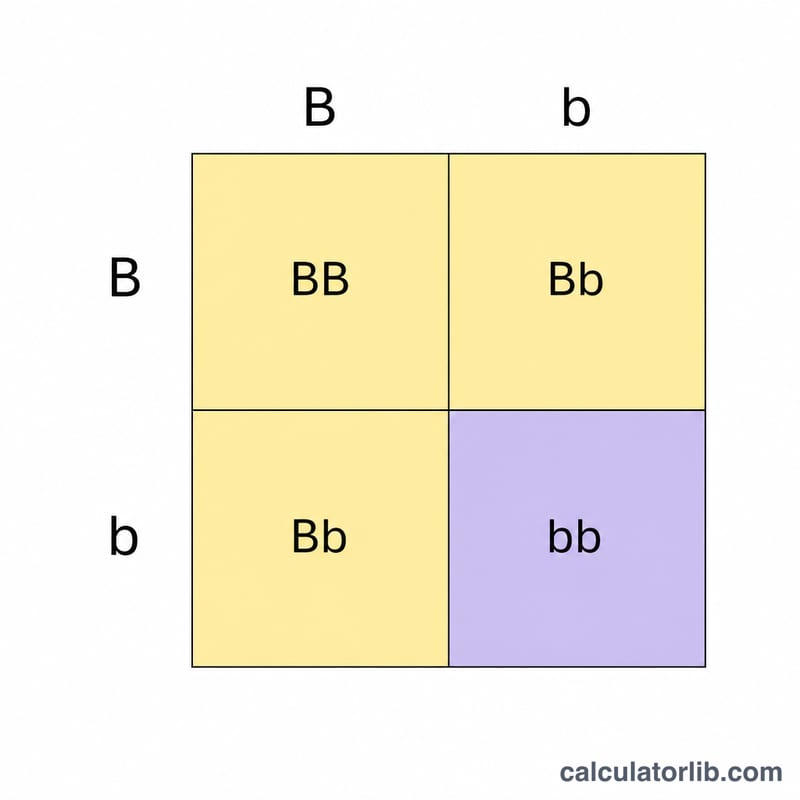
Cross two heterozygous parents, Aa × Aa. The four boxes are AA, Aa, Aa, aa. That gives a genotype ratio of 1 AA : 2 Aa : 1 aa — or 25% AA, 50% Aa, 25% aa. Because AA and Aa both show the dominant trait, the phenotype ratio is 3 dominant : 1 recessive, i.e. a 75% chance of the dominant trait and 25% chance of the recessive trait.
$$\%_{\text{dominant}} = \frac{AA + Aa}{4} \times 100 = \frac{1 + 2}{4} \times 100 = 75\%$$
FAQ
Does this work for two traits (dihybrid)? No — this tool models a single gene (monohybrid). A dihybrid cross uses a 4×4 grid.
Is "Aa" the same as "aA"? Yes. Order does not matter for genotype, so the calculator normalizes both to "Aa".
What does the phenotype percentage mean? It is the chance an offspring physically shows the dominant or recessive trait, assuming complete dominance.