
What This Calculator Does
Onions (along with garlic, leeks and chives) contain compounds called organosulfoxides that can damage a dog's red blood cells, causing a condition called hemolytic anemia. This calculator compares the amount of onion your dog ate against a commonly cited toxicity threshold of roughly 0.5% of the dog's body weight. It is an educational screening tool, not a substitute for veterinary care.
How to Use It
Enter your dog's body weight in kilograms and your best estimate of how many grams of onion it ate (raw, cooked, powdered or in food). The calculator converts body weight to grams, multiplies by 0.005 to get the toxic threshold, and reports whether the intake exceeds it along with a risk ratio.
The Formula Explained
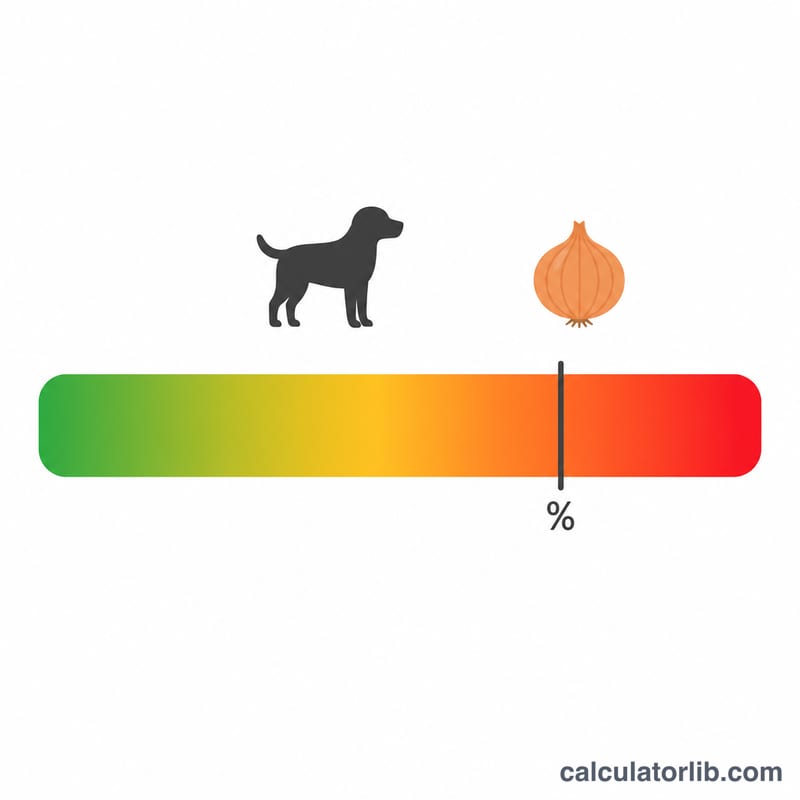
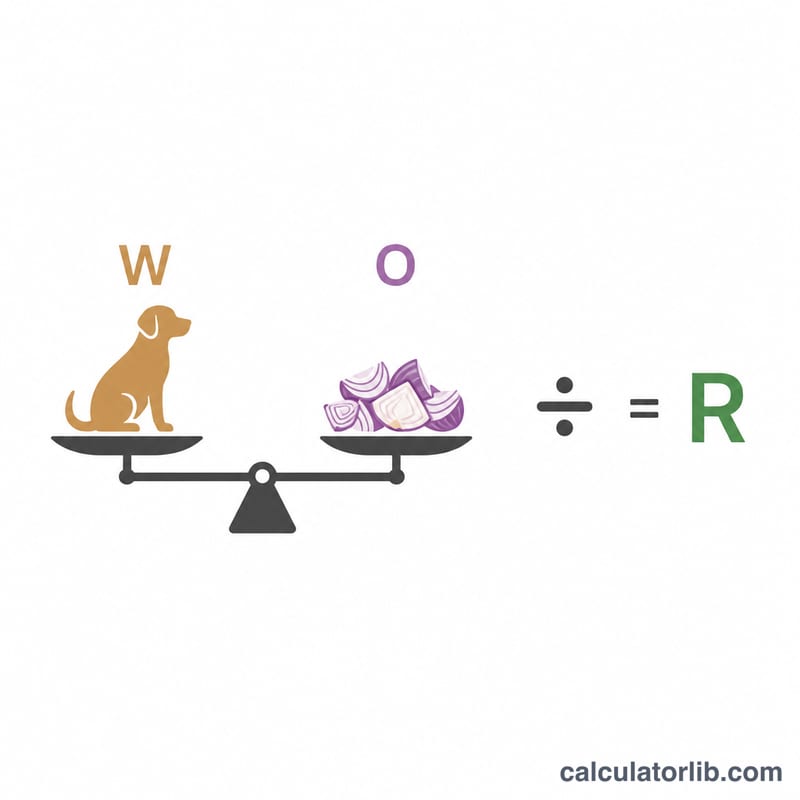
The threshold in grams is $$T = 0.005 \times (\text{weight\_kg} \times 1000)$$ The risk ratio is $$R = \text{onion\_g} \div T$$ If \(R\) is greater than 1, the amount eaten is above the threshold and considered potentially toxic. Note that onion powder is far more concentrated than fresh onion, so even small amounts of seasoned or processed food can be dangerous.
Worked Example
A 10 kg dog eats 15 g of onion. Body weight in grams = 10,000 g. Threshold = $$0.005 \times 10{,}000 = 50 \text{ g}$$ Risk ratio = $$15 \div 50 = 0.3$$ Since 15 g is below the 50 g threshold, the result is "Likely Safe" — but monitoring is still wise.
FAQ
My dog is below the threshold — is it definitely safe? No. Sensitivity varies between dogs, and repeated small doses can accumulate. When in doubt, call your vet.
What symptoms should I watch for? Weakness, lethargy, pale gums, rapid breathing, vomiting, diarrhea or reddish urine, often appearing within a few days.
What should I do if my dog ate onion? Contact your veterinarian or an animal poison control line immediately, especially for concentrated forms like onion powder or large amounts.