
What Is Boiling Point Elevation?
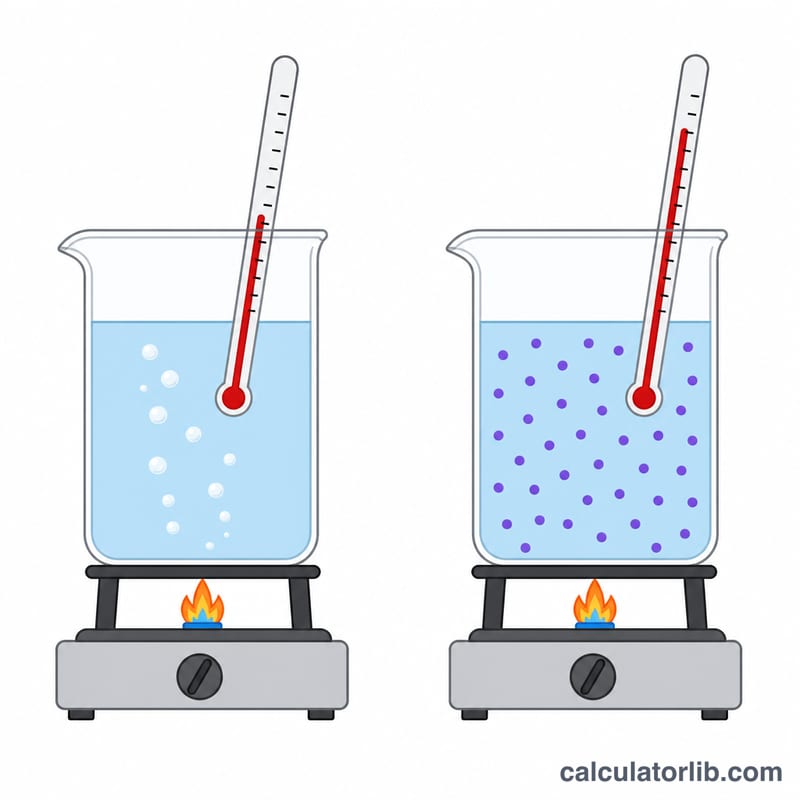
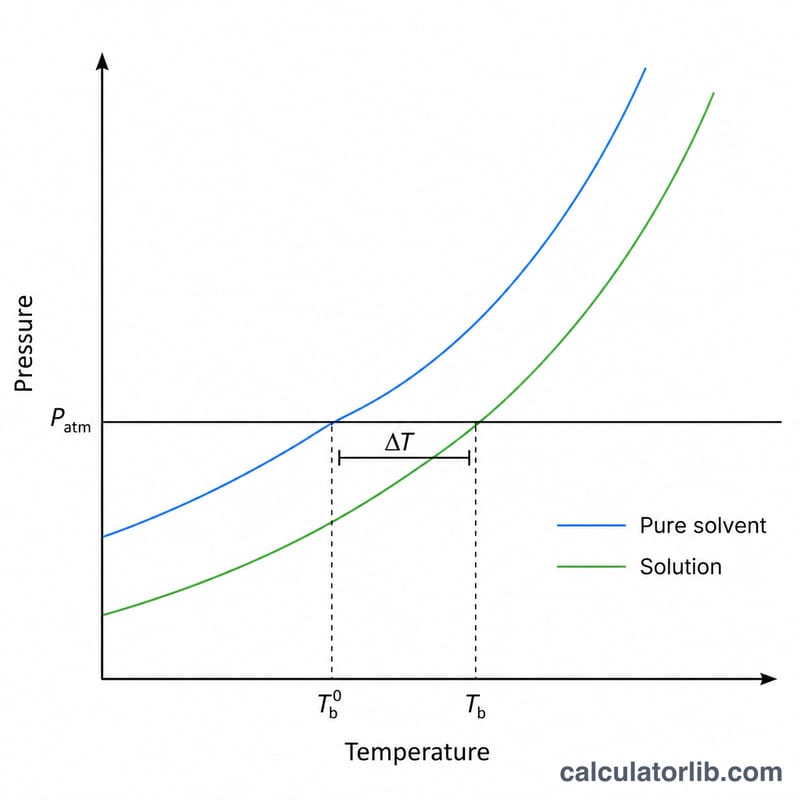
Boiling point elevation is a colligative property: dissolving a non-volatile solute in a solvent raises the temperature at which the solution boils. The size of the increase depends only on the number of dissolved particles, not their identity. This calculator computes the elevation (\(\Delta T_b\)) and the resulting boiling point of the solution.
How to Use This Calculator
Enter four values: the van't Hoff factor i (1 for non-electrolytes like sugar, ~2 for NaCl, ~3 for CaCl₂), the molal boiling point elevation constant Kb for the solvent (0.512 °C·kg/mol for water), the molality of the solution (moles of solute per kilogram of solvent), and the pure solvent boiling point (100 °C for water). The tool returns \(\Delta T_b\) and the new boiling point.
The Formula Explained
The governing equation is $$\Delta T_b = \text{i} \cdot \text{K}_b \cdot \text{m}$$ The van't Hoff factor accounts for dissociation of ionic compounds into multiple particles. Kb is solvent-specific. Multiplying these by the molality gives the temperature rise, which is then added to the pure solvent's boiling point: $$T_{b,\text{new}} = \text{Pure BP} + \Delta T_b$$
Worked Example
Dissolve NaCl in water to a molality of 1 mol/kg. NaCl splits into Na⁺ and Cl⁻, so i ≈ 2, Kb = 0.512, m = 1. $$\Delta T_b = 2 \times 0.512 \times 1 = 1.024 \ \text{°C}$$ The new boiling point is $$100 + 1.024 = \mathbf{101.024 \ \text{°C}}$$
Kb Constants and van't Hoff Factors
Boiling point elevation is a colligative property described by the equation:
$$\Delta T_b = i \cdot K_b \cdot m$$where \(i\) is the van't Hoff factor (the number of dissolved particles per formula unit of solute), \(K_b\) is the ebullioscopic (molal boiling point elevation) constant of the solvent in °C·kg/mol, and \(m\) is the molality of the solution in mol/kg. The elevated boiling point of the solution is then the pure solvent's boiling point plus \(\Delta T_b\).
Ebullioscopic Constants (Kb) of Common Solvents
Each solvent has a characteristic \(K_b\) value that depends only on the solvent, not on the solute. Larger \(K_b\) values produce greater elevation per unit molality.
| Solvent | Kb (°C·kg/mol) | Normal Boiling Point (°C) |
|---|---|---|
| Water | 0.512 | 100 |
| Ethanol | 1.22 | 78.4 |
| Benzene | 2.53 | 80.1 |
| Chloroform | 3.63 | 61.2 |
| Acetic acid | 3.07 | 118 |
Typical van't Hoff Factors (i)
The van't Hoff factor reflects how many particles a solute releases when dissolved. Non-electrolytes such as sugar do not dissociate (\(i = 1\)), while ionic compounds dissociate into multiple ions, raising \(i\). The values below are the ideal (theoretical) factors; real measured values are often slightly lower due to ion pairing.
| Solute | Dissociation | van't Hoff factor (i) |
|---|---|---|
| Sugar / glucose (non-electrolyte) | does not dissociate | 1 |
| Sodium chloride (NaCl) | Na⁺ + Cl⁻ | 2 |
| Calcium chloride (CaCl₂) | Ca²⁺ + 2 Cl⁻ | 3 |
| Potassium sulfate (K₂SO₄) | 2 K⁺ + SO₄²⁻ | 3 |
| Aluminum chloride (AlCl₃) | Al³⁺ + 3 Cl⁻ | 4 |
As a quick reference, dissolving 1 mol/kg of NaCl in water elevates the boiling point by 1.024 °C, giving a solution boiling point of about 101.024 °C.
FAQ
What is the van't Hoff factor? It is the number of particles a formula unit produces in solution — 1 for molecular solutes, 2+ for salts that dissociate.
What value of Kb should I use? Use the constant for your solvent: water 0.512, ethanol 1.22, benzene 2.53 °C·kg/mol.
Does the solute amount matter? Only through molality and particle count; the chemical identity beyond dissociation does not affect \(\Delta T_b\).