
What Is the Isoelectric Point?
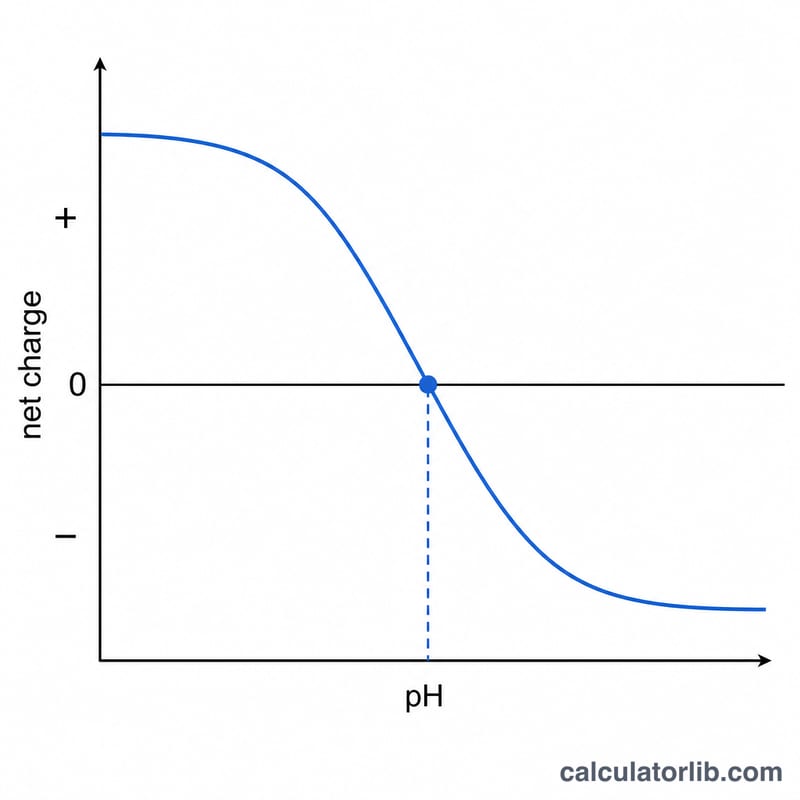
The isoelectric point (pI) is the pH at which a molecule — typically an amino acid, peptide, or protein — carries no net electrical charge. At this pH the positive and negative charges balance, so the molecule does not migrate in an electric field. The pI is a fundamental property used in biochemistry, protein purification (isoelectric focusing), and chromatography.
How to Use This Calculator
Enter the two pKa values that bracket the neutral form of your molecule. For a simple amino acid with no ionizable side chain, these are the pKa of the carboxyl group (pKa1, more acidic) and the pKa of the amino group (pKa2, less acidic). The calculator returns the pI instantly as the arithmetic mean of the two values.
The Formula Explained
The neutral, zwitterionic species exists between two charged forms. The pKa below it (pKa1) governs the loss of a proton from the +1 form, and the pKa above it (pKa2) governs the loss of a proton from the neutral form to give a −1 species. The pH at which the +1 and −1 populations are equal — the net-zero charge point — is simply their average:
$$\text{pI} = \dfrac{\text{pKa}_1 + \text{pKa}_2}{2}$$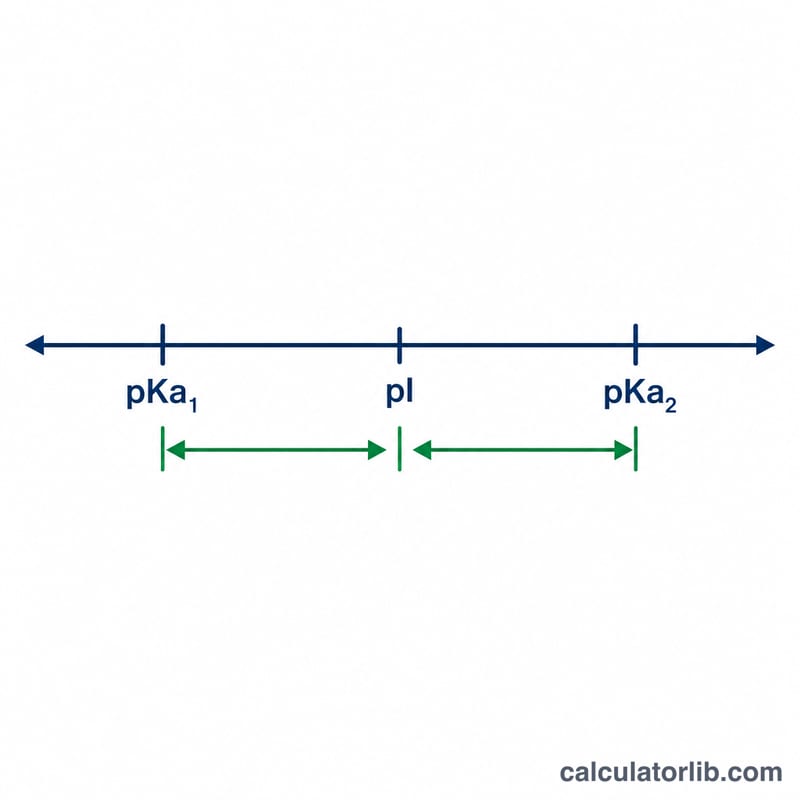
Worked Example
For glycine, pKa1 (COOH) ≈ 2.34 and pKa2 (NH3+) ≈ 9.60. The isoelectric point is
$$\text{pI} = \frac{2.34 + 9.60}{2} = \frac{11.94}{2} = \mathbf{5.97}$$This matches the well-known experimental value for glycine.
FAQ
Which two pKa values should I use? Use the two pKa values that flank the species with zero net charge. For amino acids with ionizable side chains, choose the two pKa values surrounding the neutral form.
Does this work for proteins? This simple two-pKa average works for small molecules and amino acids without charged side chains. Full proteins require summing contributions from all ionizable groups.
What does the pI tell me? It indicates the pH at which a molecule is least soluble and will not move in an electric field, useful for precipitation and isoelectric focusing.