
What Is Percent Ionic Character?
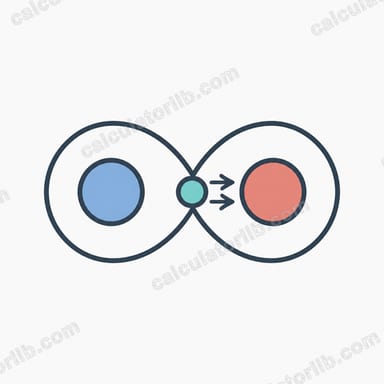
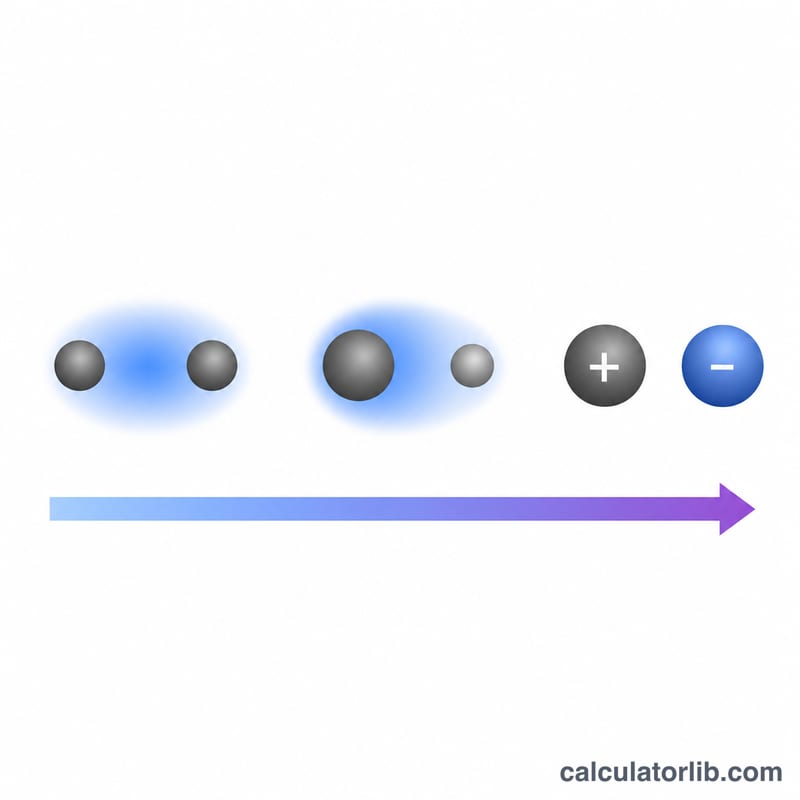
Percent ionic character expresses how ionic (versus covalent) a chemical bond is, based on the difference in electronegativity between the two bonded atoms. A bond is never purely ionic or purely covalent — it lies somewhere on a spectrum. The larger the electronegativity difference, the more the shared electrons are pulled toward the more electronegative atom, giving the bond more ionic character.
How to Use This Calculator
Enter the Pauling electronegativity of each atom (\(\chi_A\) and \(\chi_B\)). The calculator finds the absolute difference \(\Delta\chi\) and applies Pauling's exponential relation to estimate the percent ionic character of the bond. Order of the two values does not matter because only the difference is used.
The Formula Explained
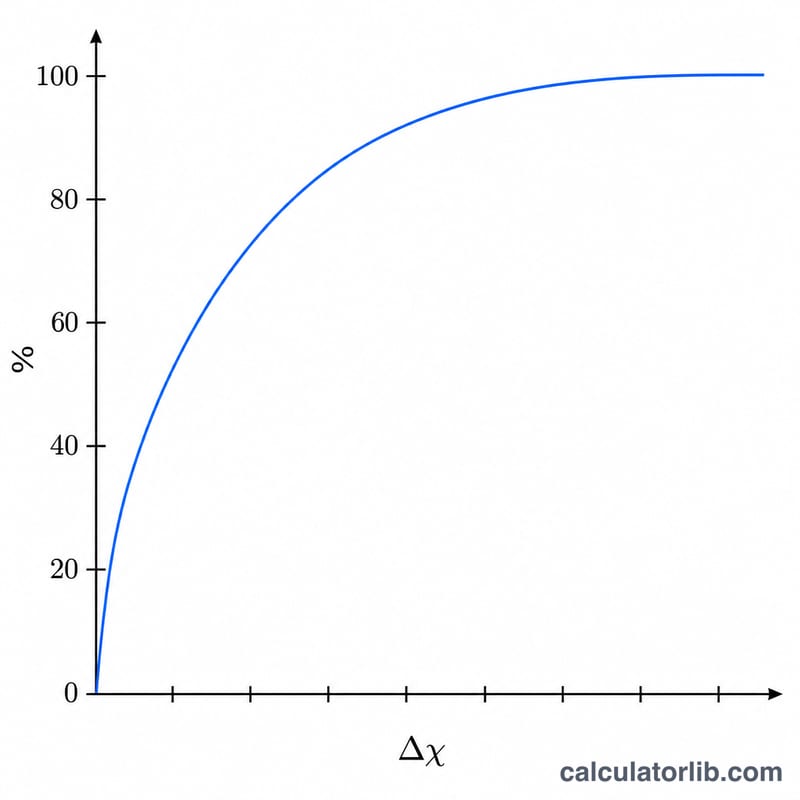
The model used is $$\%\ \text{ionic} = \left(1 - e^{-0.25(\chi_A - \chi_B)^2}\right)\times 100$$ When the two electronegativities are equal, the exponent is 0, \(e^{0} = 1\), and the result is 0% — a perfectly covalent (nonpolar) bond. As \(\Delta\chi\) grows, the exponential term shrinks toward 0 and the ionic character approaches 100%.
Worked Example: NaCl
Sodium has electronegativity 0.93 and chlorine 3.16, so \(\Delta\chi = 2.23\). Then \(0.25 \times 2.23^2 = 0.25 \times 4.9729 = 1.243225\), and \(e^{-1.243225} \approx 0.28845\). So $$\%\ \text{ionic} = (1 - 0.28845) \times 100 \approx 71.15\%$$ This high value reflects that NaCl is largely an ionic compound.
FAQ
Which electronegativity scale should I use? Use the Pauling scale, since this formula was derived from it.
At what point is a bond called ionic? A common rule of thumb treats roughly 50% ionic character (\(\Delta\chi \approx 1.7\)) as the boundary between polar covalent and predominantly ionic, though it is a gradual transition.
Why doesn't it reach exactly 100%? The exponential never fully reaches 0, so no real bond is modeled as 100% ionic — consistent with the idea that all bonds have some covalent character.