
What Is Avogadro's Number?
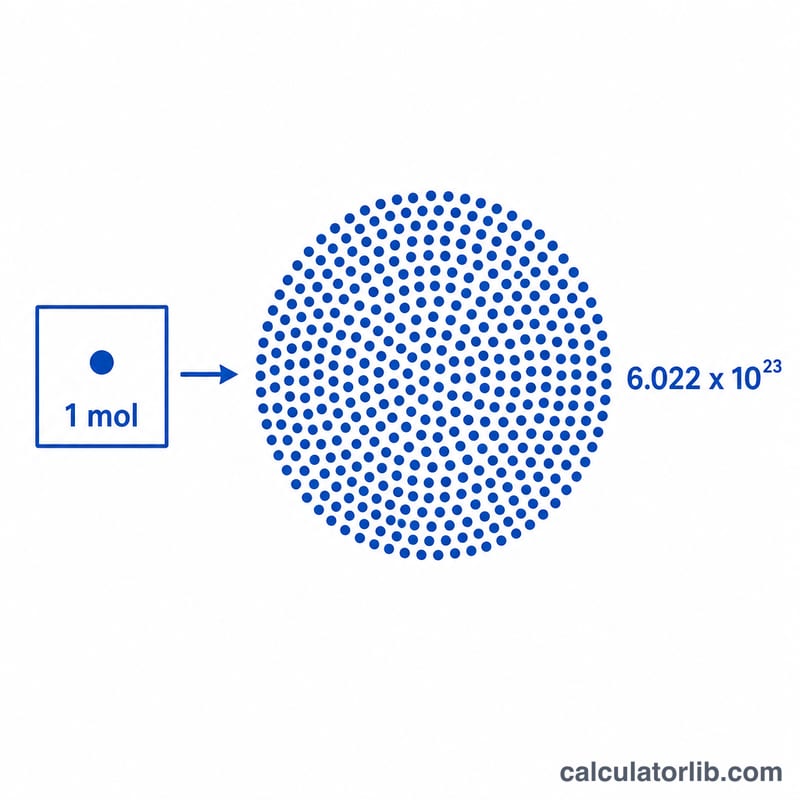
Avogadro's number, denoted NA, is the number of constituent particles — atoms, molecules, ions, or electrons — in exactly one mole of a substance. Since the 2019 SI redefinition it has an exact fixed value of 6.02214076 × 10²³ mol⁻¹. This calculator uses that exact constant to convert any amount of substance in moles into a total particle count.
How to Use the Calculator
Enter the amount of substance in moles and the tool multiplies it by Avogadro's number. The result is the total number of individual particles in that sample. You can use it for atoms in an element, molecules in a compound, or ions in solution — the unit "particle" depends on what your mole quantity describes.
The Formula Explained
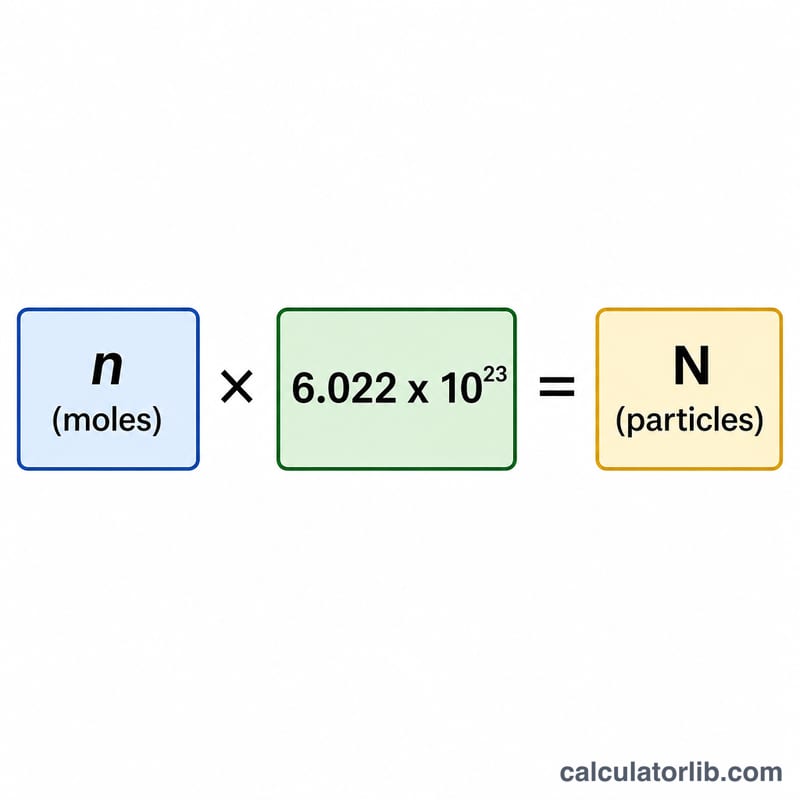
The relationship is a simple proportionality:
$$N = n \times N_A$$
where N is the number of particles, n is the amount of substance in moles, and \(N_A = 6.02214076 \times 10^{23}\) per mole. To reverse the calculation (particles to moles), divide \(N\) by \(N_A\).
Worked Example
Suppose you have 2 moles of water (H₂O). The number of water molecules is:
$$N = 2 \times 6.02214076 \times 10^{23} = 1.204428152 \times 10^{24}\ \text{molecules}$$
Note that each molecule contains 3 atoms, so the total atom count would be three times this value.
Definitions & Glossary
- Mole (mol)
- The SI base unit for amount of substance. One mole contains exactly \(6.02214076 \times 10^{23}\) elementary entities, by the 2019 SI definition.
- Avogadro constant (\(N_A\))
- The number of elementary entities per mole, equal to \(6.02214076 \times 10^{23}\ \text{mol}^{-1}\). It is the proportionality factor that links amount of substance to a particle count.
- Amount of substance (\(n\))
- The physical quantity measured in moles that expresses how many entities are present. In the formula \(N = n \times N_A\), it is the input you multiply by Avogadro's number.
- Particle / entity
- The specified elementary unit being counted — an atom, molecule, ion, electron, or formula unit. You must state which entity you mean, because one mole of a compound may contain several moles of constituent atoms or ions.
- Number of particles (\(N\))
- The total count of entities in a sample, obtained by multiplying the amount of substance by the Avogadro constant: \(N = n \times N_A\). It is dimensionless (a pure count).
FAQ
Is Avogadro's number exact? Yes. Since May 2019 it is defined exactly as 6.02214076 × 10²³ mol⁻¹, with no measurement uncertainty.
Does it work for any particle? Yes — the same number applies to atoms, molecules, ions, electrons, or any specified entity, as long as you count one mole of those entities.
How do I go from grams to particles? First divide the mass in grams by the molar mass (g/mol) to get moles, then use this calculator to convert moles to particles.