
What Is a Square Number?
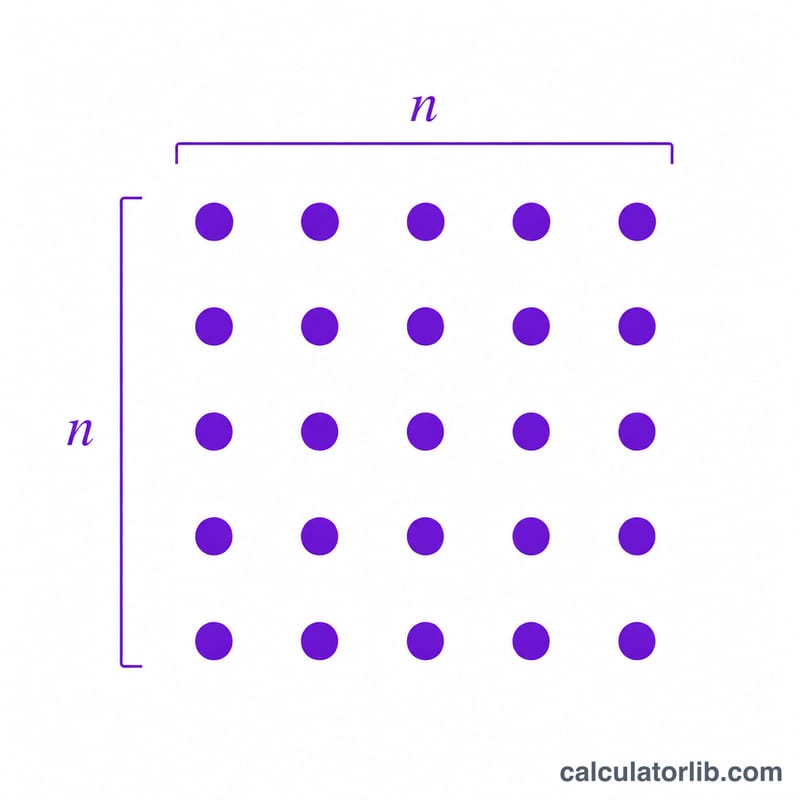
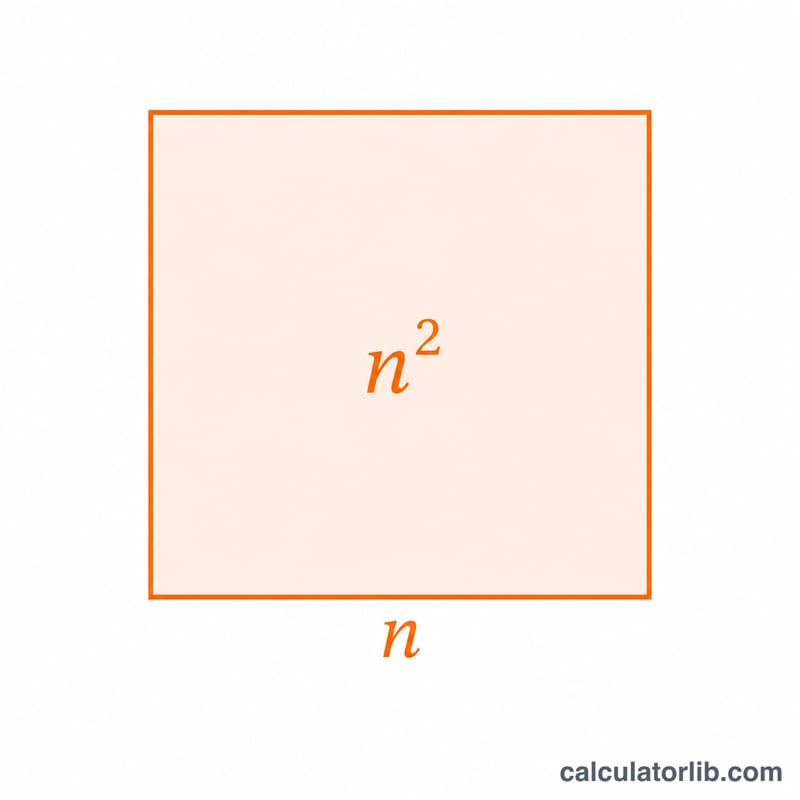
Squaring a number means multiplying it by itself. The result, written as n² (read "n squared"), is the area of a square whose side length equals n. This calculator computes n² for any value — whole numbers, decimals, and negatives. Because a negative times a negative is positive, the square of any real number is always zero or positive.
How to Use This Calculator
Type a number into the input box and the calculator returns its square instantly. For example, entering 12 gives 144, and entering 2.5 gives 6.25. There are no units — the tool works purely with numbers, so it fits maths homework, geometry (area of a square), statistics (variance and standard deviation), and physics formulas.
The Formula Explained
The square is defined by the simple equation:
$$\text{square} = n \times n = n^2$$
Multiplication is commutative and the same factor is used twice, so the order never matters. Squaring grows fast: doubling n quadruples the result, because \((2n)^2 = 4n^2\).
Worked Example
Suppose \(n = 9\). Then $$n^2 = 9 \times 9 = 81.$$ For a decimal, \(n = 1.5\) gives \(1.5 \times 1.5 = 2.25\). For a negative, \(n = -7\) gives \((-7) \times (-7) = 49\).
FAQ
Can I square a negative number? Yes. The square of a negative number is always positive, e.g. \((-4)^2 = 16\).
What is the square of a decimal? The same rule applies: \(0.5^2 = 0.25\).
How is squaring different from doubling? Doubling adds the number to itself (\(n + n = 2n\)); squaring multiplies it by itself (\(n \times n = n^2\)). For \(n = 5\), doubling gives 10 but squaring gives 25.