
What Is a Cube Number?
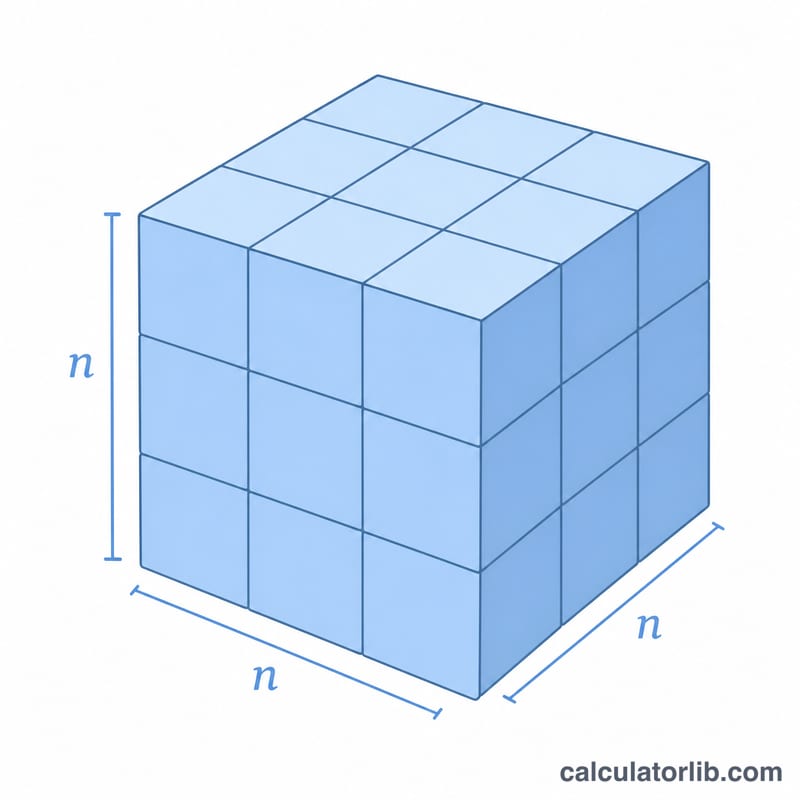
A cube number is the result of multiplying a number by itself three times. Written as \(n^3\) (read "n cubed"), it equals \(n \times n \times n\). The name comes from geometry: the volume of a cube with side length \(n\) is exactly \(n^3\). This calculator works for any value — positive numbers, negative numbers, and decimals.
How to Use This Calculator
Type any number into the field and the calculator instantly returns its cube. For example, entering 4 returns 64, while entering 2.5 returns 15.625. Negative inputs keep their sign because a negative times a negative times a negative is negative — for instance \((-3)^3 = -27\).
The Formula Explained
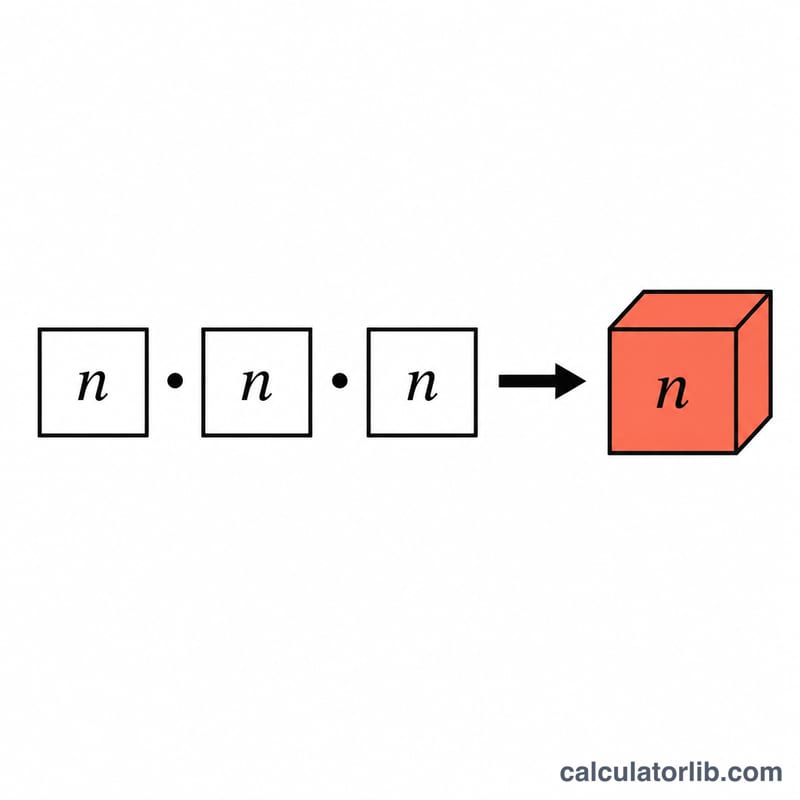
The formula is simply cube = n × n × n. Unlike squaring (which uses two factors), cubing multiplies the base three times. Cubes grow quickly: 1, 8, 27, 64, 125, 216, 343 are the cubes of 1 through 7. Because cubing preserves sign, the function is odd and one-to-one, which is why every real number has exactly one real cube root.
Worked Example
Suppose \(n = 6\). Then $$n^3 = 6 \times 6 \times 6.$$ First \(6 \times 6 = 36\), then \(36 \times 6 = 216\). So the cube of 6 is 216. As a real-world check, a storage box measuring 6 cm on every side holds 216 cubic centimetres.
FAQ
What is the cube of a negative number? It stays negative. For example \((-4)^3 = -64\).
Can I cube decimals? Yes. \((1.2)^3 = 1.728\).
How is cubing different from squaring? Squaring multiplies a number by itself once (\(n^2\)), while cubing multiplies it twice more (\(n^3\)).