What Is the Days Until Ramadan Calculator?
This tool counts how many days and weeks remain until the first day of Ramadan, the Islamic holy month of fasting. Because the Islamic calendar is lunar and the start of Ramadan depends on the sighting of the new moon, the exact date can shift by about a day depending on your region and the method of moon sighting used locally. Enter your own expected start date so the countdown matches your community.
Ramadan 2027 is expected to begin on Monday, 8 February 2027 (1 Ramadan 1448) according to the Umm al-Qura calendar; Türkiye’s Diyanet lists the same date. The actual start is confirmed by the sighting of the crescent moon, so it may come one day earlier or later (±1 day) where you live.
How to Use It
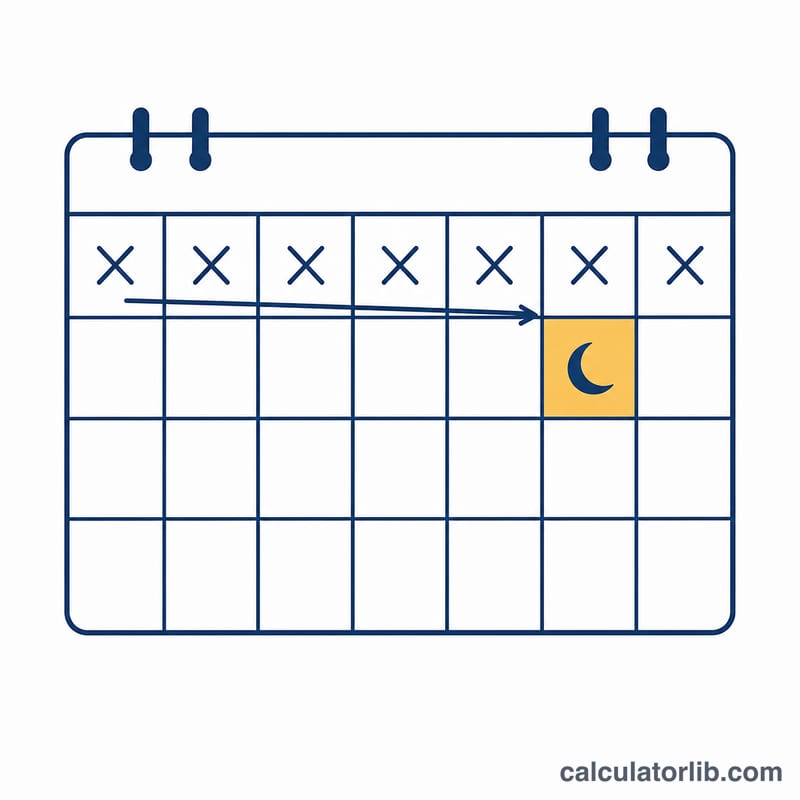
Pick today's date in the first field, then enter the expected first day of Ramadan in the second field. The calculator returns the number of days to go, along with the equivalent number of weeks. If the Ramadan date is in the past, the result will be negative.
The Formula Explained
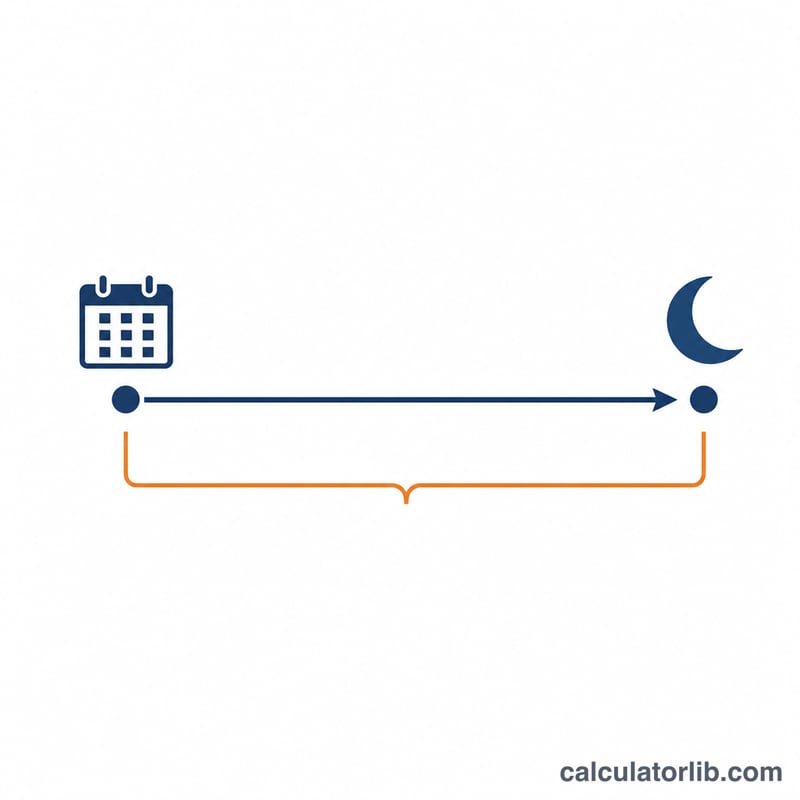
Both dates are converted to a timestamp in milliseconds at midnight. The difference is divided by 86,400,000 (the number of milliseconds in one day) and rounded up with the ceiling function so any partial day counts as a full day remaining. Weeks are simply the day count divided by seven.
$$\text{Days} = \left\lceil \text{First Day of Ramadan} - \text{Today} \right\rceil$$
Worked Example
Suppose today is January 1, 2025 and Ramadan is expected to begin March 1, 2025. January has 31 days, February 2025 has 28 days, so from Jan 1 to Mar 1 is \(31 + 28 = 59\) days. Dividing by 7 gives about 8.43 weeks remaining.
Approximate Ramadan Start Dates by Year
The table shows the expected first day of Ramadan (1 Ramadan) in the Gregorian calendar. The dates follow astronomical calculation and the Umm al-Qura calendar used in Saudi Arabia. They are approximate. Many countries and communities rely on local moon sighting, so the actual start can differ by one day, or occasionally more, depending on where you live.
| Gregorian Year | Islamic Year (AH) | Expected First Day of Ramadan |
|---|---|---|
| 2025 | 1446 | ~1 March 2025 |
| 2026 | 1447 | ~18 February 2026 |
| 2027 | 1448 | ~8 February 2027 |
| 2028 | 1449 | ~28 January 2028 |
| 2029 | 1450 | ~16 January 2029 |
| 2030 | 1451 | ~5 January 2030 |
A lunar Hijri year is about 354 or 355 days, so Ramadan moves roughly 10 to 11 days earlier in the Gregorian calendar each year. Because of this drift, Ramadan 1452 AH falls near the end of December 2030, so a second Ramadan begins in the same Gregorian year.
To use the calculator, enter today's date and the first day of Ramadan announced for your region. The result is the number of days between them, rounded up to whole days. Dividing by 7 gives the weeks.
Key Terms: Hijri Calendar, Hilal and Suhoor
- Ramadan: The ninth month of the Islamic calendar. Muslims fast from dawn to sunset during this month, and it is a time of prayer, charity and reflection.
- Hijri (Islamic) calendar: A purely lunar calendar whose year count (AH, "after Hijra") begins with the migration of the Prophet Muhammad from Mecca to Medina in 622 CE. It has 12 months and about 354 or 355 days per year.
- Hilal: The thin new crescent moon. Sighting it, or calculating that it can be sighted, marks the start of a new Hijri month, including Ramadan.
- Lunar month length (29 or 30 days): A lunar cycle takes about 29.53 days, so each Hijri month has either 29 or 30 days. This is why the exact start of Ramadan is confirmed only close to the date.
- Umm al-Qura calendar: A calculation-based Hijri calendar used officially in Saudi Arabia. It sets month starts by astronomical rules rather than by local sighting, so it can differ from sighting-based dates elsewhere.
- Suhoor: The pre-dawn meal eaten before the daily fast begins.
- Iftar: The meal that breaks the fast at sunset.
- Eid al-Fitr: The festival marking the end of Ramadan, celebrated on 1 Shawwal, the first day of the tenth month.
FAQ
Why might my mosque's date differ? Ramadan begins on the sighting of the crescent moon, which can occur a day earlier or later depending on location and methodology.
What if the result is zero? A zero means Ramadan starts today — the fast begins at dawn.
Can I use it for next year? Yes; just enter next year's estimated start date. Ramadan moves about 10–11 days earlier each Gregorian year.