
What This Calculator Does
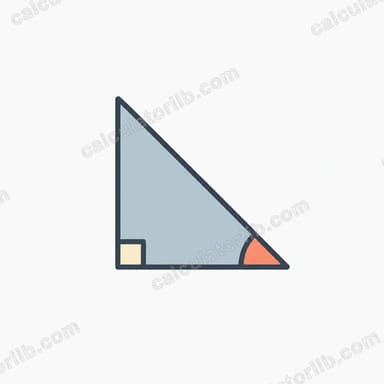
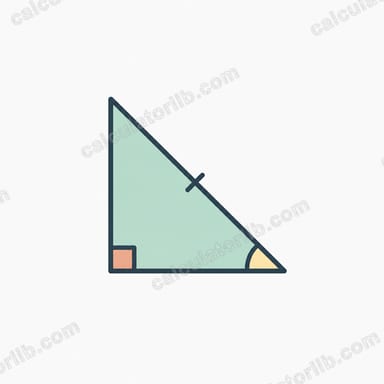
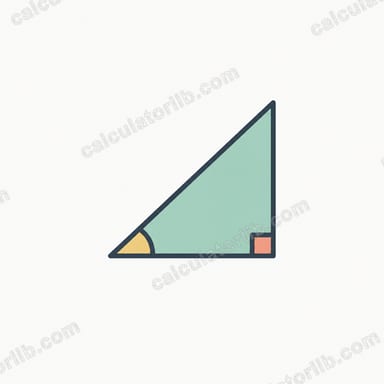
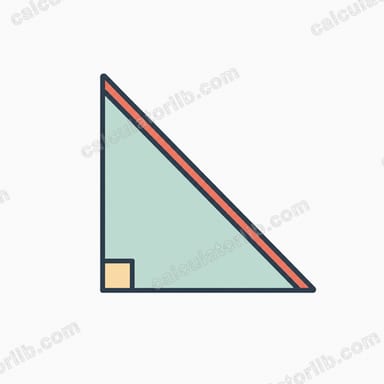
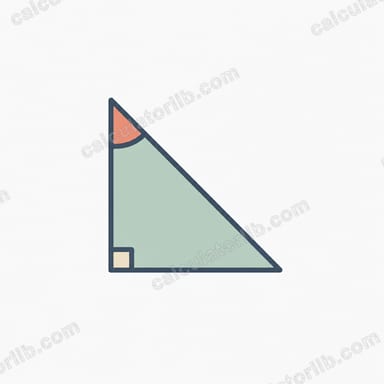
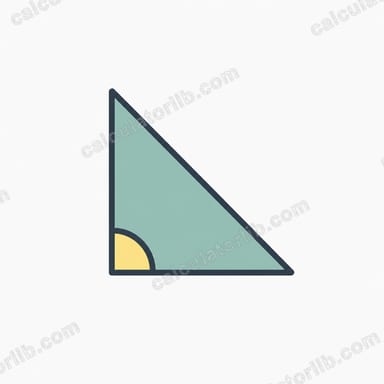
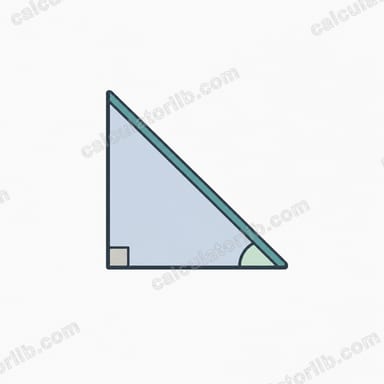
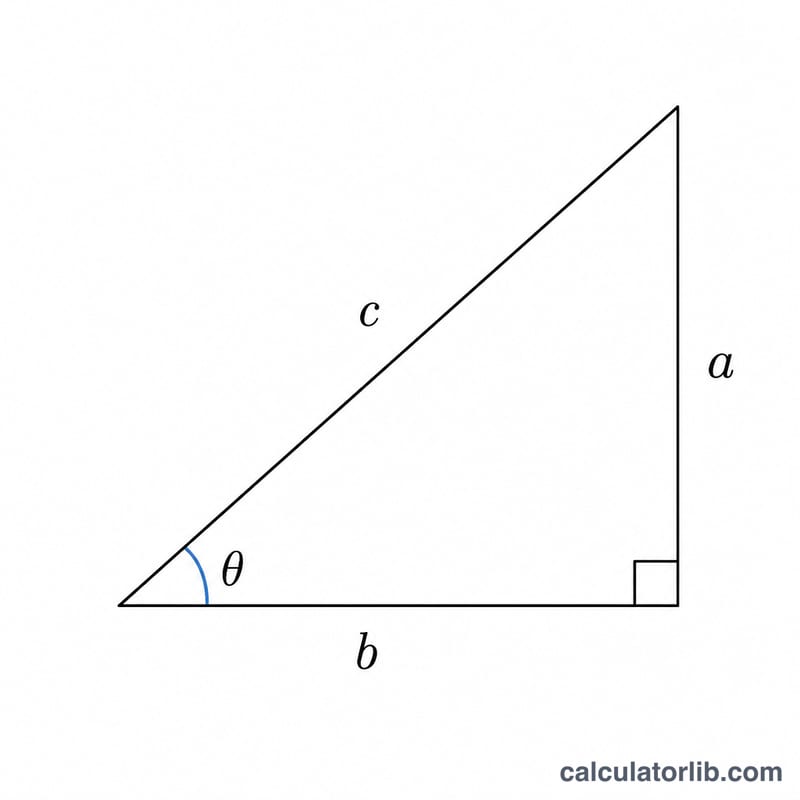
In any right triangle, the longest side is the hypotenuse (c), which sits opposite the 90° corner. The other two sides are the legs. If you know the hypotenuse and one of the acute angles, basic trigonometry lets you find both legs exactly. This tool computes the leg opposite your angle (a) and the leg adjacent to it (b) in one step.
How to Use It
Enter the hypotenuse length (c) in any consistent unit and the acute angle θ in degrees (between 0° and 90°). The calculator returns the opposite leg and the adjacent leg in the same units as the hypotenuse. The angle θ is measured at the vertex where the adjacent leg meets the hypotenuse.
The Formula Explained
By the definitions of sine and cosine in a right triangle, \(\sin\theta = \text{opposite} / \text{hypotenuse}\) and \(\cos\theta = \text{adjacent} / \text{hypotenuse}\). Rearranging gives the two formulas this calculator uses:
$$\begin{gathered} a = \text{Hypotenuse (c)} \cdot \sin\!\left(\text{Angle }\theta\right) \\[1em] b = \text{Hypotenuse (c)} \cdot \cos\!\left(\text{Angle }\theta\right) \end{gathered}$$\(a = c \cdot \sin\theta\) (the leg opposite the angle)
\(b = c \cdot \cos\theta\) (the leg next to the angle)
The angle is converted from degrees to radians internally because the trigonometric functions operate in radians.
Worked Example
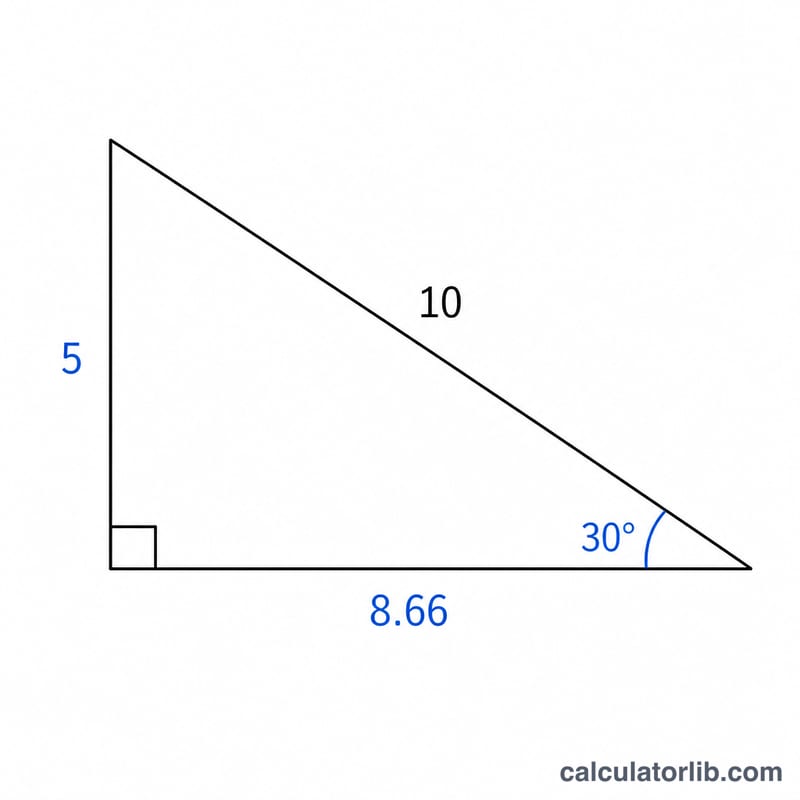
Suppose the hypotenuse is 10 and the angle is 30°. Then $$a = 10 \cdot \sin 30° = 10 \cdot 0.5 = 5,$$ and $$b = 10 \cdot \cos 30° = 10 \cdot 0.8660 = 8.6603.$$ The two legs are 5 and about 8.66, which together with the hypotenuse satisfy \(5^2 + 8.66^2 \approx 100 = 10^2\).
FAQ
Which leg is "opposite"? The opposite leg is the side that does not touch the angle θ — it faces it across the triangle. The adjacent leg shares the vertex with θ.
What units does it use? Any unit works; the legs come out in the same unit as the hypotenuse you entered.
Can the angle be 0° or 90°? At 0° the opposite leg is 0; at 90° the adjacent leg is 0. These are degenerate cases but the formulas still hold.