
What this calculator does
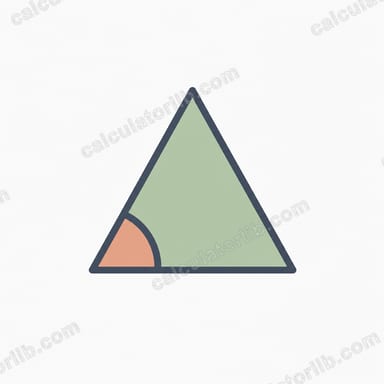
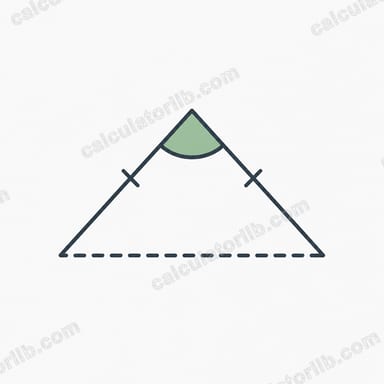
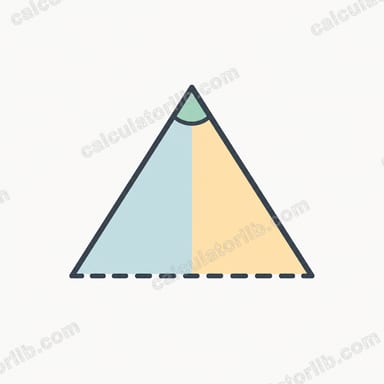
This tool finds the length of the unknown side of a triangle when you know the lengths of two sides and the angle between them (the "included" angle). This is the classic Side-Angle-Side (SAS) situation, and it is solved with the Law of Cosines. The calculator also returns the triangle's perimeter and its area.
How to use it
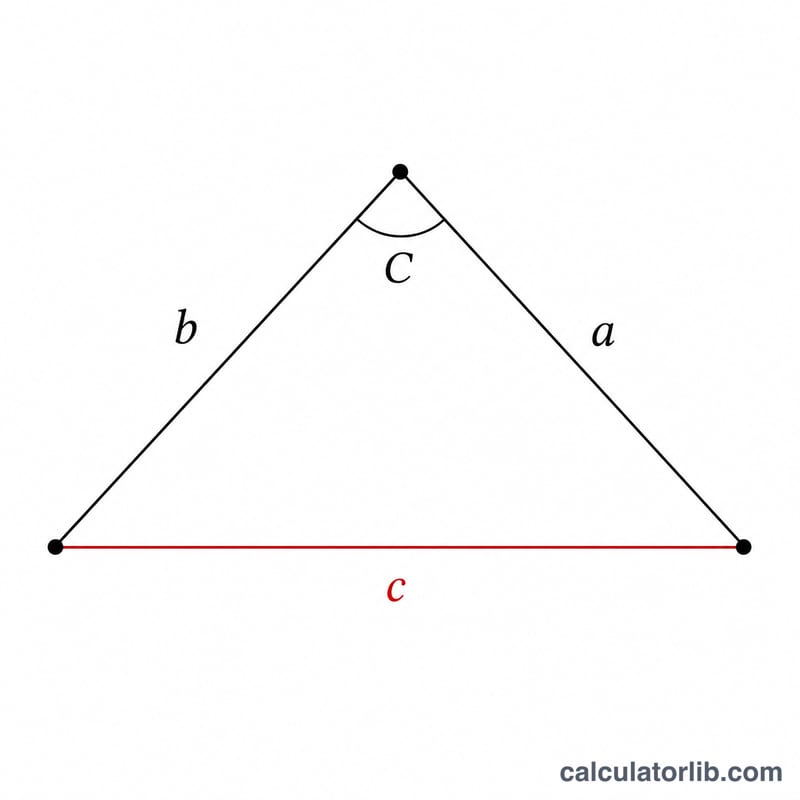
Enter the two known side lengths, a and b, in any consistent unit (cm, m, inches—just be uniform). Then enter the included angle C in degrees, which is the angle formed where sides a and b meet. The result c is the side opposite that angle.
The formula explained
The Law of Cosines generalises the Pythagorean theorem: $$c^{2} = a^{2} + b^{2} - 2ab\cos C$$ When \(C = 90°\), \(\cos C = 0\) and the equation collapses to \(a^{2} + b^{2} = c^{2}\), the Pythagorean theorem. As \(C\) grows the \(-2ab\cos C\) term lengthens \(c\); for acute angles it shortens it. The area uses the related SAS formula \(A = \tfrac{1}{2}\cdot a\cdot b\sin C\).
Worked example
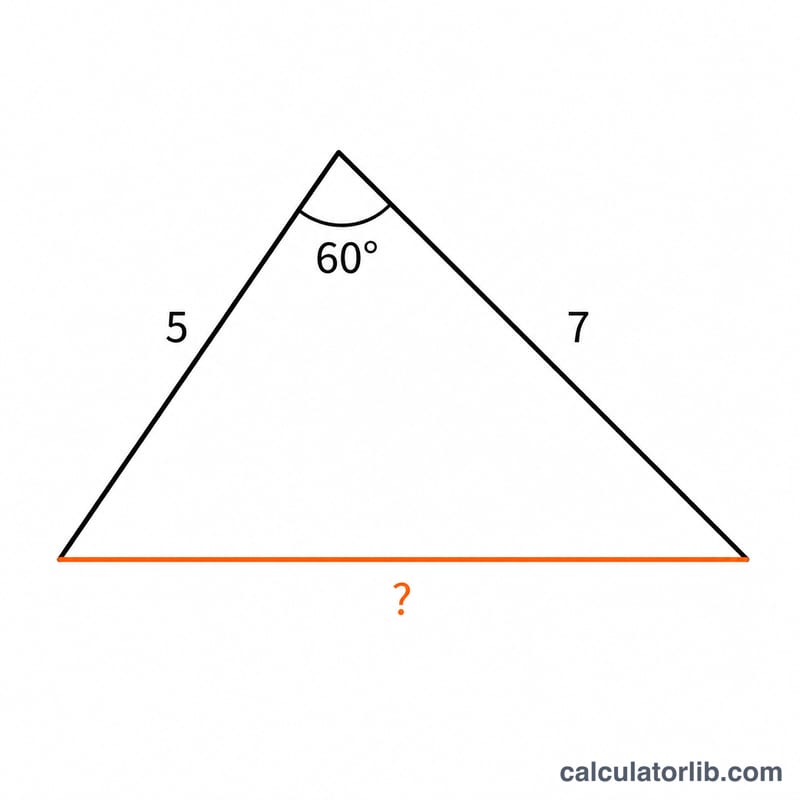
Suppose \(a = 5\), \(b = 7\) and \(C = 60°\). Then \(\cos 60° = 0.5\), so $$c^{2} = 25 + 49 - 2(5)(7)(0.5) = 74 - 35 = 39$$ Therefore \(c = \sqrt{39} \approx 6.245\). The perimeter is \(5 + 7 + 6.245 \approx 18.245\) and the area is \(\tfrac{1}{2}\cdot 5\cdot 7\sin 60° = 17.5 \times 0.8660 \approx 15.155\).
FAQ
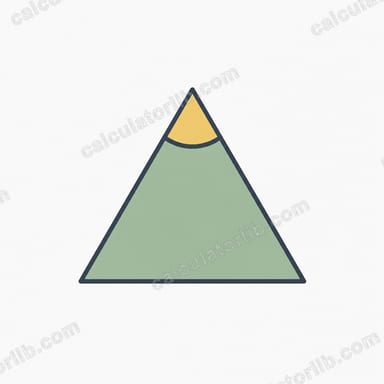
What is the "included" angle? It is the angle located between the two sides you entered—the vertex where a and b touch.
Can C be 90° or more? Yes. Any angle from just above 0° up to just below 180° forms a valid triangle. At exactly 90° you get the Pythagorean result.
Why degrees and not radians? Degrees are more intuitive for most users; the calculator converts internally to radians before applying the cosine.