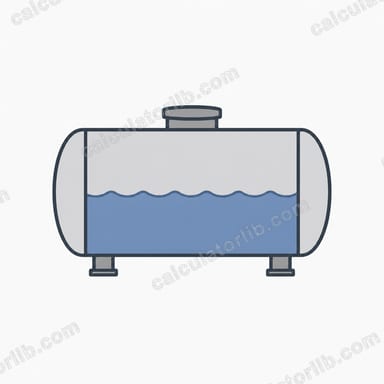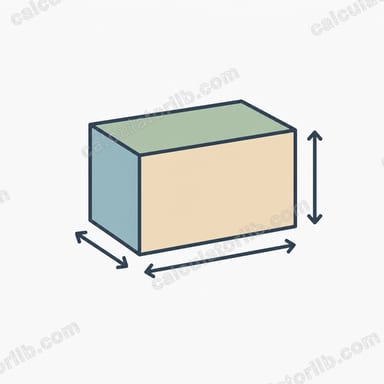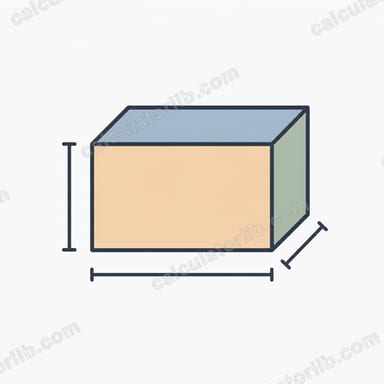

What This Calculator Does
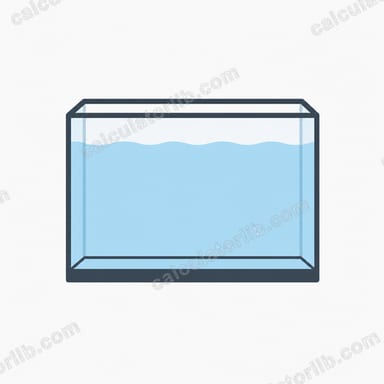
This tool calculates the internal volume of a rectangular (box-shaped) tank and expresses it in liters. Just enter the three interior dimensions — length, width, and height — in centimeters, and it returns the capacity in liters, cubic centimeters, and US gallons. It is useful for aquariums, water storage tanks, fuel tanks, fish ponds, and any cuboid container.
How to Use It
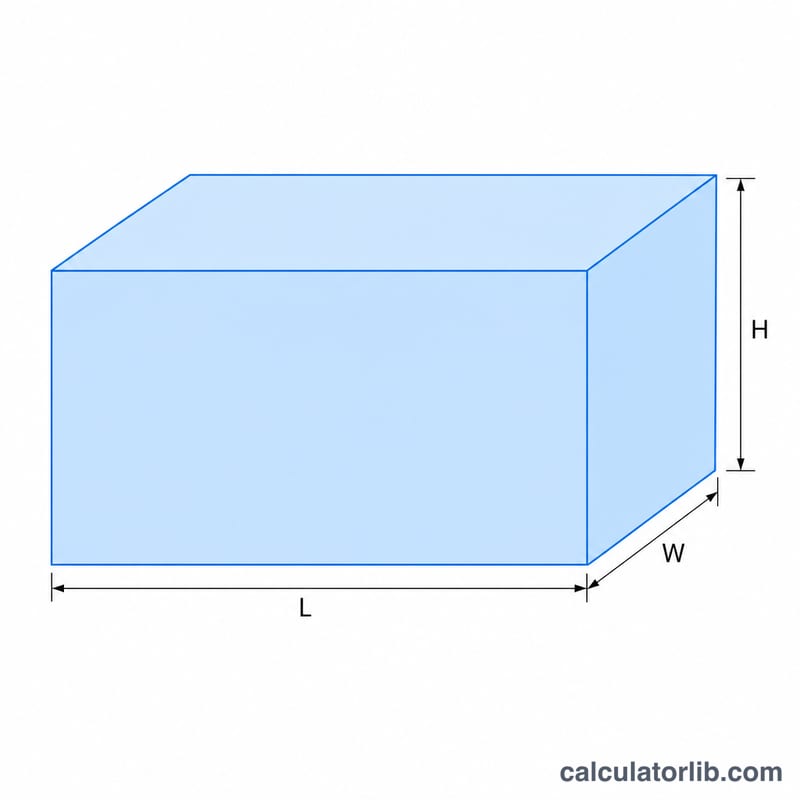
Measure the inside of the tank in centimeters: the length (longest horizontal side), the width (the other horizontal side), and the height (the vertical fill depth). Type each value into its field and read the result. For partially filled tanks, enter the actual water depth as the height to get the current volume rather than the maximum capacity.
The Formula Explained
Volume of a rectangular box is length × width × height, giving cubic centimeters. Because exactly 1 liter equals 1000 cubic centimeters, you divide the cubic-centimeter result by 1000 to convert to liters:
$$\text{Liters} = \frac{\text{L} \times \text{W} \times \text{H}}{1000}$$
This relationship is exact in the metric system, which is why measuring in centimeters makes liter conversion so clean.
Worked Example
Suppose a tank measures 100 cm long, 50 cm wide, and 40 cm high. The cubic volume is $$100 \times 50 \times 40 = 200{,}000 \text{ cm}^3.$$ Dividing by 1000 gives 200 liters. Converted to US gallons (\(1 \text{ liter} \approx 0.264172 \text{ gal}\)), that is about 52.83 gallons.
FAQ
Why centimeters and not meters? Using centimeters lets you divide by exactly 1000 to get liters. If you measure in meters, the volume in cubic meters would be multiplied by 1000 instead.
Should I use inside or outside dimensions? Always use the inside dimensions for an accurate capacity, since wall thickness reduces usable volume.
Does this work for water weight? Yes — 1 liter of fresh water weighs about 1 kilogram, so a 200-liter tank holds roughly 200 kg of water.