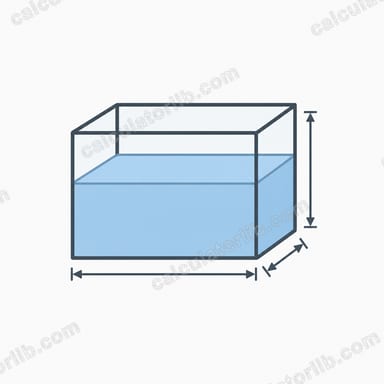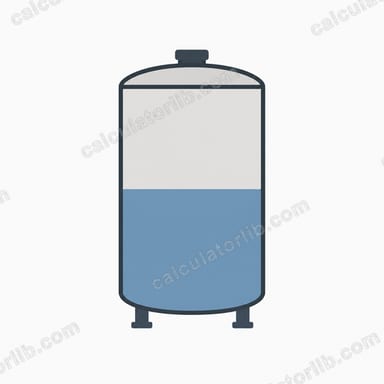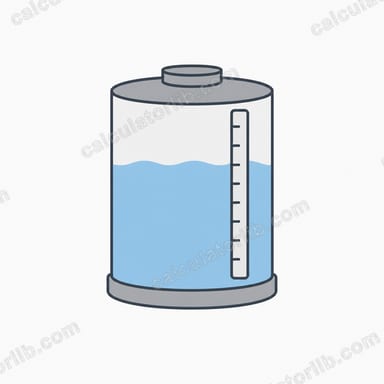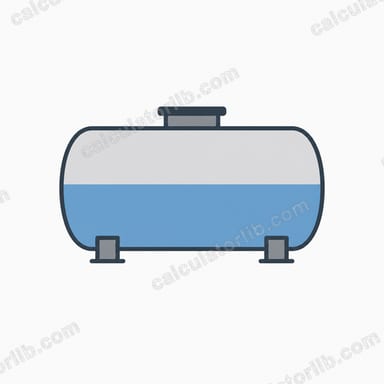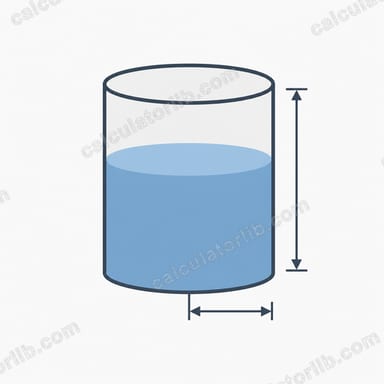

What is the Water Tank Volume Calculator?
This calculator works out how much water a storage tank can hold. Enter the dimensions of a cylindrical or rectangular tank in centimeters and it returns the capacity in liters, US gallons, UK (imperial) gallons, and cubic meters. It is useful for sizing rainwater tanks, aquariums, storage drums, pools, and industrial vessels.
How to use it
First choose the tank shape. For a cylinder enter the diameter and the height. For a rectangular tank enter the length, width, and height. All measurements should be the internal dimensions in centimeters for an accurate usable capacity. Click calculate and read the capacity from the result panel.
The formula explained
A cylinder's volume is \(V = \pi r^2 h\), where \(r\) is half the diameter. A rectangular (box) tank uses \(V = L \times W \times H\). Because 1 liter equals exactly 1000 cubic centimeters, the volume in cm³ is divided by 1000 to get liters. Liters are then converted: 1 US gallon = 3.785411784 L, 1 imperial gallon = 4.54609 L, and 1 cubic meter = 1000 L.
$$\text{Liters} = \frac{\pi \left(\frac{\text{Diameter (cm)}}{2}\right)^2 \cdot \text{Height (cm)}}{1000}$$$$\text{Liters} = \frac{\text{Length (cm)} \times \text{Width (cm)} \times \text{Height (cm)}}{1000}$$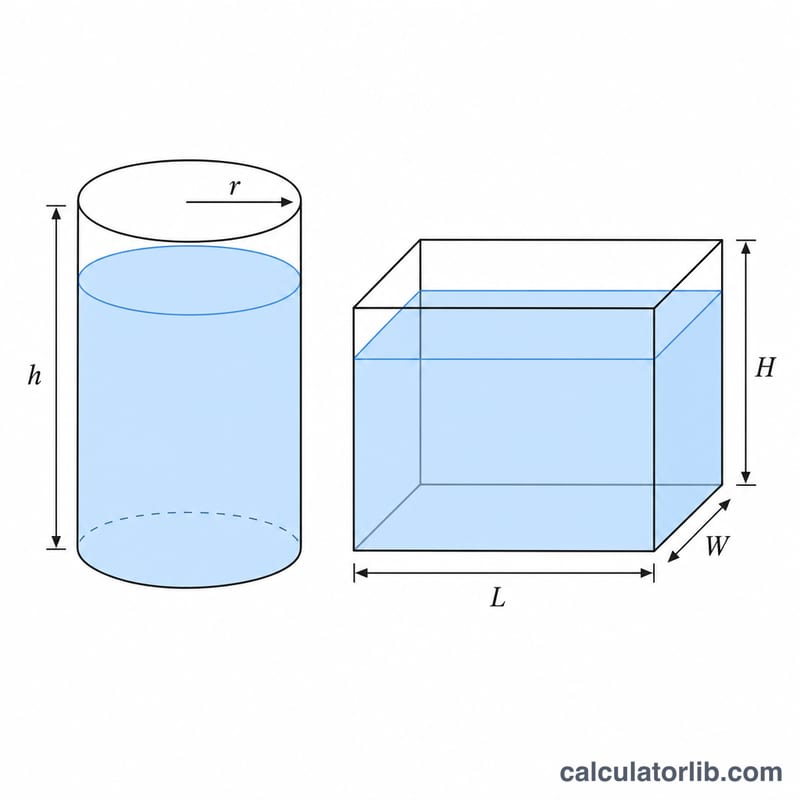
Worked example
A cylindrical tank with a diameter of 100 cm and height of 150 cm has radius 50 cm. Volume = $$\pi \times 50^2 \times 150 = \pi \times 2500 \times 150 \approx 1{,}178{,}097 \text{ cm}^3,$$ which is about 1,178 liters — roughly 311 US gallons or 259 imperial gallons.
FAQ
Should I use internal dimensions? Yes. Wall thickness reduces usable volume, so measure inside the tank for true capacity.
Why are US and UK gallons different? They are simply different historical units — an imperial gallon (4.546 L) is about 20% larger than a US gallon (3.785 L).
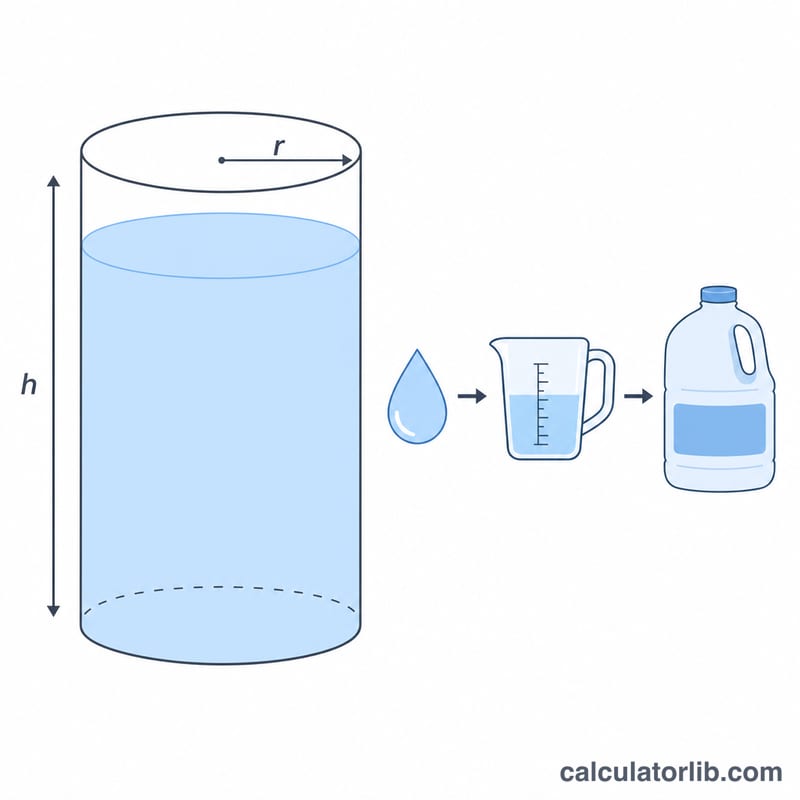
Can I use it for partially filled tanks? Enter the height of the water (not the tank) to estimate the volume currently stored.