What Is the Pool Water Volume Calculator?
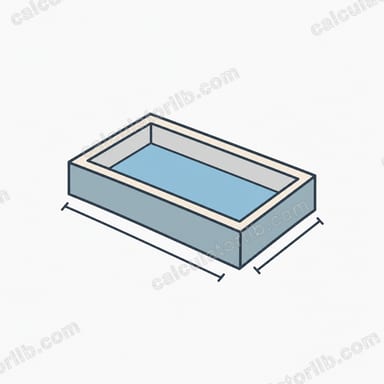
This calculator estimates how much water your swimming pool holds, expressed in both US gallons and liters. Knowing your pool's volume is essential for dosing chemicals correctly, sizing a heater or pump, and budgeting for fill-ups. The tool works for rectangular and square pools using length, width, and average depth, and supports both imperial (feet) and metric (meters) measurements.
How to Use It
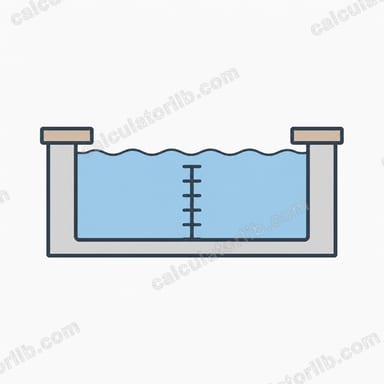
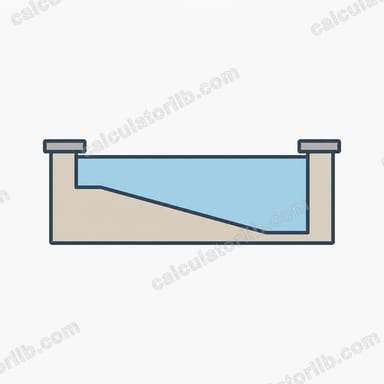
Pick your unit system. Enter the pool's length, width, and average depth. For pools with a shallow and deep end, the average depth is roughly (shallow depth + deep depth) ÷ 2. Click calculate to see the volume in gallons and liters at once.
The Formula Explained
The water volume of a rectangular pool is simply length × width × average depth. In feet this gives cubic feet, which we convert to US gallons by multiplying by 7.48 (since one cubic foot holds about 7.48 gallons). In meters the product gives cubic meters, and one cubic meter equals exactly 1000 liters.
$$\text{Gallons} = \text{Length (ft)} \times \text{Width (ft)} \times \text{Depth (ft)} \times 7.48052$$$$\text{Liters} = \text{Length (m)} \times \text{Width (m)} \times \text{Depth (m)} \times 1000$$
Worked Example
Consider a pool 20 ft long, 10 ft wide, with an average depth of 5 ft. The geometric volume is \(20 \times 10 \times 5 = 1{,}000\) cubic feet. Multiplying by 7.48 gives roughly 7,481 US gallons, equivalent to about 28,316 liters.
$$20 \times 10 \times 5 \times 7.48 \approx 7{,}481 \text{ gallons} \approx 28{,}316 \text{ liters}$$
Volume Multipliers for Common Pool Shapes
All formulas below give US gallons from dimensions in feet. The depth is the average depth (for a pool with a shallow and a deep end, add the two depths and divide by 2). Here \(r\) is the radius and \(d\) the diameter.
| Pool shape | Gallons formula (feet) | Shortcut multiplier |
|---|---|---|
| Rectangular | \(L \times W \times D \times 7.48\) | L × W × D × 7.48 |
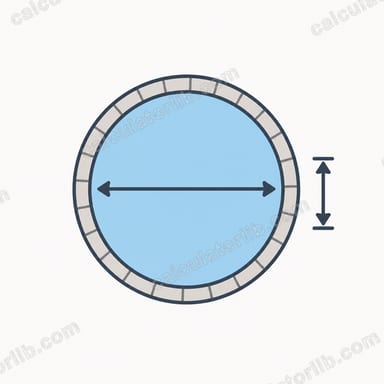
| Round | \(3.14 \times r^2 \times D \times 7.48\) | d² × D × 5.9 (more precisely ≈ 5.88) |
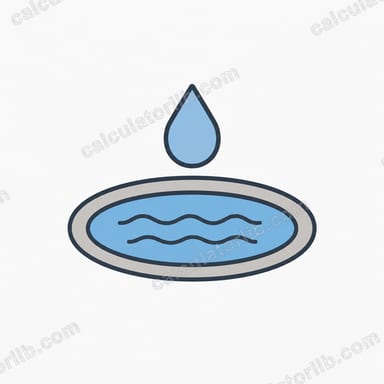
| Oval | \(L \times W \times D \times 0.785 \times 7.48\) | L × W × D × 5.9 (more precisely ≈ 5.88) |
| Kidney / freeform (estimate) | \(L \times W \times D \times 0.45 \times 7.48\) (or 0.5 instead of 0.45) | L × W × D × 3.4 (0.45) to × 3.7 (0.5) |
Note: the figures for kidney and freeform pools are rough estimates only, because the true volume depends on the exact outline. Round and oval results are also approximate when the shortcut multiplier 5.9 is used. For irregular shapes, split the pool into simpler sections, or treat the result as a ±10% estimate. This calculator uses the rectangular formula.
Typical Pool Sizes Compared
Rectangular pools with the given average depth. Cubic feet = L × W × D; gallons = cubic feet × 7.48052; liters = gallons × 3.78541 (rounded to the nearest whole number).
| Pool size (L × W × avg. depth, ft) | Cubic feet | US gallons | Liters |
|---|---|---|---|
| 10 × 20 × 4 | 800 | 5,984 | 22,653 |
| 12 × 24 × 4.5 | 1,296 | 9,695 | 36,699 |
| 16 × 32 × 5 | 2,560 | 19,150 | 72,491 |
| 20 × 40 × 5.5 | 4,400 | 32,914 | 124,594 |
Example substitution for the 12 × 24 × 4.5 pool: \(12 \times 24 \times 4.5 = 1{,}296\ \text{ft}^3\), then \(1{,}296 \times 7.48052 \approx 9{,}695\) gallons, and \(9{,}695 \times 3.78541 \approx 36{,}699\) liters.
Volume Conversion Reference
| Unit | Equivalent |
|---|---|
| 1 cubic foot (ft³) | 7.48052 US gallons = 28.3168 liters |
| 1 cubic meter (m³) | 1,000 liters = 264.172 US gallons = 35.3147 ft³ |
| 1 US gallon | 3.78541 liters |
| 1 imperial (UK) gallon | 4.54609 liters = 1.20095 US gallons |
Note: this calculator reports volume in US gallons (and liters), not imperial gallons. If a product label or pool manual uses imperial (UK) gallons, multiply US gallons by 0.832674 (that is, divide by 1.20095) to convert.
FAQ
What is average depth? It is the mean of the shallowest and deepest points of your pool floor, used so a single number represents a sloped bottom.
Why are my gallons different from a chart? Many charts use 7.5 gal/ft³ as a round figure; this tool uses the more precise 7.48 conversion.
Does this work for round or oval pools? It is built for rectangular pools. For round pools, multiply \(\pi \times \text{radius}^2 \times \text{depth}\) and convert separately.