What this calculator does
This tool estimates how much water an oval (elliptical) swimming pool holds. Knowing the volume in gallons is essential for dosing chlorine and other chemicals, sizing a pump or heater, and budgeting your water bill. It works for any pool with a rounded, racetrack or true elliptical shape.

How to use it
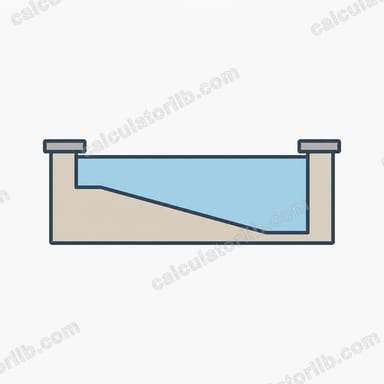
Measure the pool's overall length and width at the widest points (in feet), then measure the water depth at the shallow end and the deep end. Enter all four values and the calculator returns the volume in US gallons, cubic feet and liters. If your pool has a constant depth, simply enter the same number for both shallow and deep.
The formula explained
An oval pool's surface is an ellipse. The area of an ellipse is \((\pi/4) \times L \times W\), where \(L\) and \(W\) are the full long and short axes. Multiplying that surface area by the average depth gives the volume in cubic feet. The average depth is simply \((\text{shallow} + \text{deep}) \div 2\), which works for a pool with a flat-sloping floor. Finally, each cubic foot holds roughly 7.48 US gallons, so we multiply the cubic-foot volume by 7.48.
$$\text{Gallons} = \frac{\pi}{4} \times \text{Length} \times \text{Width} \times \frac{\text{Shallow} + \text{Deep}}{2} \times 7.48$$

Worked example
Suppose a pool is 32 ft long, 16 ft wide, with a 3 ft shallow end and an 8 ft deep end. The average depth is \((3 + 8) \div 2 = 5.5\) ft. Volume \(= (\pi/4) \times 32 \times 16 \times 5.5 \approx 2{,}211.7\) cubic feet. In gallons: \(2{,}211.7 \times 7.48 \approx 16{,}544\) US gallons.
Oval Pool Volume for Common Sizes
The table uses the oval (ellipse) formula with a fixed average depth of 4.5 ft: \(V = \frac{\pi}{4} \times L \times W \times d_{avg}\) in cubic feet, then × 7.48 for US gallons and × 28.3168 for liters. Figures are rounded and assume the pool floor slopes evenly.
| Pool size (L × W) | Avg. depth | Cubic feet | US gallons | Liters |
|---|---|---|---|---|
| 12 × 24 ft | 4.5 ft | 1,018 | ≈ 7,614 | ≈ 28,823 |
| 15 × 30 ft | 4.5 ft | 1,590 | ≈ 11,896 | ≈ 45,036 |
| 18 × 33 ft | 4.5 ft | 2,099 | ≈ 15,703 | ≈ 59,447 |
| 15 × 30 ft (depth −1 ft) | 3.5 ft | 1,237 | ≈ 9,253 | ≈ 35,028 |
| 15 × 30 ft (depth +1 ft) | 5.5 ft | 1,944 | ≈ 14,540 | ≈ 55,044 |
Effect of depth: for the 15 × 30 ft oval, each 1 ft change in average depth shifts the volume by \(\frac{\pi}{4} \times 15 \times 30 \approx 353.4\) ft³, which is about 2,644 US gallons (about 10,008 liters). Depth matters a lot, so measure it carefully.
Volume Unit Conversions
| Conversion | Value |
|---|---|
| 1 cubic foot (ft³) | 7.48052 US gallons |
| 1 US gallon | 3.78541 liters |
| 1 cubic foot | 28.3168 liters |
| 1 cubic meter (m³) | 264.172 US gallons = 1,000 liters |
| 1 imperial gallon | 4.54609 liters = 1.20095 US gallons |
Quick-reference rows
| US gallons | Liters | Cubic feet |
|---|---|---|
| 1,000 | 3,785 | 133.7 |
| 10,000 | 37,854 | 1,337 |
| 20,000 | 75,708 | 2,674 |
The calculator multiplies cubic feet by 7.48, a common rounded factor. The more exact 7.48052 differs by less than 0.01%, which is negligible for pool work. Note that US and imperial gallons are different units, so check which one a product label uses.
Practical Tips for Using Your Pool Volume
- Measure the water surface, not the coping. The outer edge of the coping or deck overstates the length and width. Measure across the water at the waterline.
- Measure depth at the water line. Use the depth with the pool filled to its normal operating level, not to the top of the wall.
- Know the limits of the average-depth method. Averaging the shallow and deep ends assumes the floor slopes evenly. A distinct shallow shelf, a deep hopper or a sharp break in the slope will make the true volume differ somewhat. Treat the result as a good estimate, not an exact figure.
- Round sensibly. Rounding to the nearest 100 gallons is fine for chemical dosing. Re-check the water level periodically, because a level that is lower or higher than when you measured changes the actual volume.
- Follow the labels. Chemical dosing is usually given per a set volume (for example per 10,000 gallons), so confirm the unit and dose on the product label and in your equipment manual.
- Don't over-size equipment from a rough figure. Pumps, filters, heaters and chemical feeders should be chosen from the manufacturer's specifications and a careful volume, not a quick guess.
This is general information, not professional advice. For water chemistry or equipment sizing, follow manufacturer instructions or consult a qualified pool professional.
FAQ
Is this US or imperial gallons? The result is in US gallons (1 ft³ ≈ 7.48 US gallons). Liters are also shown for metric users.
Why π/4 and not the full pool area? An oval is an ellipse, not a rectangle. The \(\pi/4\) factor (about 0.785) converts the bounding rectangle \(L \times W\) into the smaller ellipse area.
My pool depth is uniform — what do I enter? Put the same depth value in both the shallow and deep boxes; the average will equal that depth.