
What this calculator does
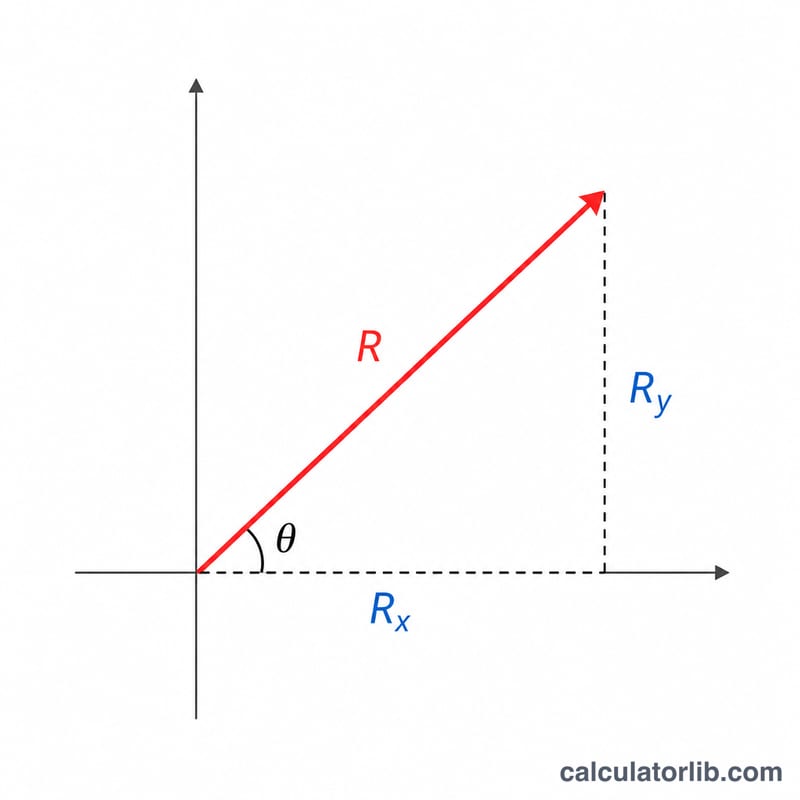
This tool adds or subtracts two two-dimensional vectors given by their x and y components and returns the resultant vector. It reports the resultant components (Rx, Ry), the magnitude R, and the direction θ measured in degrees counterclockwise from the positive x-axis. It is a universal math/physics tool and applies everywhere — no jurisdiction or unit system is assumed beyond consistency of the inputs.
How to use it
Enter the x and y components of Vector A and Vector B, choose whether to add or subtract, and read off the magnitude and angle. If your vectors are given in magnitude–angle form, first convert them to components with \(x = m\cdot\cos(\theta)\) and \(y = m\cdot\sin(\theta)\), then enter those values here.
The formula explained
Vector addition is component-wise: \(R_x = A_x + B_x\) and \(R_y = A_y + B_y\) (use minus signs for subtraction). The magnitude follows from the Pythagorean theorem, $$R = \sqrt{R_x^2 + R_y^2}.$$ The direction uses the two-argument arctangent, $$\theta = \operatorname{atan2}(R_y, R_x),$$ which correctly places the angle in the right quadrant — unlike a plain arctan — returning a value between −180° and +180°.
Worked example
Add \(A = (3, 4)\) and \(B = (1, 2)\). Then \(R_x = 3 + 1 = 4\) and \(R_y = 4 + 2 = 6\). The magnitude is $$\sqrt{4^2 + 6^2} = \sqrt{52} \approx 7.2111 \text{ units}.$$ The direction is \(\operatorname{atan2}(6, 4) \approx 56.31^\circ\) above the positive x-axis.
Definitions & Glossary
- Resultant vector
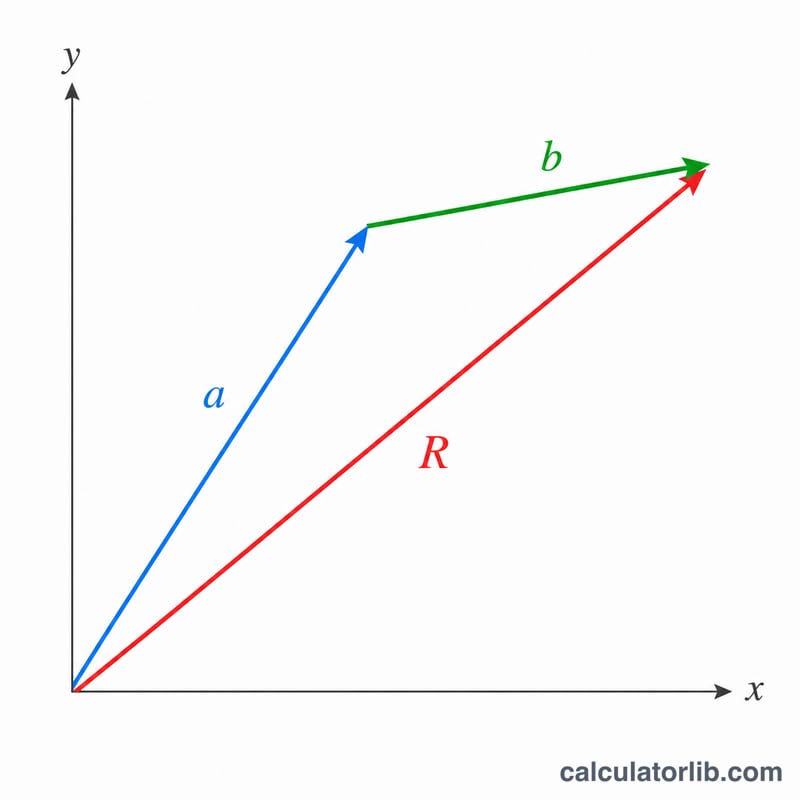
- The single vector \(\vec{R}\) equal to the sum (or difference) of two vectors. For addition \(\vec{R} = \vec{A} + \vec{B}\); for subtraction \(\vec{R} = \vec{A} - \vec{B}\). It represents the net effect of the combined vectors.
- Component (x / y)
- The projection of a vector onto the x- and y-axes. \(R_x\) is the horizontal part and \(R_y\) the vertical part. Components add independently: \(R_x = A_x \pm B_x\), \(R_y = A_y \pm B_y\). Components carry the same arbitrary but consistent unit as the original vectors (m, N, m/s, etc.).
- Magnitude
- The length of the vector, \(|\vec{R}| = \sqrt{R_x^2 + R_y^2}\). Always non-negative and expressed in the vectors' shared unit.
- Direction angle \(\theta\)
- The angle the vector makes with the positive x-axis, measured counterclockwise. Typically reported in degrees or radians; the unit is a convention, not a physical quantity.
- atan2 vs atan
- \(\operatorname{atan}(R_y/R_x)\) returns only values in \((-90^\circ, 90^\circ)\) and loses sign information when both components are negative or when \(R_x<0\). \(\operatorname{atan2}(R_y, R_x)\) uses the signs of both components to return the correct angle in the full range \((-180^\circ, 180^\circ]\), placing the vector in its proper quadrant.
- Tip-to-tail addition
- A graphical method: draw \(\vec{A}\), then draw \(\vec{B}\) starting at the tip of \(\vec{A}\). The resultant runs from the tail of \(\vec{A}\) to the tip of \(\vec{B}\). It is the geometric equivalent of adding components.
FAQ
What does a negative angle mean? A negative \(\theta\) means the resultant points below the positive x-axis (clockwise direction). Add 360° if you prefer angles in the 0–360° range.
Can I subtract vectors? Yes — select the Subtract option to compute \(A - B\), which is equivalent to adding A and the reverse of B.
What if the resultant is zero? If both components are 0 the magnitude is 0 and the direction is undefined; the calculator will report 0° by convention.