
What this calculator does
This subtracting fractions calculator finds the difference of two fractions, \(a/b\) minus \(c/d\), and returns the answer as a fraction in lowest terms together with its decimal value. It handles negative results and automatically simplifies, so you never have to reduce by hand.
How to use it
Enter the numerator and denominator of the first fraction (\(a\) and \(b\)) and the second fraction (\(c\) and \(d\)), then read off the simplified result. Denominators must be non-zero. Negative numerators are allowed.
The formula explained
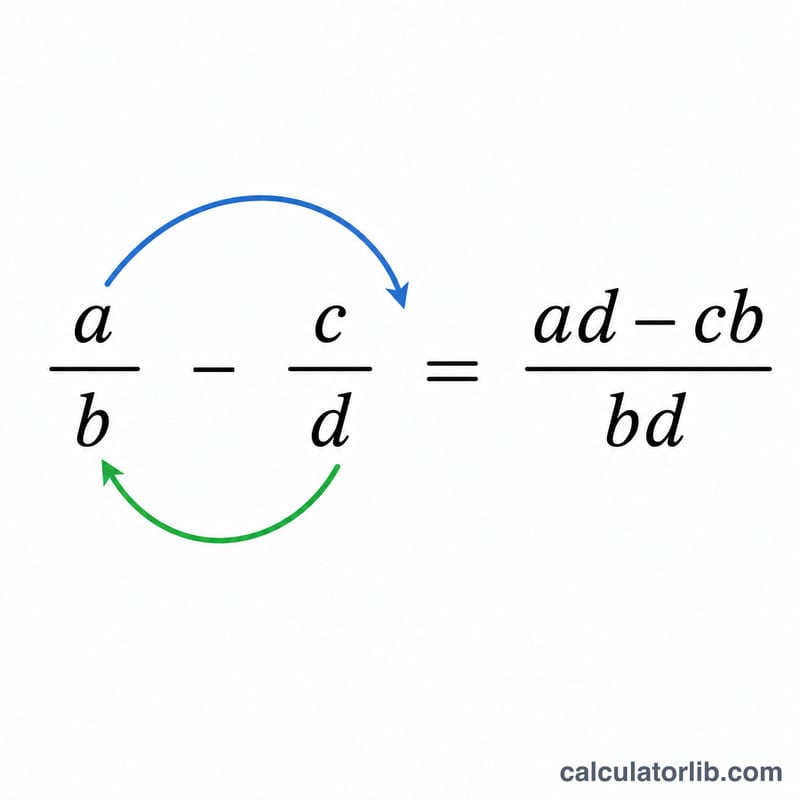
To subtract fractions you need a common denominator. The fastest universal method is cross multiplication: rewrite \(a/b - c/d\) as $$\frac{a}{b} - \frac{c}{d} = \frac{a\cdot d - c\cdot b}{b\cdot d}$$ The numerator becomes \(a\cdot d - c\cdot b\) and the denominator becomes \(b\cdot d\). Finally, divide the top and bottom by their greatest common divisor (gcd) to express the answer in lowest terms.
Worked example
Compute \(3/4 - 1/6\). Cross multiply: numerator $$= 3\cdot 6 - 1\cdot 4 = 18 - 4 = 14$$ denominator $$= 4\cdot 6 = 24$$ So the raw answer is \(14/24\). The gcd of \(14\) and \(24\) is \(2\), giving \(7/12 \approx 0.583333\).
FAQ
Can the result be negative? Yes. For example \(1/2 - 3/4 = -1/4\). The calculator keeps the denominator positive and places the sign on the numerator.
What if the answer is a whole number? It will appear as that number over 1, e.g. \(3/2 - 1/2 = 1/1\).
Do the fractions need the same denominator? No. Cross multiplication creates a common denominator automatically.