
What is Polar to Cartesian Conversion?
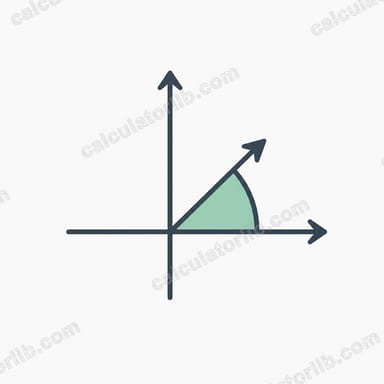
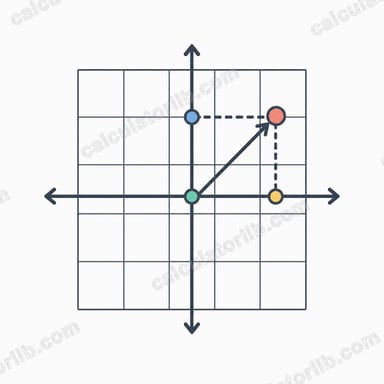
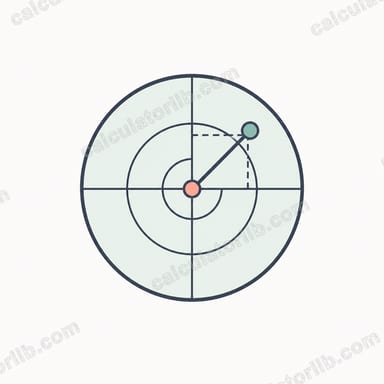
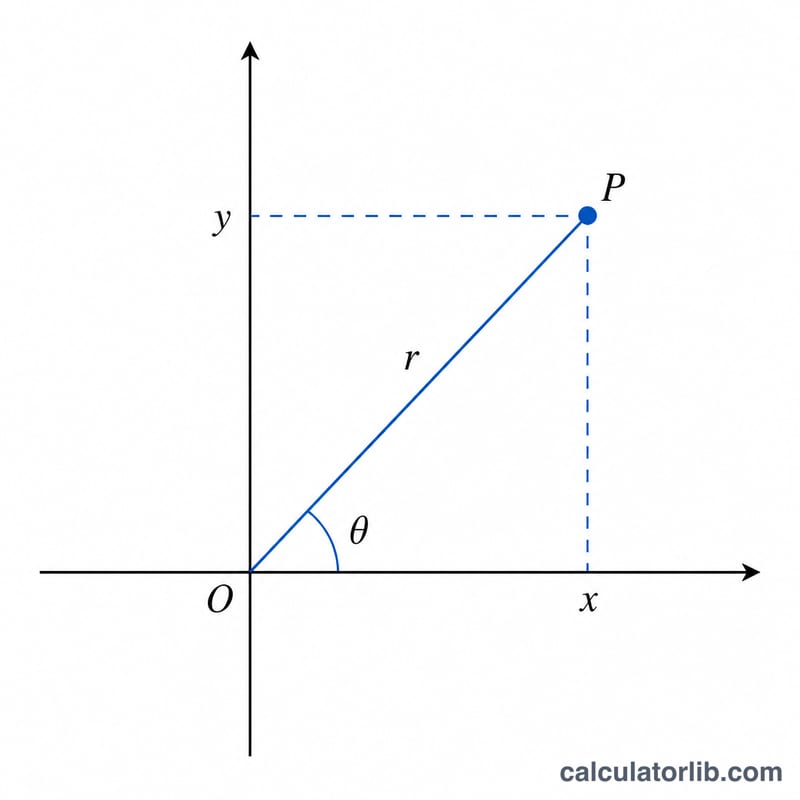
Polar coordinates describe a point in a 2D plane using a distance from the origin, the radius r, and an angle theta measured from the positive x-axis. Cartesian (rectangular) coordinates instead describe the same point using its horizontal and vertical distances, x and y. This calculator converts any polar point into its equivalent Cartesian form, with support for angles entered in either degrees or radians.
How to Use This Calculator
Enter the radius r (the distance from the origin), then enter the angle theta. Choose whether your angle is in degrees or radians using the toggle. The converter instantly returns the matching x and y coordinates. The radius can be any real number; a negative radius simply reflects the point through the origin (equivalent to angle theta + 180 degrees).
The Formula Explained
The conversion uses basic trigonometry: \(x = r \cos(\theta)\) and \(y = r \sin(\theta)\). Because the trig functions require radians, a degree input is first converted with the factor \(\pi/180\). So \(\theta_{rad} = \theta \cdot (\pi/180)\) for degrees, or \(\theta_{rad} = \theta\) directly for radians.
$$x = r \cos\!\left(\theta \cdot \frac{\pi}{180}\right), \quad y = r \sin\!\left(\theta \cdot \frac{\pi}{180}\right)$$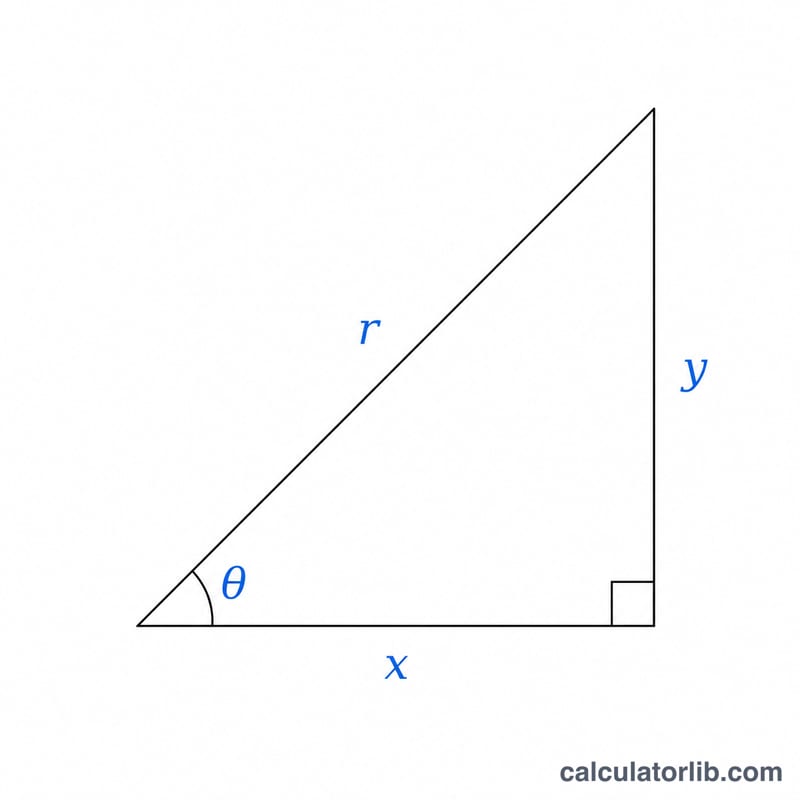
Worked Example
Suppose \(r = 5\) and \(\theta = 60\) degrees. Converting the angle: \(\theta_{rad} = 60 \cdot \pi/180 = 1.047197551\) rad. Then $$x = 5 \cdot \cos(60^\circ) = 5 \cdot 0.5 = 2.5,$$ and $$y = 5 \cdot \sin(60^\circ) = 5 \cdot 0.8660254038 = 4.330127019.$$ The Cartesian point is \((2.5, 4.330127019)\).
FAQ
What happens when r = 0? The point sits at the origin, so \(x = 0\) and \(y = 0\) regardless of the angle.
Can the radius be negative? Yes. A negative radius is mathematically valid and places the point in the opposite direction, equivalent to adding 180 degrees (\(\pi\) radians) to the angle.
Does the angle need to be between 0 and 360 degrees? No. Any real angle works because cosine and sine are periodic and handle the full range; no modulo is required.