
What is a catenary curve?
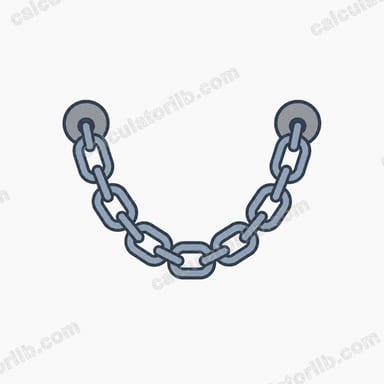
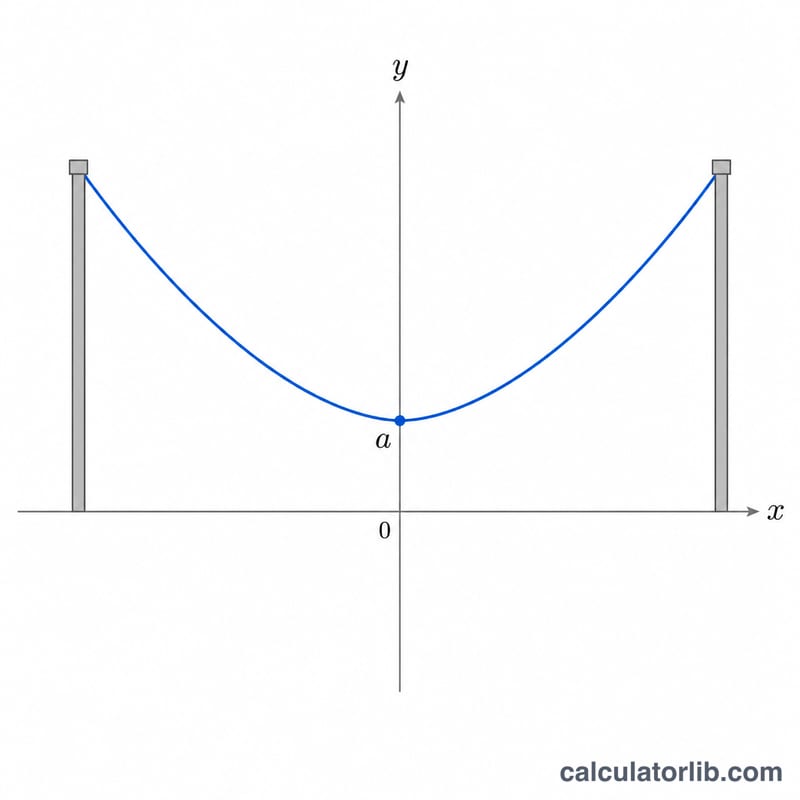
A catenary is the shape formed by a flexible chain or cable hanging freely under its own weight, supported only at its two ends. Despite resembling a parabola, the true curve is described by the hyperbolic cosine function, \(y = a \cdot \cosh\!\left(\frac{x}{a}\right)\). The constant a sets how "deep" or "flat" the curve is: a larger a produces a flatter, more taut curve, while a smaller a gives a deeper sag.
How to use this calculator
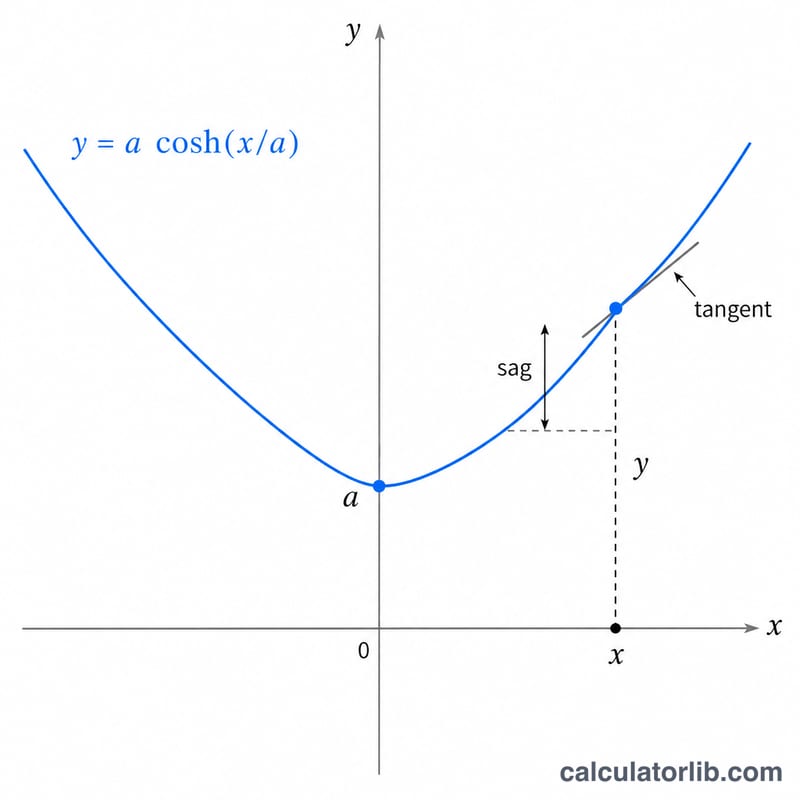
Enter the catenary constant a and the horizontal position x measured from the lowest point (the vertex). The calculator returns the curve height y, the sag above the vertex (y − a), and the slope (dy/dx) at that point. The vertex sits at x = 0, where y = a and slope = 0.
The formula explained
The height is $$y = a \cdot \cosh\!\left(\frac{x}{a}\right)$$ where cosh is the hyperbolic cosine. Differentiating once gives the slope, $$\frac{dy}{dx} = \sinh\!\left(\frac{x}{a}\right)$$ At the vertex (\(x = 0\)), \(\cosh(0) = 1\) so \(y = a\), and \(\sinh(0) = 0\) so the tangent is horizontal. The sag relative to the lowest point is simply \(y - a\).
Worked example
Take \(a = 10\) and \(x = 5\). Then \(x/a = 0.5\). \(\cosh(0.5) \approx 1.12763\), so $$y = 10 \times 1.12763 \approx 11.2763$$ The sag is \(y - a \approx 1.2763\), and the slope is \(\sinh(0.5) \approx 0.52110\).
FAQ
Is a catenary the same as a parabola? No. They look similar near the bottom, but a hanging chain follows cosh, while a parabola (\(y = kx^2\)) describes a load distributed evenly along the horizontal, like a suspension-bridge deck.
What does the constant a represent? It equals the horizontal tension divided by the weight per unit length of the cable, and it is also the height of the vertex above the directrix.
Why can't a be zero? Dividing x by a is required, so a = 0 is undefined; the calculator returns zero in that case.