
What this calculator does
This tool fits a regression curve to a frequency-distribution table of points. Each row is a triple (x, y, f) where x is the independent value, y is the dependent value, and f is the frequency (weight) telling how many times that pair occurred. You pick one of seven curve shapes, the calculator performs a frequency-weighted least-squares fit, then reports the coefficients, the correlation coefficient, and an estimated value. It is pure mathematics and applies anywhere.
The seven models
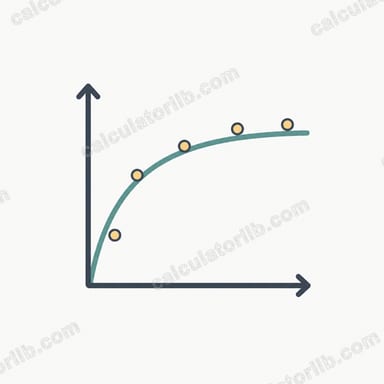
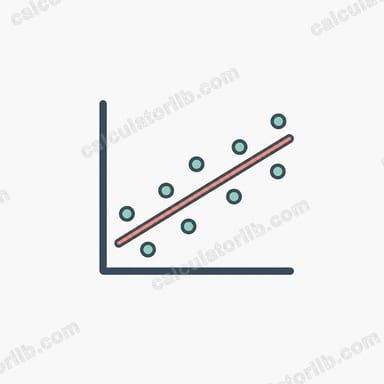
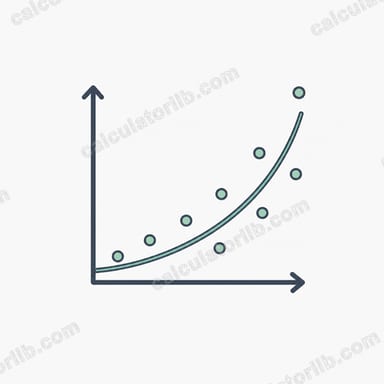
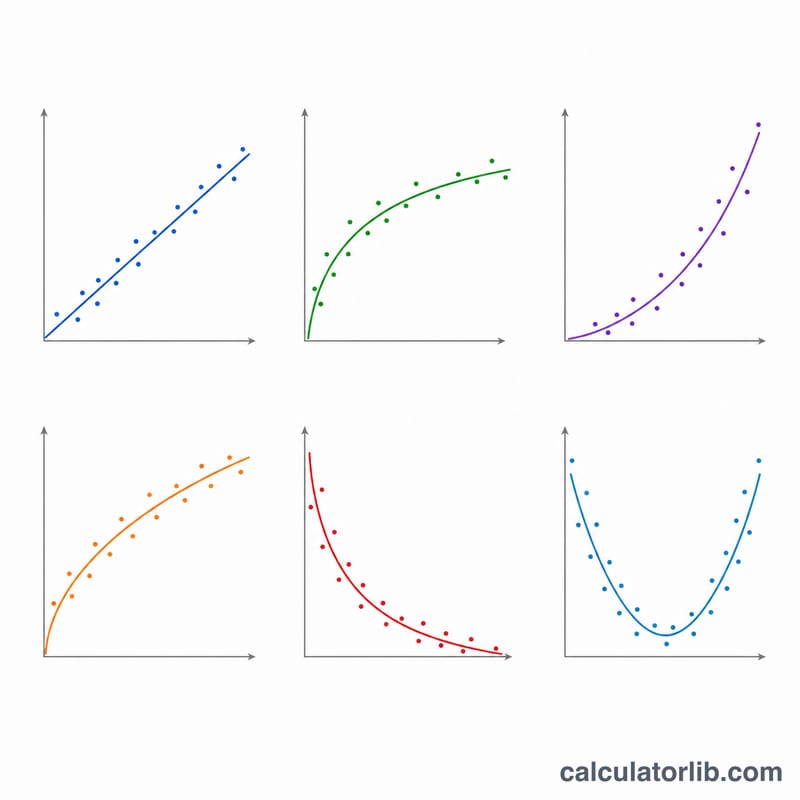
Linear: \(y = A + Bx\). Logarithmic: \(y = A + B\ln x\). e-Exponential: \(y = A\,e^{Bx}\). ab-Exponential: \(y = A\,B^{x}\). Power: \(y = A\,x^{B}\). Inverse: \(y = A + \dfrac{B}{x}\). Quadratic: \(y = A + Bx + Cx^{2}\). Every non-quadratic model is linearized to \(Y = a + bX\) with a suitable transform (logarithm or reciprocal) before fitting, then the result is back-transformed into \(A\) and \(B\). The quadratic model is solved directly from the weighted normal equations.
How to use it
Enter your data, one row per line, as x, y, f. Choose a regression type. Pick whether you want to estimate y from a supplied x, or x from a supplied y, and type the known value. Choose how many significant digits to display. Rows with frequency zero or blank are ignored, and models that need positive x or y (logarithmic, exponential, power) require valid values.
Worked example
Data (x, y, f): (1,2,3), (2,4,5), (3,5,2), (4,8,4), (5,9,1). For the Linear model the weighted sums give \(N=15\), \(S_x=40\), \(S_y=77\), \(S_{xx}=130\), \(S_{xy}=249\). The denominator is $$15 \times 130 - 40^{2} = 350,$$ so $$B = \frac{15 \times 249 - 40 \times 77}{350} = \frac{655}{350} = 1.8714$$ and $$A = \frac{77 - 1.8714 \times 40}{15} = 0.1429.$$ The correlation \(r\) is about 0.9879 (strong). Estimating y at \(x=4\) gives $$0.1429 + 1.8714 \times 4 = 7.6286.$$
FAQ
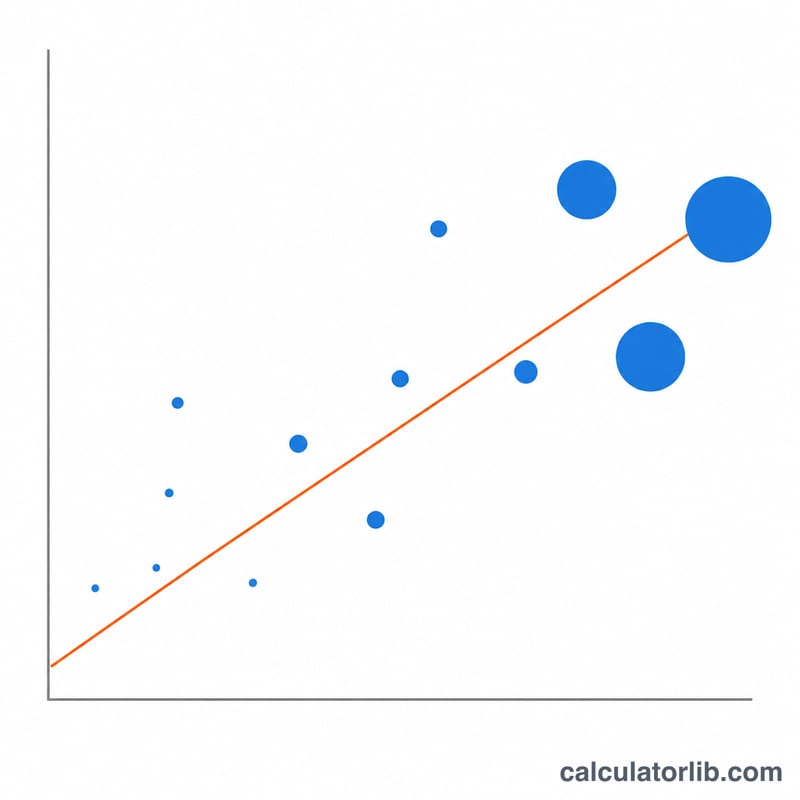
What does the frequency do? It weights each observation, so a pair with \(f=5\) influences the fit five times as much as a pair with \(f=1\).
Why is C zero? The \(C\) coefficient only exists for the Quadratic model; for the other six it stays zero.
What does r measure for transformed models? It is the Pearson correlation of the linearized \((X, Y)\) variables, so \(|r|=1\) means a perfect fit of the linearized form rather than of the original curve.