
What Is Net Force?
The net force is the overall force acting on an object once all individual forces are combined. When forces act along the same line, you simply add them together using signs: positive for one direction and negative for the opposite. If the net force is zero, the object is in equilibrium and its motion does not change.
How to Use This Calculator
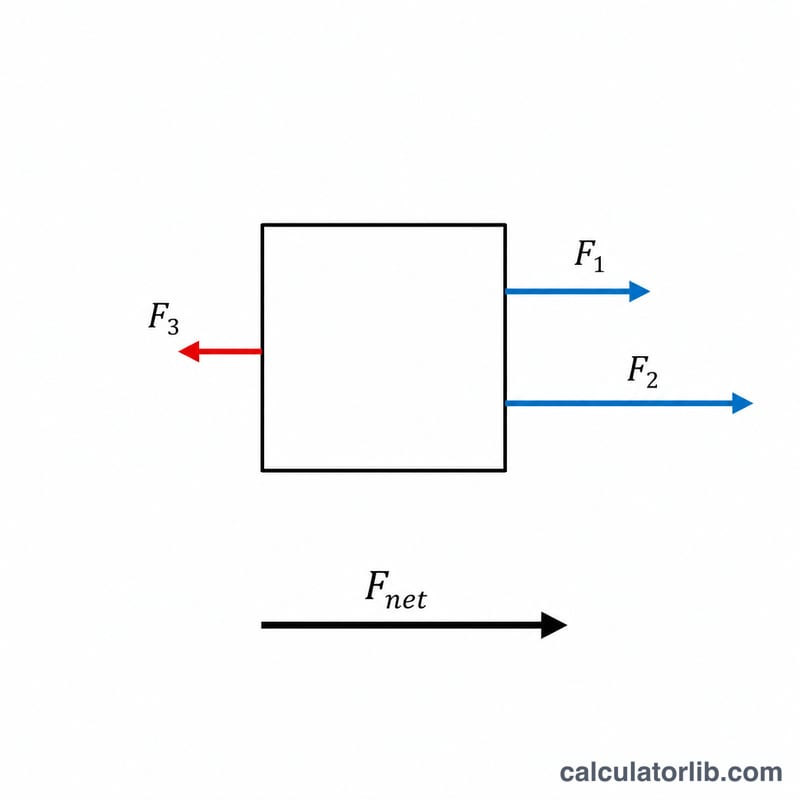
Enter up to three forces in newtons (N). Give each a sign so opposing forces cancel correctly — for example, a 10 N push to the right and a 4 N push to the left become 10 and -4. The calculator adds them to give the net force. Optionally enter the object's mass in kilograms to find the acceleration it produces.
The Formula Explained
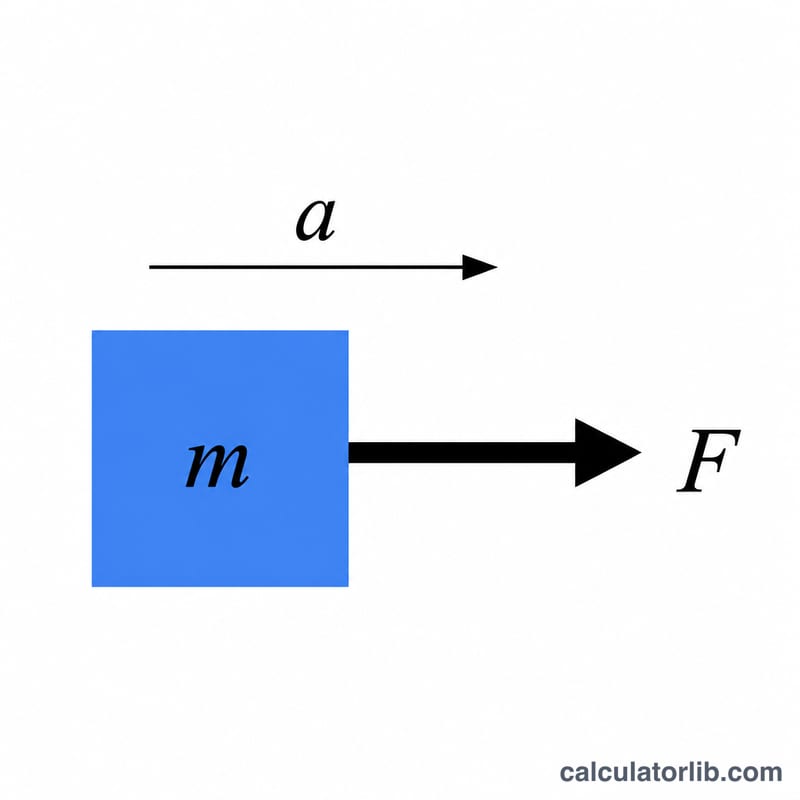
The net force is the sum of all applied forces: $$F_{net} = F_1 + F_2 + F_3$$ By Newton's second law, \(F = m\cdot a\), so the resulting acceleration is $$a = \frac{F_{net}}{m}$$ A larger net force produces a larger acceleration, while a heavier mass resists acceleration.
Worked Example
Suppose three forces act on a 2 kg block: +10 N, -4 N, and 0 N. The net force is $$10 + (-4) + 0 = 6\ \text{N}$$ in the positive direction. The acceleration is $$a = 6\ \text{N} \div 2\ \text{kg} = 3\ \text{m/s}^2$$ The block accelerates at \(3\ \text{m/s}^2\) in the positive direction.
FAQ
What if I only have one force? Just enter Force 1; leave the others at zero. The net force equals that single force.
Why is acceleration zero or blank? If you leave mass empty or zero, acceleration cannot be computed (division by zero), so it is shown as a dash.
Can I use pounds? This tool uses SI units — newtons for force and kilograms for mass. Convert other units first.