
What Is the Contact Lens Vertex Calculator?
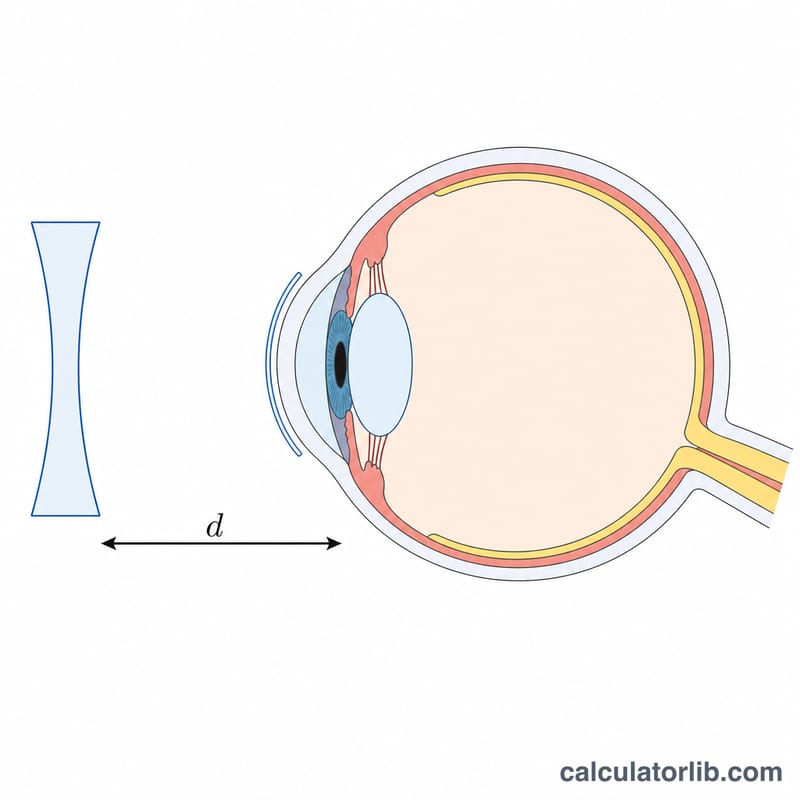
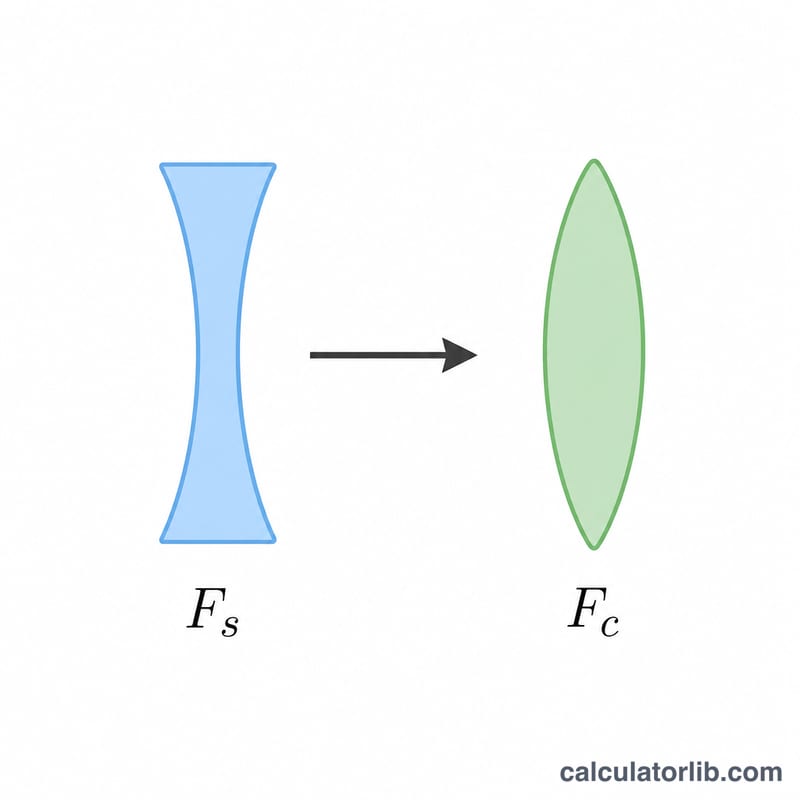
The contact lens vertex calculator converts the power of a spectacle (eyeglass) lens into the equivalent power needed at the corneal plane for a contact lens. Because glasses sit a short distance in front of the eye while contacts rest directly on the cornea, the effective power changes. This effect — called vertex distance compensation — becomes clinically significant for prescriptions stronger than about ±4.00 D.
How to Use It
Enter the spectacle lens power in diopters (use a negative value for myopia and a positive value for hyperopia) and the vertex distance in millimeters (a typical value is 12 mm). The calculator outputs the equivalent contact lens power.
The Formula Explained
The conversion uses:
$$F_c = \dfrac{F_s}{1 - d \cdot F_s}$$where \(F_s\) is the spectacle power in diopters, \(F_c\) is the contact lens power, and \(d\) is the vertex distance in meters (millimeters ÷ 1000). For minus lenses the resulting contact power is weaker (less minus); for plus lenses it is stronger.
Worked Example
A patient has a spectacle prescription of −8.00 D at a 12 mm vertex distance. Convert d to meters: \(12 / 1000 = 0.012\) m. Then $$F_c = \dfrac{-8}{1 - 0.012 \times -8} = \dfrac{-8}{1 + 0.096} = \dfrac{-8}{1.096} \approx -7.30 \text{ D}.$$ The contact lens power is about −7.25 D (rounded to the nearest 0.25 D step).
FAQ
When does vertex distance matter? Compensation is generally recommended for prescriptions of ±4.00 D or higher; below this the change is usually negligible.
What vertex distance should I use? 12 mm is a common average for spectacle frames, but use the measured value when available.
Does this replace a fitting? No. This is a clinical aid; final contact lens power should be confirmed by an eye-care professional during fitting.