
What Is Lens Magnification?
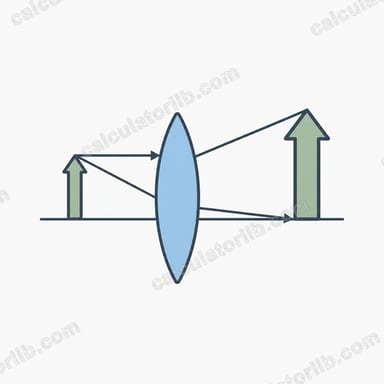
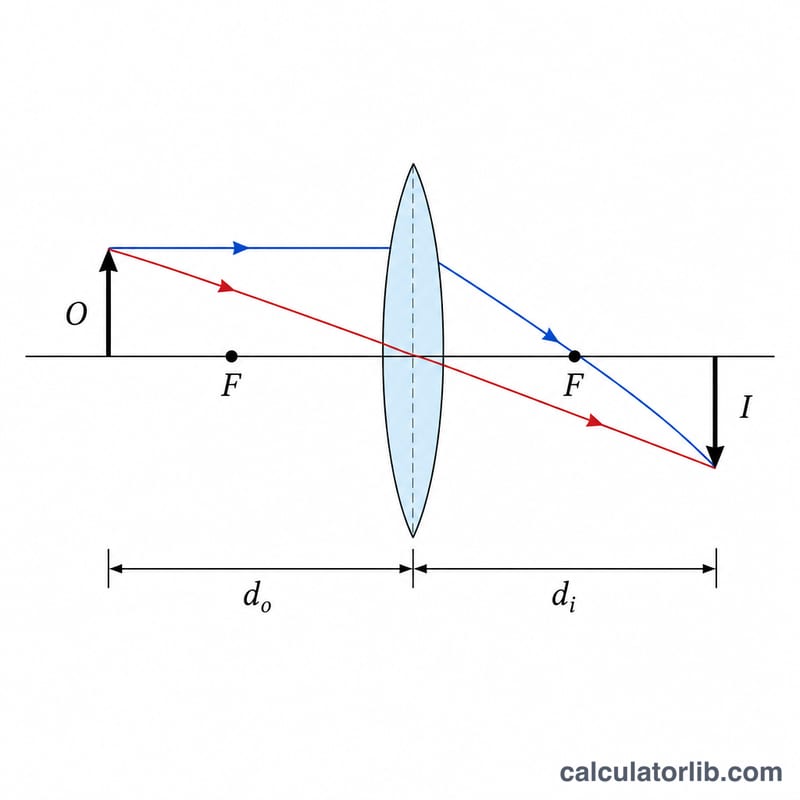
The magnification of a lens describes how much larger or smaller an image appears compared to the original object. It is defined as the ratio of the image distance to the object distance, with a negative sign that encodes orientation: \(m = -d_i/d_o\). A magnification of 2 means the image is twice as tall as the object; a magnification of 0.5 means it is half as tall. This relationship is fundamental in optics for cameras, microscopes, projectors, and corrective lenses.
How to Use This Calculator
Enter the object distance (\(d_o\)) — how far the object sits from the lens — and the image distance (\(d_i\)) — where the image forms. Both are measured in centimetres (any consistent unit works). The calculator returns the signed magnification, its magnitude, and whether the image is upright or inverted. Use the standard sign convention: real images formed on the opposite side of the lens take a positive \(d_i\), producing a negative (inverted) magnification.
The Formula Explained
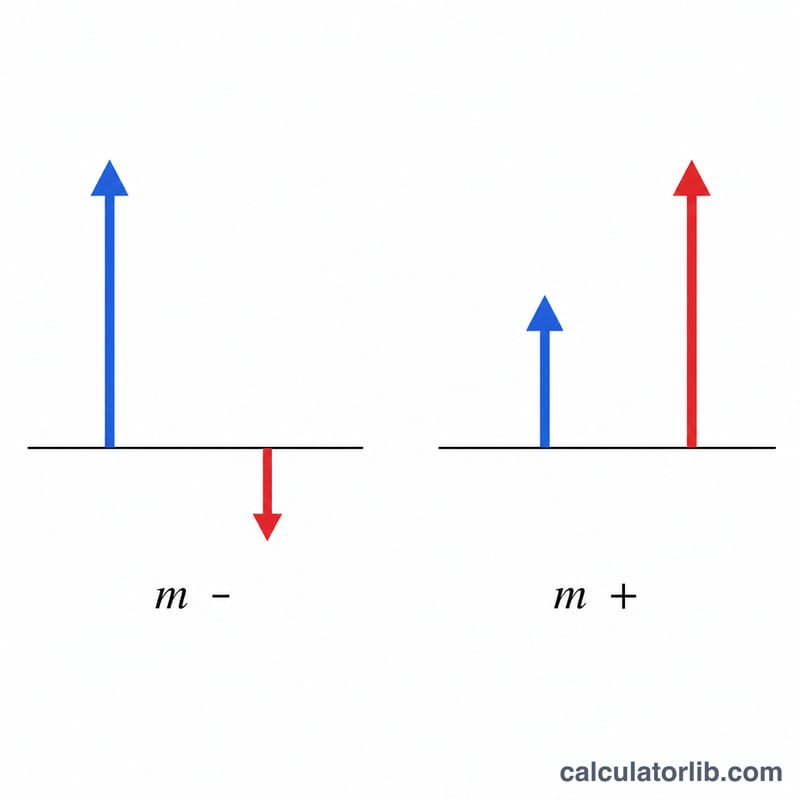
The thin-lens magnification equation is $$m = -\frac{\text{Image Distance (cm)}}{\text{Object Distance (cm)}}$$ The minus sign is a sign-convention bookkeeping device. When both distances are positive (a typical real image from a converging lens), \(m\) comes out negative, meaning the image is inverted. A positive \(m\) means the image is upright, as with a virtual image from a magnifying glass. The absolute value \(|m|\) tells you the linear scale factor between image and object heights.
Worked Example
Suppose an object is placed 20 cm in front of a lens and a real image forms 60 cm behind it. Then $$m = -\frac{d_i}{d_o} = -\frac{60}{20} = -3$$ The image is three times larger than the object and inverted, because the magnification is negative.
FAQ
Why is the magnification negative? A negative value indicates the image is inverted relative to the object. A positive value means it is upright.
What does a magnification between 0 and 1 mean? The image is smaller than the object — it has been reduced, as in a camera photographing a distant scene.
Can I use metres or inches? Yes. Magnification is a ratio, so any unit works as long as both distances use the same unit.