
What Is the Lens Maker's Equation?
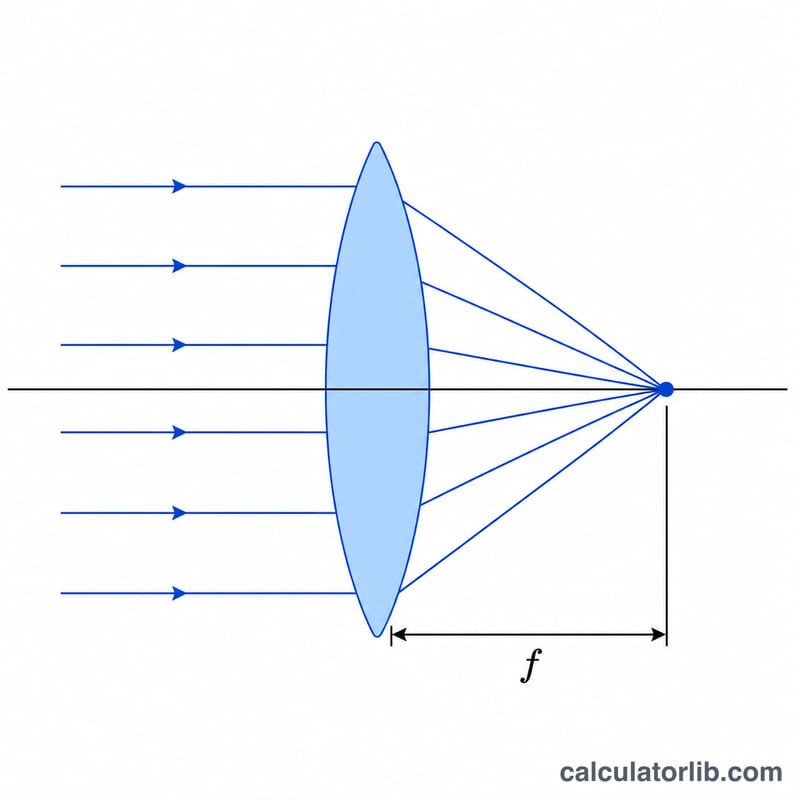
The lens maker's equation predicts the focal length of a thin lens from two physical properties: the refractive index of the lens material and the radii of curvature of its two surfaces. It is a cornerstone of geometric optics, used by lens designers, photographers, and physics students to relate the shape and material of a lens to how strongly it bends light.
How to Use the Calculator
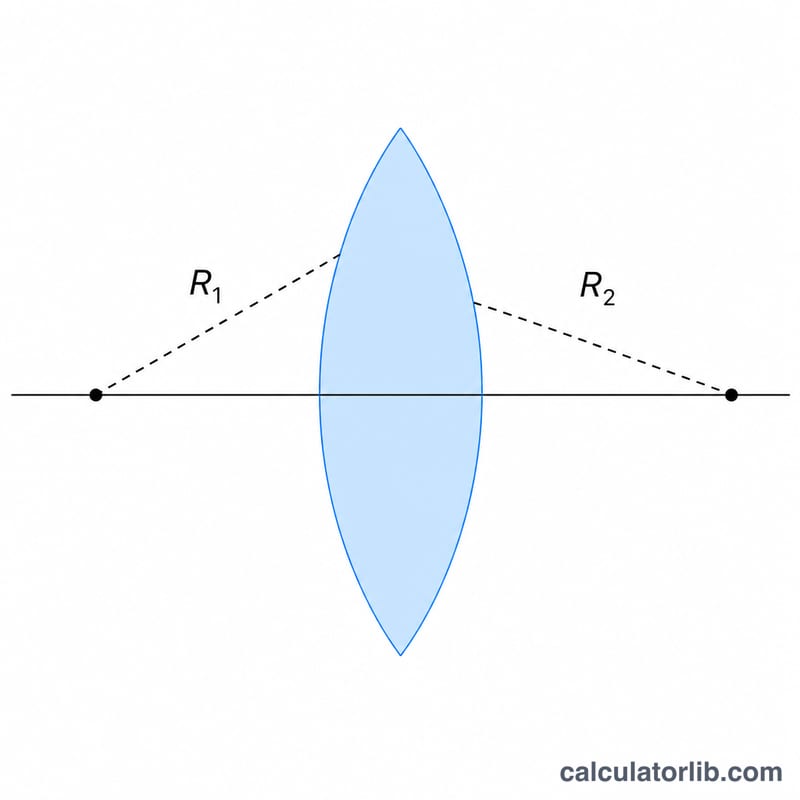
Enter the refractive index (\(n\)) of the lens material — typically about 1.5 for crown glass. Then enter the radius of curvature of the first surface (\(R_1\)) and the second surface (\(R_2\)) in metres. Use the sign convention: a radius is positive if the surface's centre of curvature is on the outgoing side of the light, and negative otherwise. The calculator returns the focal length \(f\) in metres and the optical power in dioptres.
The Formula Explained
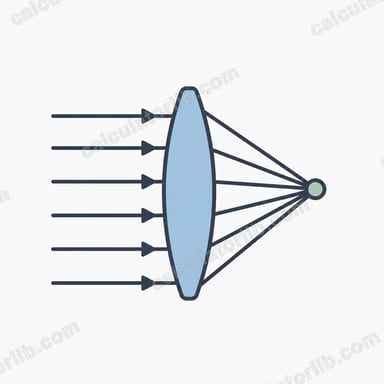
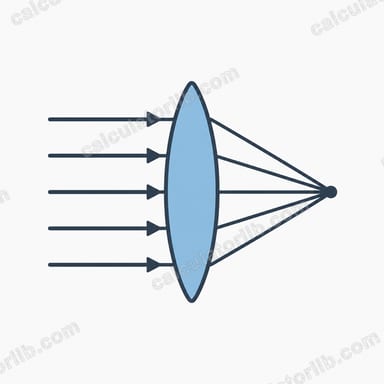
The equation is $$\frac{1}{f} = \left(\text{Index } n - 1\right)\left(\frac{1}{\text{R}_1} - \frac{1}{\text{R}_2}\right)$$ The factor \((n - 1)\) captures how much the material slows light relative to air, while the bracketed term captures the combined curvature of the two surfaces. A positive focal length indicates a converging (convex) lens; a negative value indicates a diverging (concave) lens. Optical power is simply \(1/f\), measured in dioptres.
Worked Example
Consider a biconvex lens with \(n = 1.5\), \(R_1 = 0.2\ \text{m}\) and \(R_2 = -0.2\ \text{m}\). Then $$\frac{1}{f} = (1.5 - 1)\left(\frac{1}{0.2} - \frac{1}{-0.2}\right) = 0.5 \times (5 + 5) = 5$$ So \(f = 1/5 = 0.2\ \text{m}\) and the power is 5 dioptres.
FAQ
What sign convention is used? A surface radius is positive when its centre of curvature lies on the side the light exits, and negative otherwise. Flat surfaces have an effectively infinite radius (enter 0 here to ignore that term).
What does a negative focal length mean? It indicates a diverging lens that spreads light outward, such as a concave lens used to correct nearsightedness.
Does this account for lens thickness? No — this is the thin-lens form, which assumes the lens thickness is negligible compared with the radii of curvature.