
What Is a Laser Beam Expander?
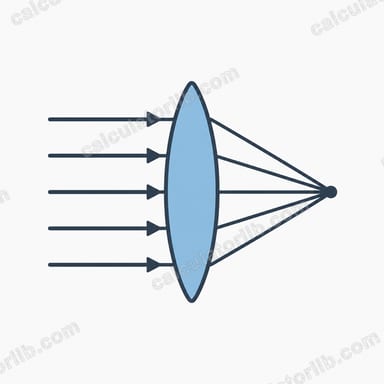
A laser beam expander is an optical system, typically built from two lenses, that increases the diameter of a collimated laser beam while proportionally reducing its angular divergence. Expanders are widely used in laser cutting, interferometry, laser ranging, and free-space optical communication where a larger, more collimated beam improves focusing and reduces spreading over distance.
How to Use This Calculator
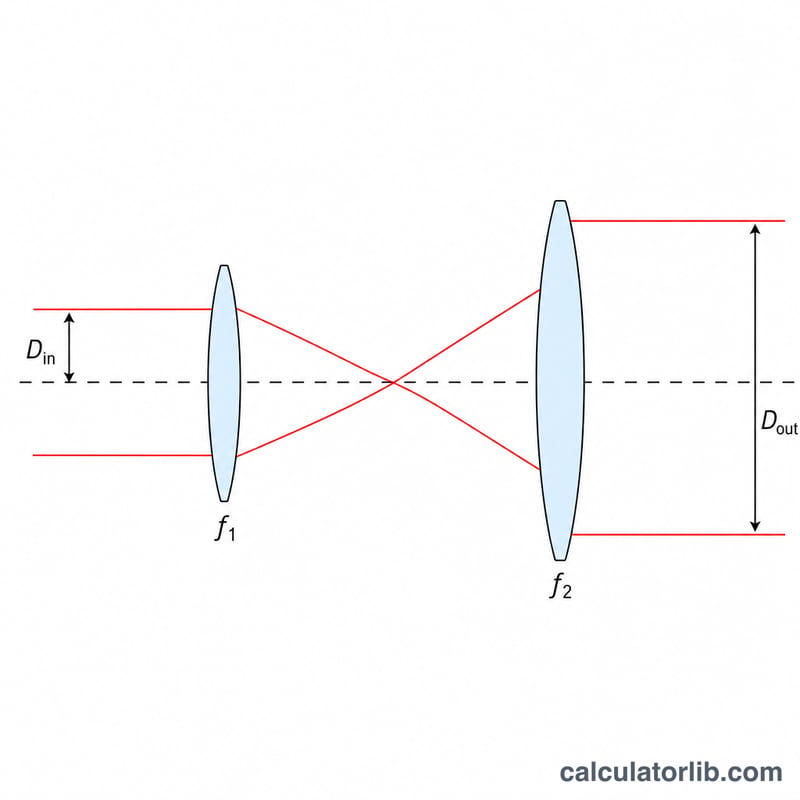
Enter the focal length of the input (first) lens f1 and the output (second) lens f2, both in millimeters. Add your input beam diameter and its divergence (in milliradians). The calculator returns the magnification power, the expanded output beam diameter, and the new, smaller divergence angle.
The Formula Explained
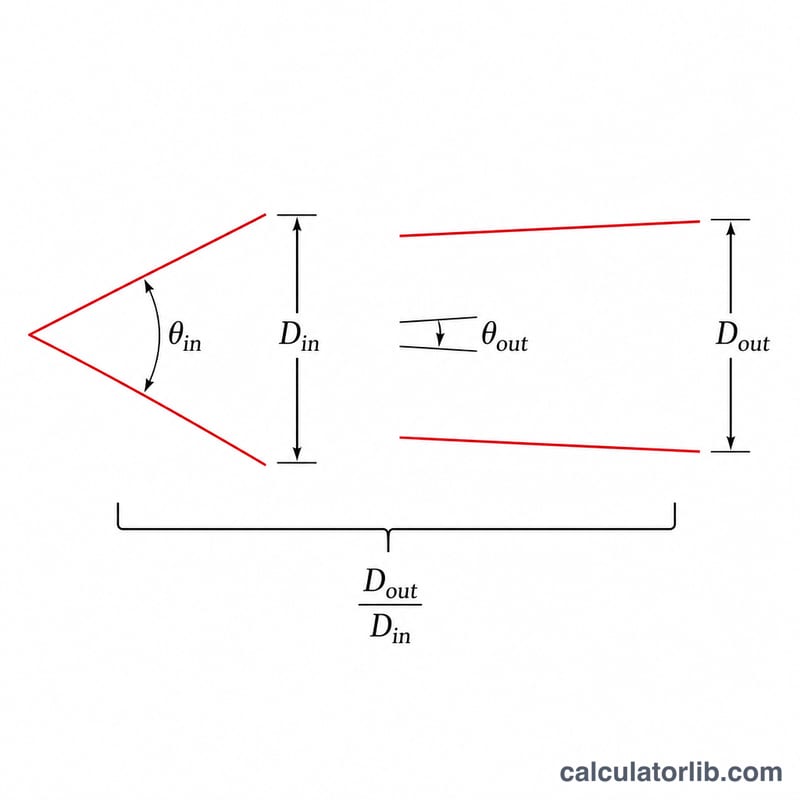
For a Keplerian or Galilean two-lens expander, the magnification power is the ratio of the two focal lengths: \(MP = f_2 / f_1\). Because the optical throughput (etendue) is conserved, the beam diameter scales up by MP while divergence scales down by the same factor: \(D_{out} = D_{in} \times MP\) and \(\theta_{out} = \theta_{in} / MP\). This inverse relationship is why a wider beam stays collimated over longer ranges.
Worked Example
Suppose f1 = 10 mm, f2 = 50 mm, an input beam of 1 mm diameter, and 1 mrad divergence. Then $$MP = 50/10 = 5\times.$$ The output diameter is $$1 \times 5 = 5 \text{ mm},$$ and the output divergence is $$1/5 = 0.2 \text{ mrad}$$ — a 5× tighter, wider beam.
FAQ
Does lens spacing matter? Yes — for proper collimation the lenses should be separated by \(f_1 + f_2\) so the system is afocal. This calculator assumes an ideal afocal arrangement.
What is the difference between Galilean and Keplerian designs? Galilean uses a negative input lens (no internal focus, good for high power), while Keplerian uses two positive lenses with an internal focus. Both follow \(MP = f_2/f_1\).
Can MP be less than 1? Yes; if \(f_2 < f_1\) the system reduces the beam (a beam reducer) and increases divergence.