
What This Calculator Does
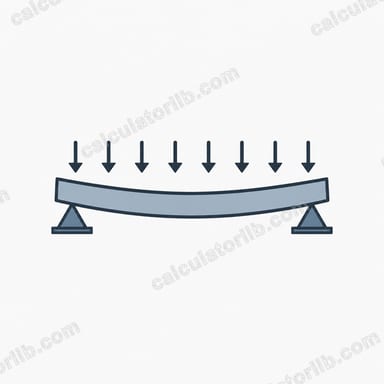
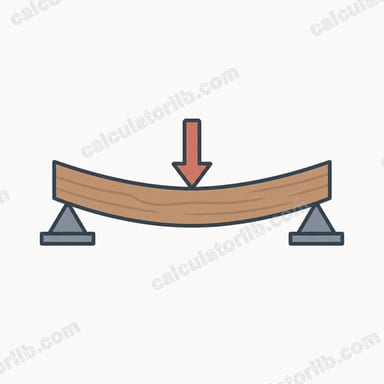
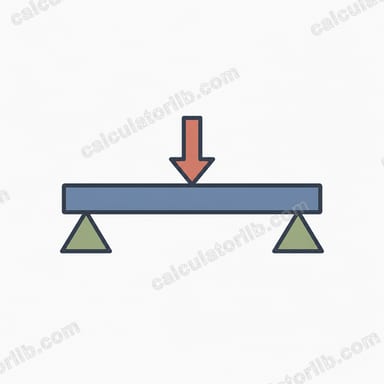
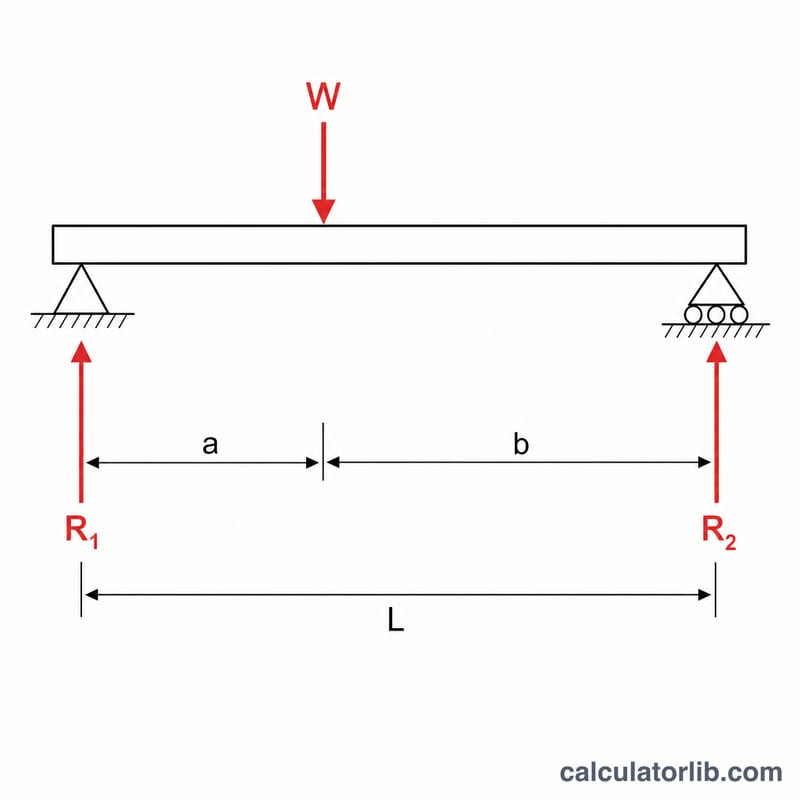
This tool finds the vertical support reactions of a simply supported beam carrying a single concentrated (point) load. A simply supported beam rests on two supports — one at each end — and the calculator returns the upward force each support must provide to keep the beam in static equilibrium. It is a universal physics and engineering tool with no country-specific assumptions.
How to Use It
Enter the magnitude of the point load W in newtons, the total span of the beam L in metres, and the distance a from the left support to the point where the load is applied. The calculator automatically computes the remaining distance \(b = L - a\) and returns both reactions R1 (left) and R2 (right).
The Formula Explained
Static equilibrium requires that the sum of vertical forces and the sum of moments both equal zero. Taking moments about the right support gives \(R_1 = W \cdot b / L\), and taking moments about the left support gives \(R_2 = W \cdot a / L\). As a check, \(R_1 + R_2\) always equals the total applied load \(W\).
$$\begin{gathered} R_1 = \frac{W \cdot b}{L}, \qquad R_2 = \frac{W \cdot a}{L} \\[1.5em] \text{where}\quad \left\{ \begin{aligned} W &= \text{Point Load (N)} \\ L &= \text{Span (m)} \\ a &= \text{Distance from Left (m)} \\ b &= \text{Span (m)} - \text{Distance from Left (m)} \end{aligned} \right. \end{gathered}$$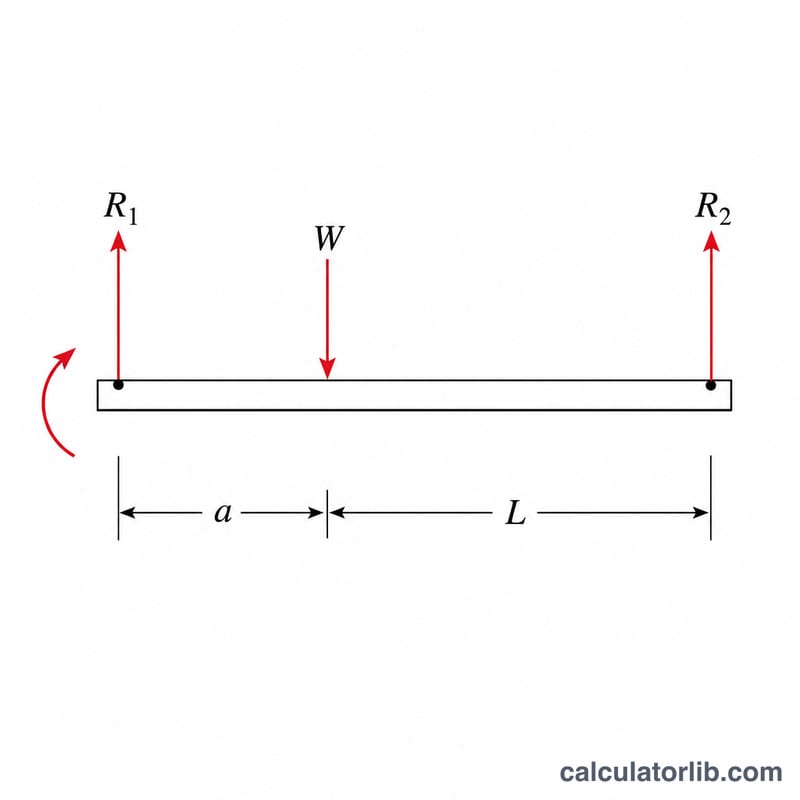
Worked Example
Suppose a 1000 N load sits 2 m from the left support on a 5 m beam. Then \(b = 5 - 2 = 3\) m.
$$R_1 = \frac{1000 \times 3}{5} = 600 \text{ N}$$$$R_2 = \frac{1000 \times 2}{5} = 400 \text{ N}$$The two reactions sum to 1000 N, confirming equilibrium.
FAQ
Why is the closer support carrying more load? The support nearer the load carries a larger share because it has the shorter moment arm — here R2 is closer when a is small, but in the example the load is nearer the left support so R1 is larger.
Does this account for the beam weight? No, this calculator treats the beam as weightless and considers only the single point load. For self-weight, model it as a separate distributed load.
What units should I use? Use consistent units. Newtons for load and metres for distances give reactions in newtons; pounds and feet would give reactions in pounds.