
What Is the Rational Zero Test?
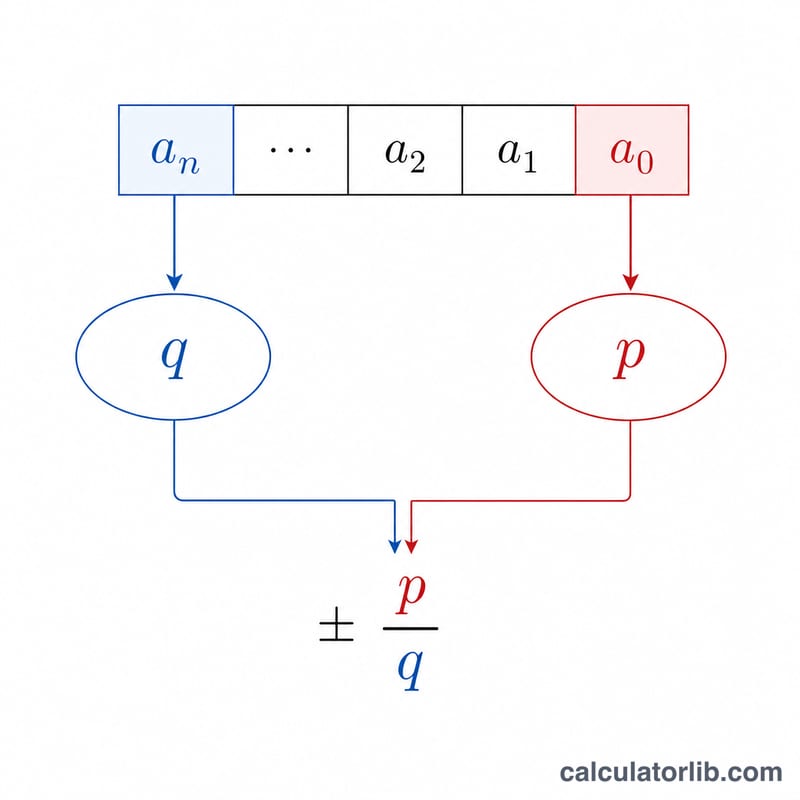
The Rational Root Theorem (also called the Rational Zero Test) gives every possible rational root of a polynomial with integer coefficients. If a polynomial has a rational zero \(p/q\) in lowest terms, then \(p\) must be a factor of the constant term and \(q\) must be a factor of the leading coefficient. This calculator builds the complete list of candidate zeros so you can test each one with synthetic division or substitution.
How to Use It
Enter the constant term (a₀) and the leading coefficient (aₙ) of your polynomial. The calculator finds all positive integer factors of each, forms every reduced fraction \(p/q\), and reports each as \(\pm p/q\). The headline number counts every distinct candidate including both plus and minus signs.
The Formula Explained
Possible zeros:
$$\frac{p}{q} = \pm\frac{\text{factors of }\text{Constant }(a_0)}{\text{factors of }\text{Leading }(a_n)}$$Duplicate fractions are removed after reducing to lowest terms, so \(2/2\) and \(1/1\) are counted once. Each unique fraction contributes two candidates (a positive and a negative value).
Worked Example
For \(2x^3 - x^2 - 6\), the constant is \(6\) (factors \(1, 2, 3, 6\)) and the leading coefficient is \(2\) (factors \(1, 2\)). The distinct reduced fractions \(p/q\) are:
$$1,\ 2,\ 3,\ 6,\ \tfrac{1}{2},\ \tfrac{3}{2}$$— that is 6 unique magnitudes. Counting \(\pm\) gives 12 possible rational zeros:
$$\pm 1,\ \pm 2,\ \pm 3,\ \pm 6,\ \pm\tfrac{1}{2},\ \pm\tfrac{3}{2}$$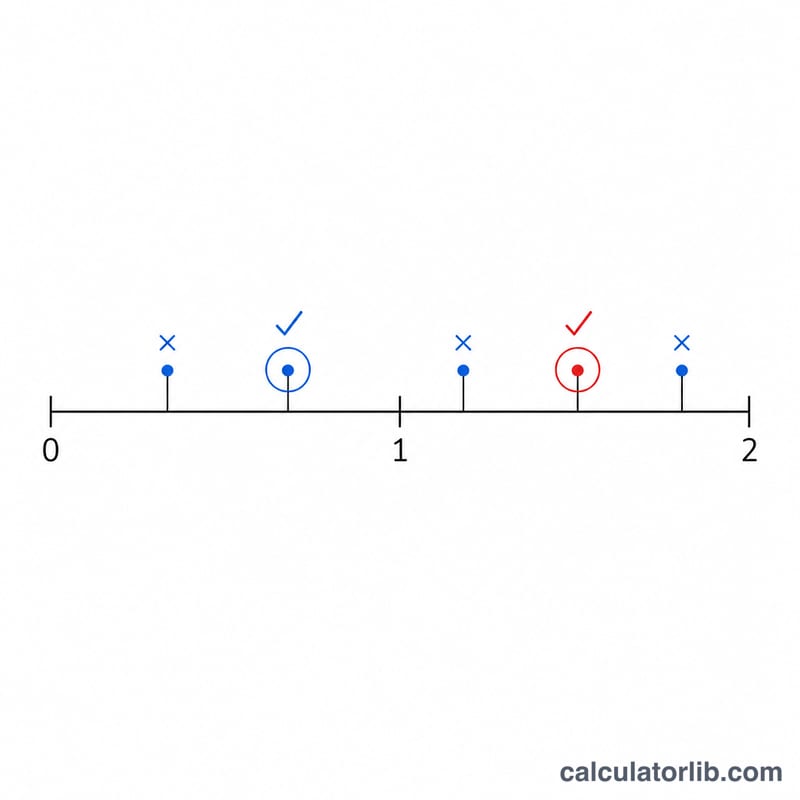
FAQ
Does the theorem guarantee a rational root exists? No. It only lists candidates; the polynomial may have no rational roots at all.
Why use absolute values of the inputs? Only the magnitudes of the factors matter, and the \(\pm\) already accounts for sign.
What if the leading coefficient is 1? Then \(q\) can only be \(1\), so the possible zeros are just \(\pm\) the factors of the constant term (the Integer Root Theorem).