
What Is a Rational Exponent?
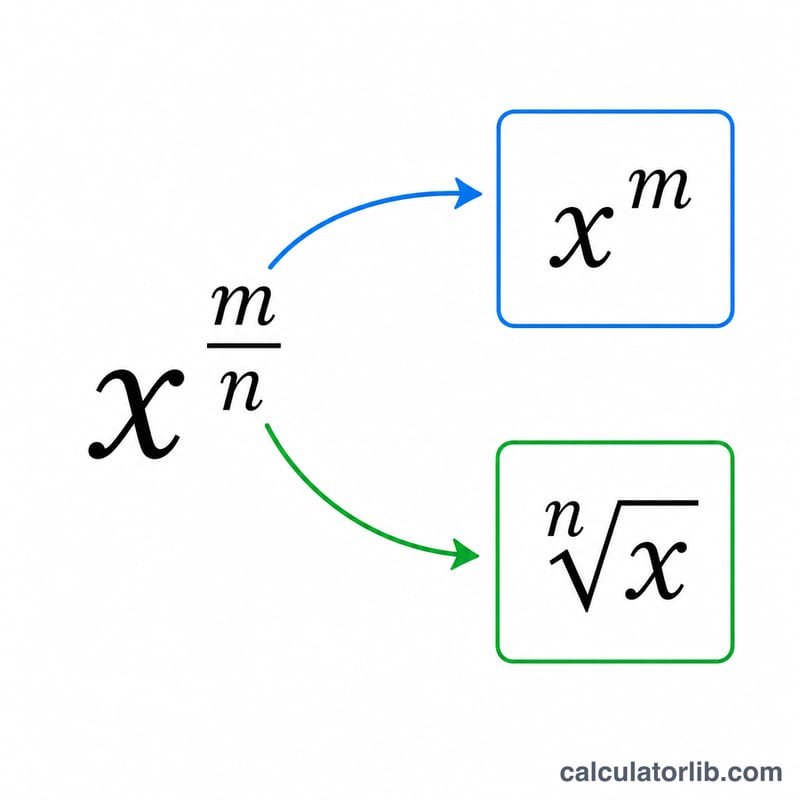
A rational exponent is a fractional power of the form \(m/n\), where \(m\) is the numerator and \(n\) is the denominator. The expression \(x^{m/n}\) combines two operations: taking the \(n\)-th root of \(x\) and raising the result to the \(m\)-th power. This calculator evaluates any such expression for you in a single step, handling roots and powers together.
How to Use the Calculator
Enter the base (\(x\)), the numerator (\(m\)), and the denominator (\(n\)) of the exponent. The calculator returns the value of \(x^{m/n}\) along with the decimal value of the exponent itself. Negative bases are supported only when the denominator is an odd whole number, since other roots of negatives are not real numbers.
The Formula Explained
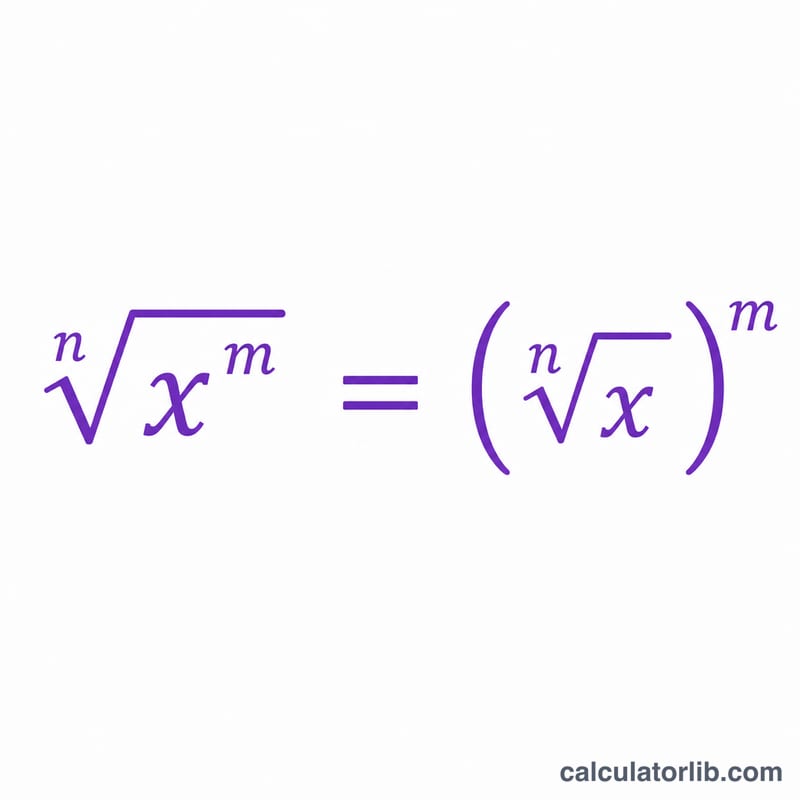
By the laws of exponents, \(x^{m/n} = \left(x^{1/n}\right)^m\). The term \(x^{1/n}\) is the \(n\)-th root of \(x\), and raising it to the power \(m\) applies the numerator. This is identical to the radical form $$\text{x}^{\frac{\text{m}}{\text{n}}} = \sqrt[\text{n}]{\text{x}^{\text{m}}} = \left(\sqrt[\text{n}]{\text{x}}\right)^{\text{m}}$$ Both forms give the same value, so you can root first then power, or power first then root.
Worked Example
Evaluate \(8^{2/3}\). First take the cube root of 8: \(\sqrt[3]{8} = 2\). Then raise it to the 2nd power: \(2^2 = 4\). So $$8^{\frac{2}{3}} = 4$$ Equivalently, \(8^2 = 64\) and \(\sqrt[3]{64} = 4\) — the same answer.
FAQ
What does a negative exponent mean? A negative exponent gives a reciprocal: \(x^{-m/n} = 1 / x^{m/n}\). Enter a negative numerator to compute it.
Can the base be negative? Only when the denominator \(n\) is an odd integer (e.g. cube roots). Even roots of negative numbers are not real.
What if \(x = 0\)? 0 raised to any positive rational exponent is 0, while a negative exponent is undefined because it requires dividing by zero.