
What is the Fractional Exponents Calculator?
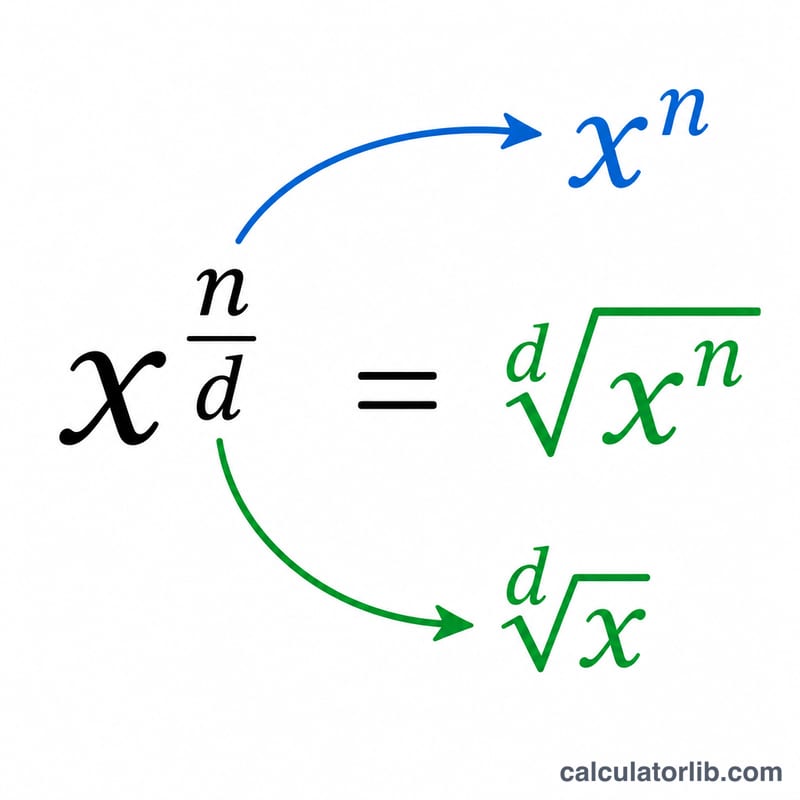
A fractional (rational) exponent like \(x^{n/d}\) means "raise x to the power n, then take the d-th root." This calculator evaluates \(x^{n/d}\) for any real base and any integer numerator and denominator, and shows the equivalent radical form so you can see exactly what is being computed.
How to use it
Enter the base in the "x =" box, the exponent numerator in "n =", and the exponent denominator in "d =". Use a minus sign for negative values. Press calculate to get the answer. When the reduced denominator is even and the base is positive, the result has two real roots, so the answer is shown with a plus-minus sign.
The formula explained
By the laws of exponents, $$x^{\frac{n}{d}} = \sqrt[d]{x^{\,n}}$$ For \(x > 0\) the value equals \(\exp\left(\frac{n}{d}\cdot \ln x\right)\). The fraction \(n/d\) is reduced to lowest terms to determine root parity: an even reduced denominator means an even root, which gives two real values for a positive base and no real value (NaN) for a negative base.
Worked example
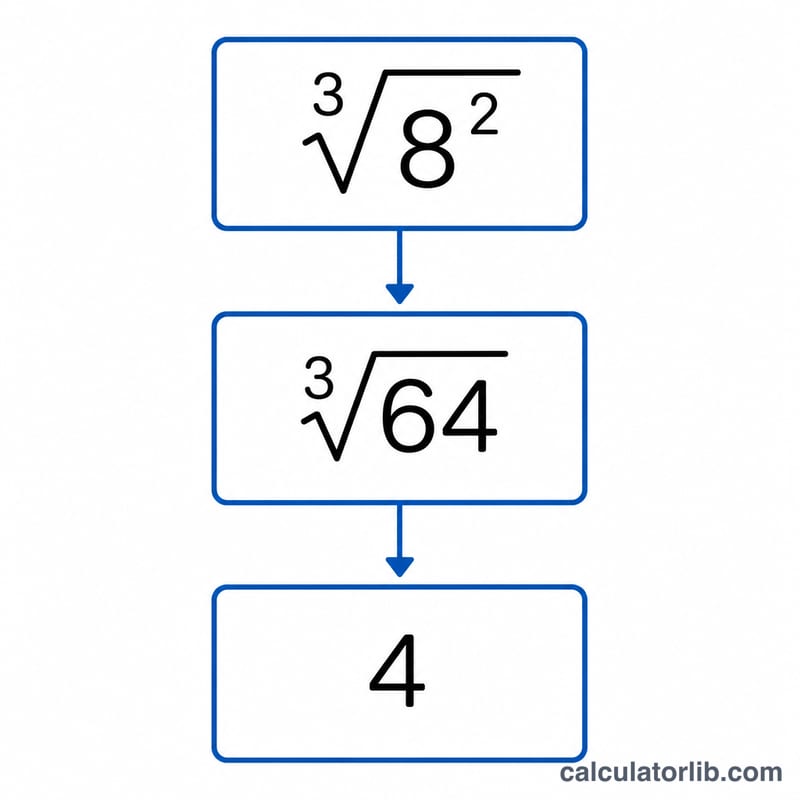
For x = 4, n = 3, d = 2: the exponent is \(3/2 = 1.5\), so $$4^{1.5} = \left(4^{3}\right)^{1/2} = 64^{1/2} = 8$$ Because the reduced denominator 2 is even and the base is positive, both \(+8\) and \(-8\) are real roots, so the calculator reports \(\pm 8\).
FAQ
Why does a negative base sometimes give NaN? An even root of a negative number (for example the square root of -16) has no real value, so the result is Not a Number.
What happens with a negative exponent? A negative exponent gives the reciprocal: \(x^{-n/d} = 1 / x^{n/d}\).
Can the denominator be zero? No. A zero denominator means division by zero, so the exponent is undefined and the calculator returns an error.