
What is the Vector Dot Product?
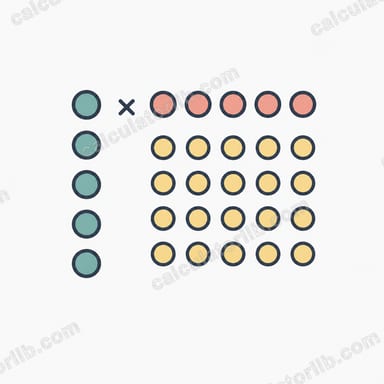
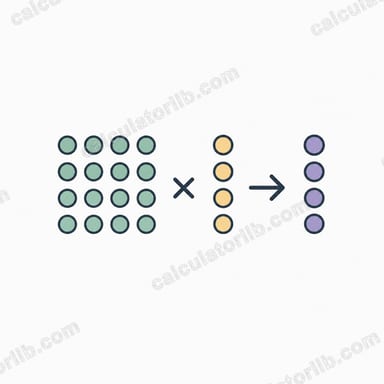
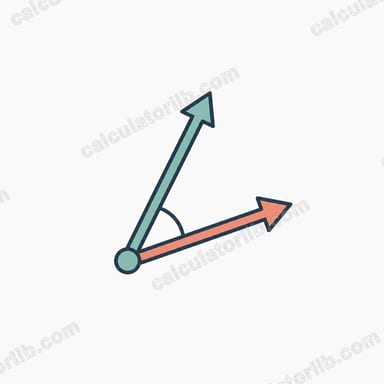
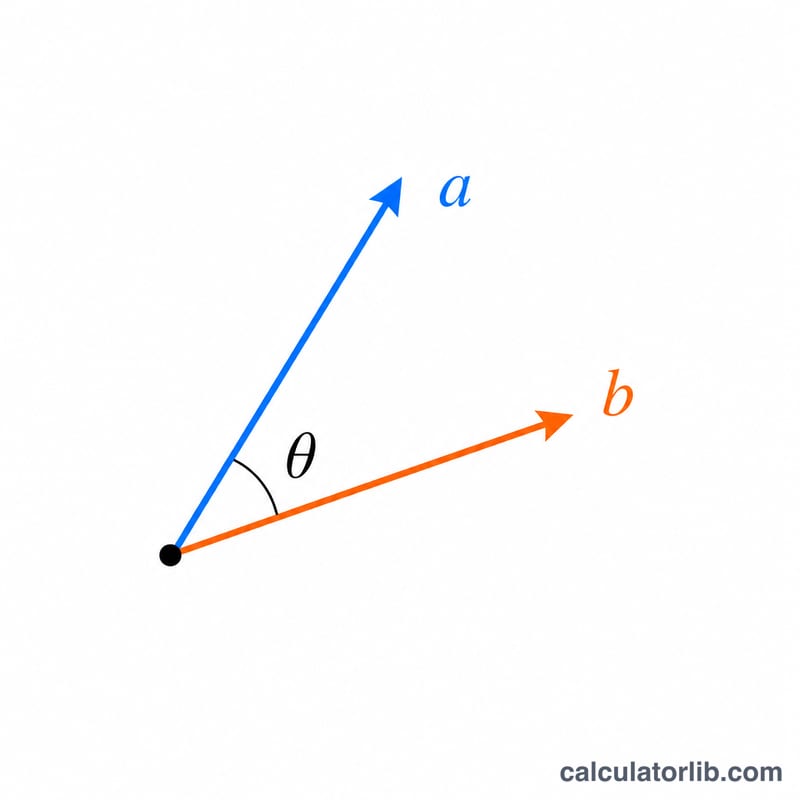
The dot product (also called the scalar product) takes two or more vectors of the same dimension and returns a single number. For two vectors it is the sum of the products of their corresponding components. The result is a scalar, not a vector, and it appears throughout geometry, physics, and machine learning - for example to measure how aligned two directions are or to compute work done by a force.
How to Use This Calculator
Type your vectors into the text box. Each vector can be wrapped in parentheses (1,2,3), square brackets [1,2,3], angle brackets <1,2,3>, or simply placed on its own line. Separate the components within a vector using commas. Every vector must contain the same number of terms. Choose "Auto" to see the exact value, or pick a number of significant figures to round the displayed answer.
The Formula Explained
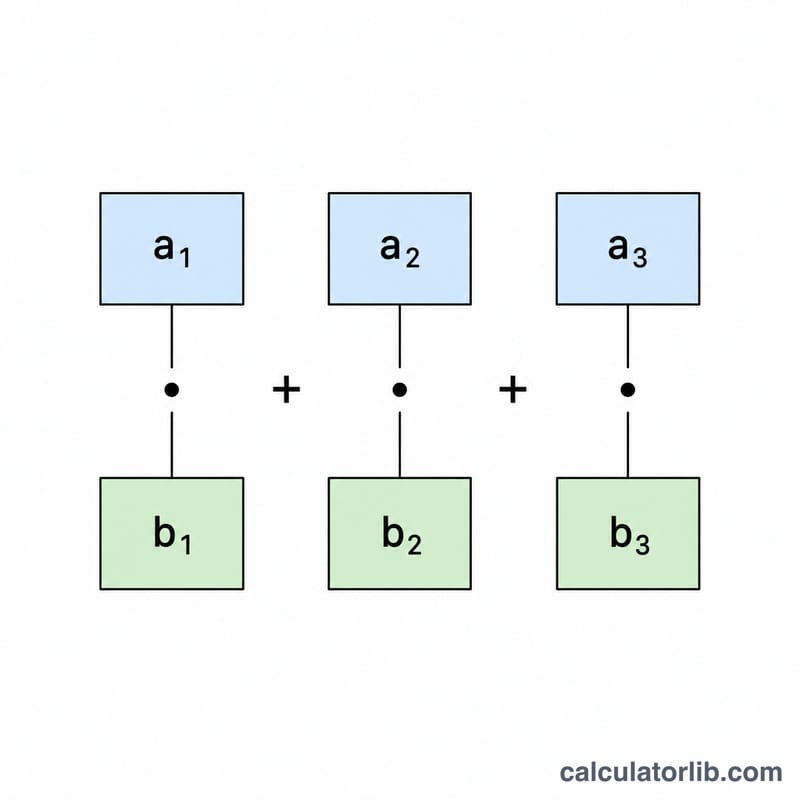
For vectors a and b of dimension \(n\), the dot product is \(\vec{a}\cdot\vec{b} = a_1 b_1 + a_2 b_2 + \ldots + a_n b_n\). This calculator generalizes the idea to two or more vectors: it multiplies the i-th component across every vector, then adds those products together. The general form is
$$\vec{v}_1 \cdot \vec{v}_2 \cdots = \sum_{i=1}^{n} \left( \prod_{j} v_{j,i} \right)$$With exactly two vectors this reduces to the familiar dot product.
Worked Example
Take a = <3, 5, 8> and b = <2, 7, 1>. The dot product is $$(3\times 2) + (5\times 7) + (8\times 1) = 6 + 35 + 8 = 49$$ For three vectors v1 = <1,2,3>, v2 = <4,5,6>, v3 = <1,1,2>, the per-component products are \(4\), \(10\), and \(36\), summing to 50.
FAQ
Can the dot product be negative or zero? Yes. Two perpendicular (orthogonal) vectors have a dot product of zero, and vectors pointing in roughly opposite directions give a negative result.
What if my vectors have different lengths? The dot product is only defined for vectors of equal dimension, so the calculator shows an error if the term counts differ.
Does significant figures change the math? No - it only rounds the final displayed value. The underlying computation always uses full precision.