
What is the cross product?
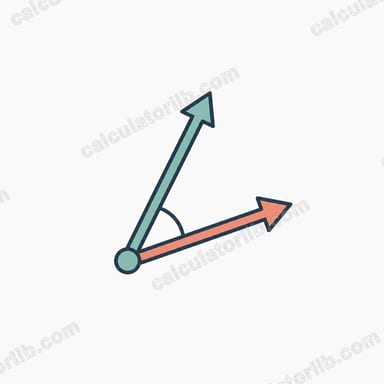
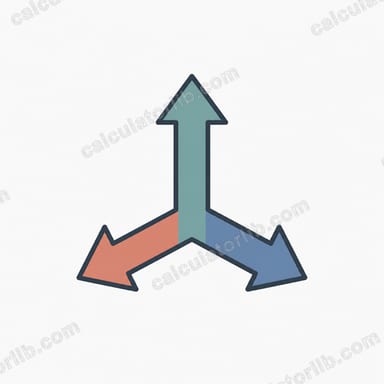
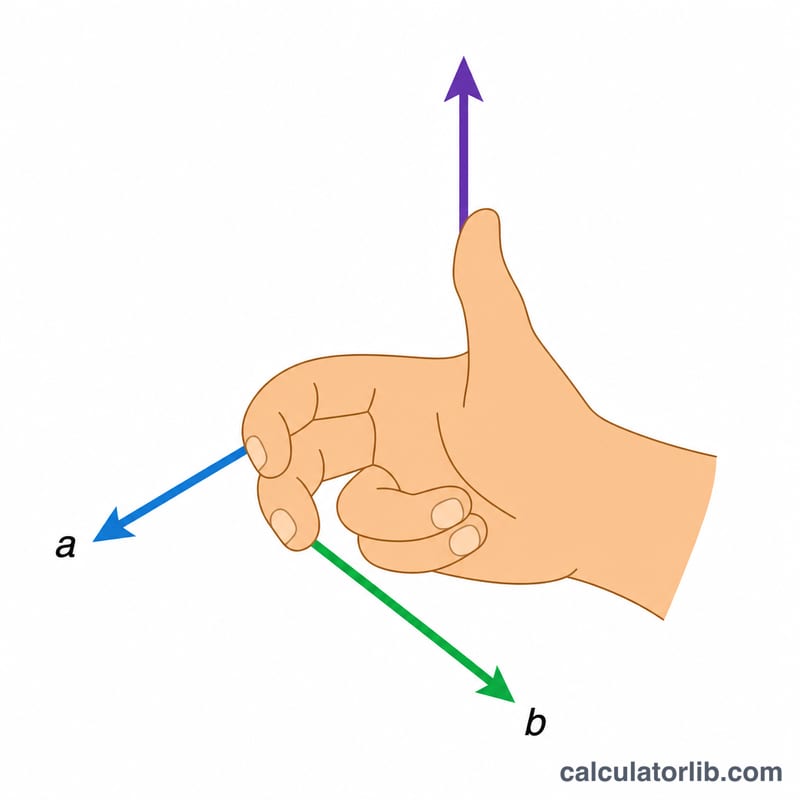
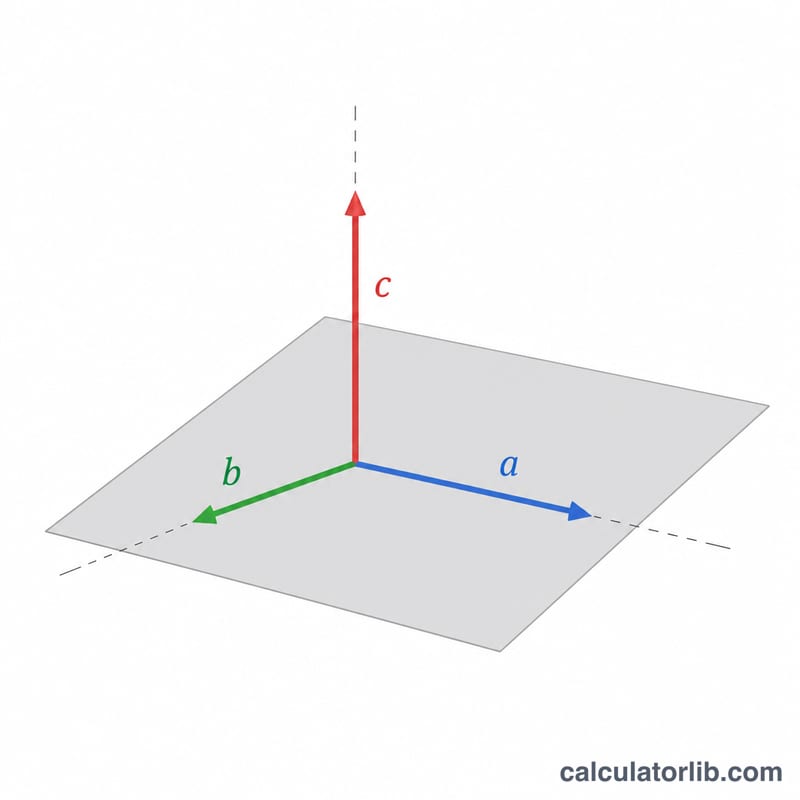
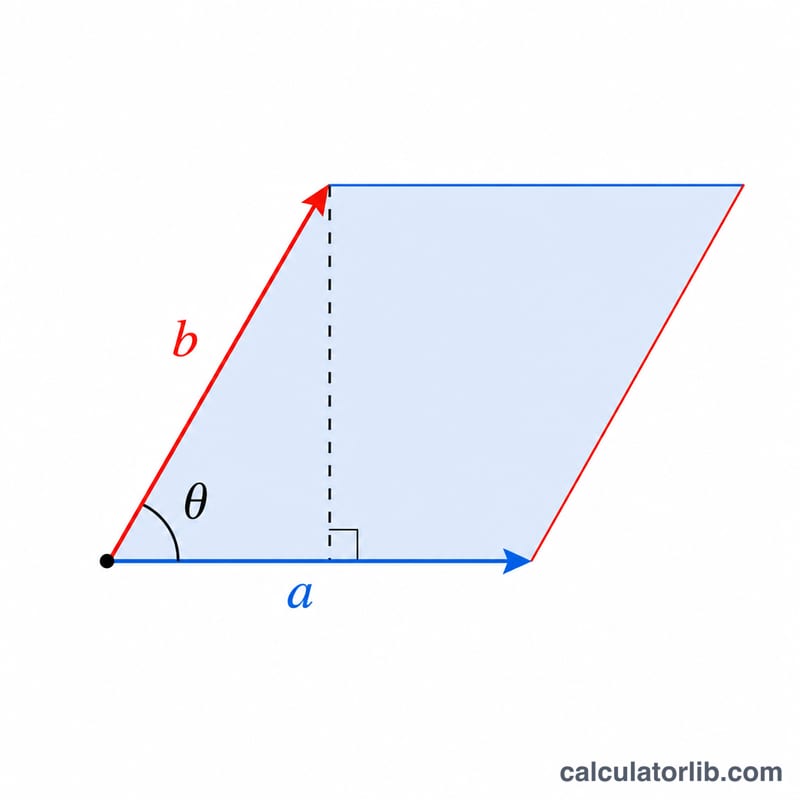
The cross product of two three-dimensional vectors a and b, written a × b, is a new vector that is perpendicular to both inputs. Its direction follows the right-hand rule, and its magnitude equals the area of the parallelogram spanned by the two vectors. This calculator returns the full result vector, its magnitude, and the angle between the inputs.
How to use this calculator
Enter the x, y and z components of vector a (\(a_1\), \(a_2\), \(a_3\)) and vector b (\(b_1\), \(b_2\), \(b_3\)). Press calculate to see the cross product components, the magnitude \(\left|\vec{a}\times\vec{b}\right|\), and the angle \(\theta\) between the two vectors in degrees.
The formula explained
The components are computed as a determinant expansion:
$$\vec{a}\times\vec{b} = \left( a_2\,b_3 - a_3\,b_2,\;\; a_3\,b_1 - a_1\,b_3,\;\; a_1\,b_2 - a_2\,b_1 \right)$$The magnitude is $$\left|\vec{a}\times\vec{b}\right| = \sqrt{c_x^{2} + c_y^{2} + c_z^{2}},$$ which also equals \(\left|\vec{a}\right|\left|\vec{b}\right|\sin\theta\). We recover the angle with $$\theta = \arcsin\!\left( \frac{\left|\vec{a}\times\vec{b}\right|}{\left|\vec{a}\right|\,\left|\vec{b}\right|} \right).$$
Worked example
Let \(\vec{a} = (3, -3, 1)\) and \(\vec{b} = (4, 9, 2)\). Then \(c_x = (-3)(2) - (1)(9) = -15\), \(c_y = (1)(4) - (3)(2) = -2\), \(c_z = (3)(9) - (-3)(4) = 39\). So $$\vec{a}\times\vec{b} = (-15, -2, 39)$$ with magnitude $$\sqrt{225 + 4 + 1521} = \sqrt{1750} \approx 41.83.$$
FAQ
Is the cross product commutative? No. \(\vec{a}\times\vec{b} = -(\vec{b}\times\vec{a})\); swapping the order reverses the direction.
What if the result is the zero vector? Then the two vectors are parallel (or one is zero), and the angle between them is 0° or 180°.
Does this work in 2D? The true cross product is defined in 3D. For 2D vectors, set the z-components to 0 and only \(c_z\) will be non-zero.