
What Is the CPI to Inflation Rate Calculator?
The Consumer Price Index (CPI) measures the average price level of a basket of goods and services over time. By itself a CPI number is just an index value — its real usefulness comes from comparing two points in time. This calculator turns any two CPI readings into the inflation rate, expressed as a percentage change. It works with any CPI series (CPI-U, CPI-W, HICP, etc.) and for any period, whether that's month-over-month, year-over-year, or across decades.
How to Use It
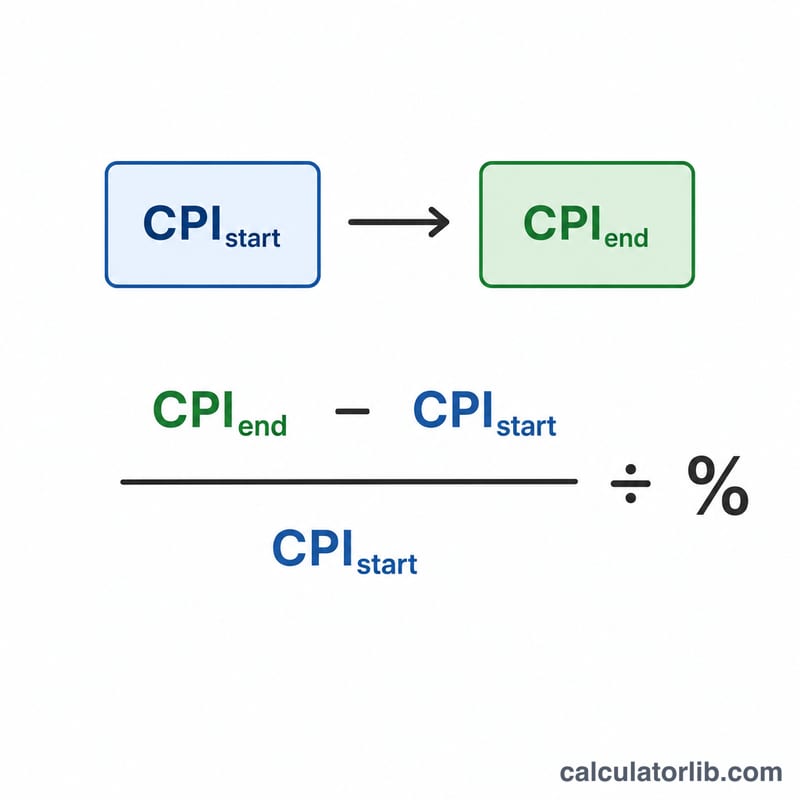
Enter the CPI value at the start of your period and the CPI value at the end. The calculator subtracts the two, divides by the starting value, and multiplies by 100 to give the inflation rate. A positive result means prices rose (inflation); a negative result means prices fell (deflation).
The Formula Explained
The equation is $$\text{Inflation Rate} = \frac{\text{CPI}_{\text{end}} - \text{CPI}_{\text{start}}}{\text{CPI}_{\text{start}}} \times 100$$ The numerator is the absolute change in index points, and dividing by the starting CPI converts that change into a proportion of the original price level. Multiplying by 100 expresses it as a familiar percentage.
Worked Example
Suppose the CPI was 250 at the start of the year and 260 at the end. The change is \(260 - 250 = 10\) points. Dividing by the starting value gives \(10 \div 250 = 0.04\), and multiplying by 100 yields a 4% inflation rate for the year.
$$\text{Inflation Rate} = \frac{260 - 250}{250} \times 100 = 4\%$$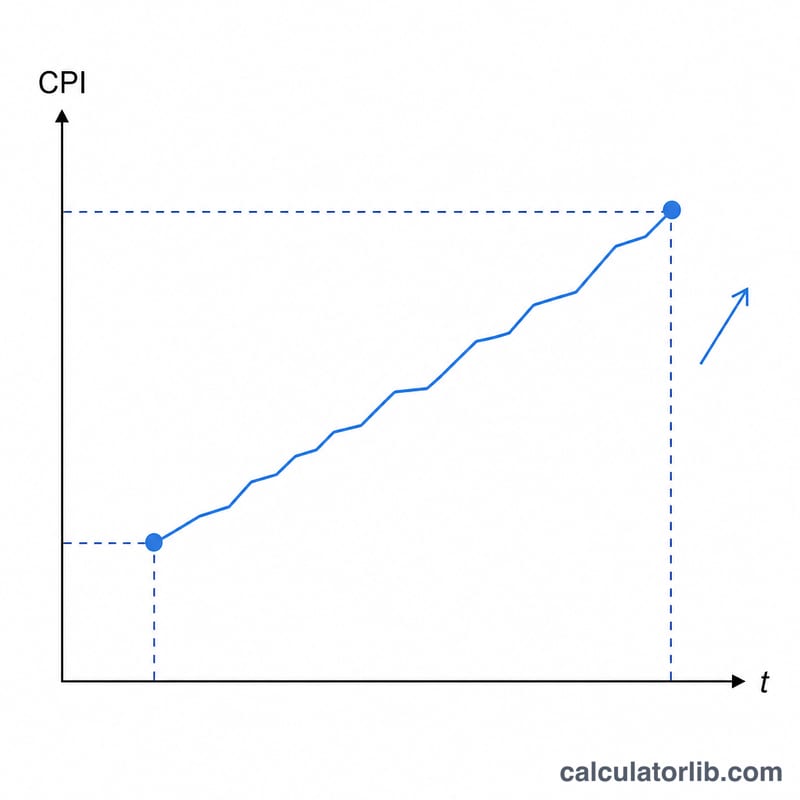
FAQ
What if the rate is negative? A negative inflation rate means the CPI fell over the period, indicating deflation — overall prices dropped.
Which CPI value goes first? Use the earlier date as the starting CPI and the later date as the ending CPI so the rate reflects the change over time correctly.
Can I use this for year-over-year inflation? Yes. Enter the CPI from the same month one year earlier as the starting value and the current month's CPI as the ending value for an annual inflation rate.