What is the Steps to Calories Calculator?
This calculator estimates how many calories you burn from a given number of walking steps. Unlike fixed "calories per 1,000 steps" rules of thumb, it factors in your body weight and stride length — the two variables that matter most. Heavier people and longer strides move more mass over more distance, so they burn more energy per step.
How to use it
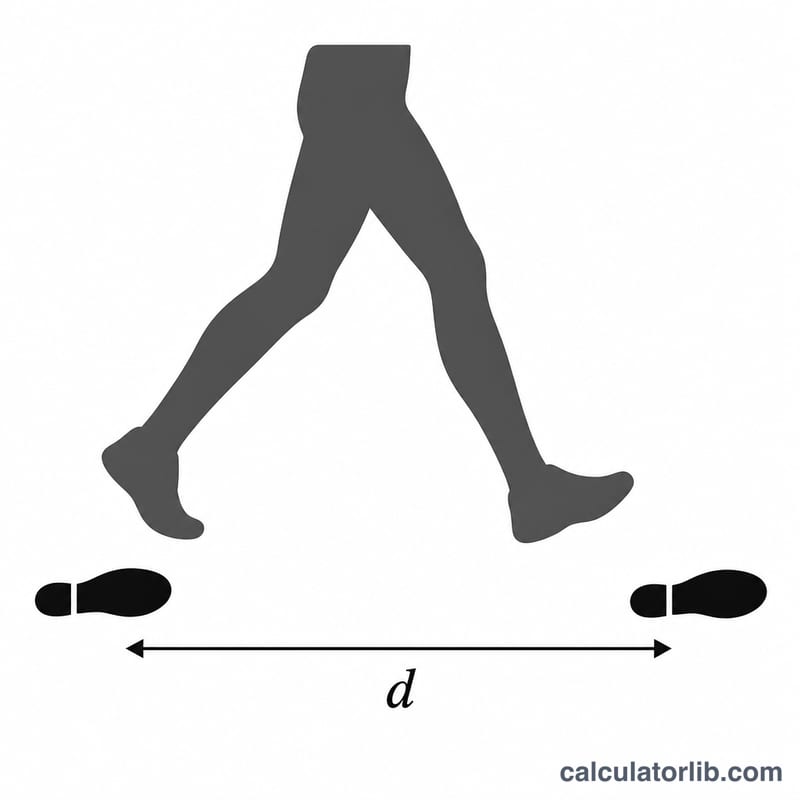
Enter three values: your total steps (for example a daily count from a fitness tracker), your body weight in kilograms, and your average stride length in metres. A typical adult stride is roughly 0.65–0.80 m (about 41–45% of your height). Press calculate to see estimated calories burned and the distance you covered.
The formula explained
The estimate uses \(\text{kcal} \approx \text{steps} \times \text{stride(m)} \times \text{weight(kg)} \times 0.0005\).
$$\text{Calories} = \text{Steps} \times \text{Stride (m)} \times \text{Weight (kg)} \times 0.0005$$The product of steps and stride gives the distance in metres; multiplying by weight scales the energy cost to your body mass, and the 0.0005 constant, the net walking cost above resting (ACSM walking equation: about 0.1 mL of O2 per kg per metre, at roughly 5 kcal per litre of O2), converts that into kilocalories. The result is the net energy of walking, above resting. Distance is reported separately as steps × stride ÷ 1000.
$$\text{Distance (km)} = \frac{\text{Steps} \times \text{Stride (m)}}{1000}$$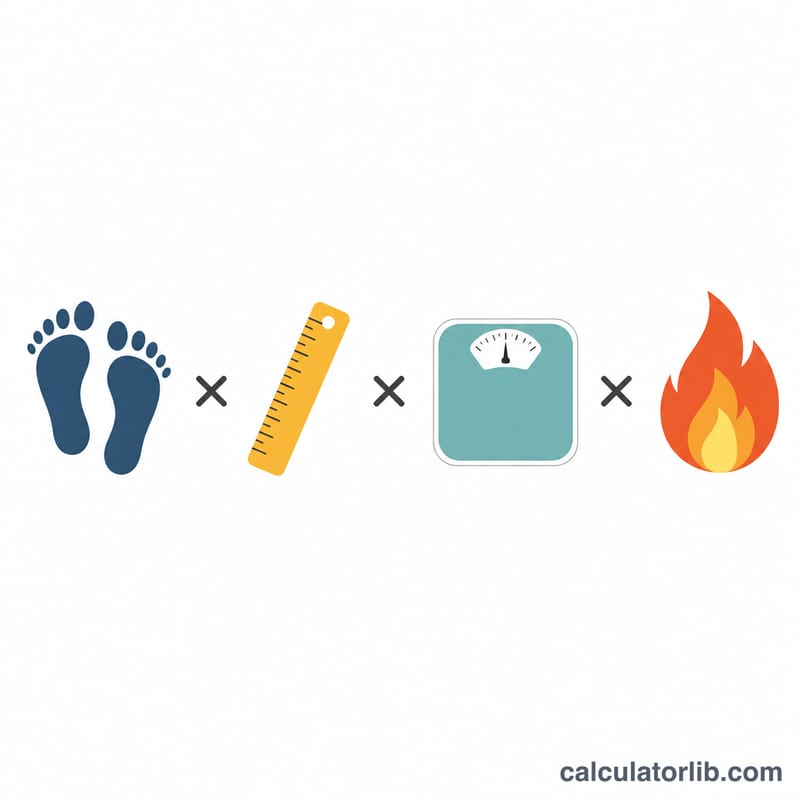
Worked example
Suppose you walk 8,000 steps with a 0.75 m stride at 70 kg.
$$\text{Calories} = 8000 \times 0.75 \times 70 \times 0.0005 = \textbf{210 kcal}$$$$\text{Distance} = \frac{8000 \times 0.75}{1000} = \textbf{6 km}$$Calories Burned Across Common Step Counts
The table below applies the calculator's formula \(\text{kcal} = \text{steps} \times \text{stride (m)} \times \text{weight (kg)} \times 0.0005\) at a fixed stride length of 0.75 m, which is a common average adult walking stride. Each cell is the net energy cost above resting in kilocalories, rounded to the nearest whole number; the distance column is simply \(\text{steps} \times 0.75\ \text{m}\) converted to kilometres.
| Steps | Distance (km) | 55 kg | 70 kg | 85 kg | 100 kg |
|---|---|---|---|---|---|
| 2,000 | 1.50 | 41 | 53 | 64 | 75 |
| 5,000 | 3.75 | 103 | 131 | 159 | 188 |
| 7,500 | 5.63 | 155 | 197 | 239 | 281 |
| 10,000 | 7.50 | 206 | 263 | 319 | 375 |
| 15,000 | 11.25 | 309 | 394 | 478 | 563 |
Two patterns are worth reading off the table. First, the output scales linearly in both directions: double the steps and the kcal doubles; a 100 kg walker burns roughly 1.8 times what a 55 kg walker burns over the same distance, because heavier bodies cost more energy to move. Second, all figures assume a steady moderate pace on reasonably level ground with a consistent stride. Stop-start walking, a shorter stride, or very slow strolling will push the real value lower, while hills, stairs, a backpack or a brisk pace push it higher.
Step-Count Activity Categories
Daily step totals are often sorted into bands using the widely cited pedometer-based index proposed by Tudor-Locke and Bassett for healthy adults. The distance column converts each band at a 0.75 m stride, so you can see roughly how far each category corresponds to on foot.
| Category | Steps per day | Approximate distance per day |
|---|---|---|
| Sedentary | Under 5,000 | Under 3.75 km |
| Low active | 5,000 – 7,499 | 3.75 – 5.62 km |
| Somewhat active | 7,500 – 9,999 | 5.63 – 7.50 km |
| Active | 10,000 – 12,499 | 7.50 – 9.37 km |
| Highly active | 12,500 or more | 9.38 km or more |
These bands are population descriptors for adults — a vocabulary for describing how much ambulatory activity a group or a person accumulates — and not personal targets. They were not derived as a prescription, they do not account for age, health status, body composition, occupation or non-walking exercise, and they say nothing about cycling, swimming or strength work, which can make a low step count perfectly consistent with high overall activity. Children, older adults and people with mobility limitations fall outside the ranges the index was described for. Treat the categories as a reference scale for your own trend over weeks, not as a pass/fail line to clear each day.
FAQ
How accurate is this? It is an estimate. Actual burn depends on pace, terrain, fitness and metabolism, so treat the number as a guide rather than a precise measurement.
What if I don't know my stride length? Use about \(0.42 \times\) your height in metres, or simply use 0.75 m as a reasonable default for an adult.
Does walking faster burn more? Yes — brisk walking increases the cost per step, but this simplified model assumes a steady moderate pace.