
What This Calculator Does
The Daily Water Intake by Body Weight Calculator estimates how much water you should drink each day based on your weight and how active you are. Hydration needs scale with body mass, so a heavier or more active body generally needs more fluid. This tool works with both pounds and kilograms and returns the result in fluid ounces, milliliters, liters, and 8-ounce cups.
How to Use It
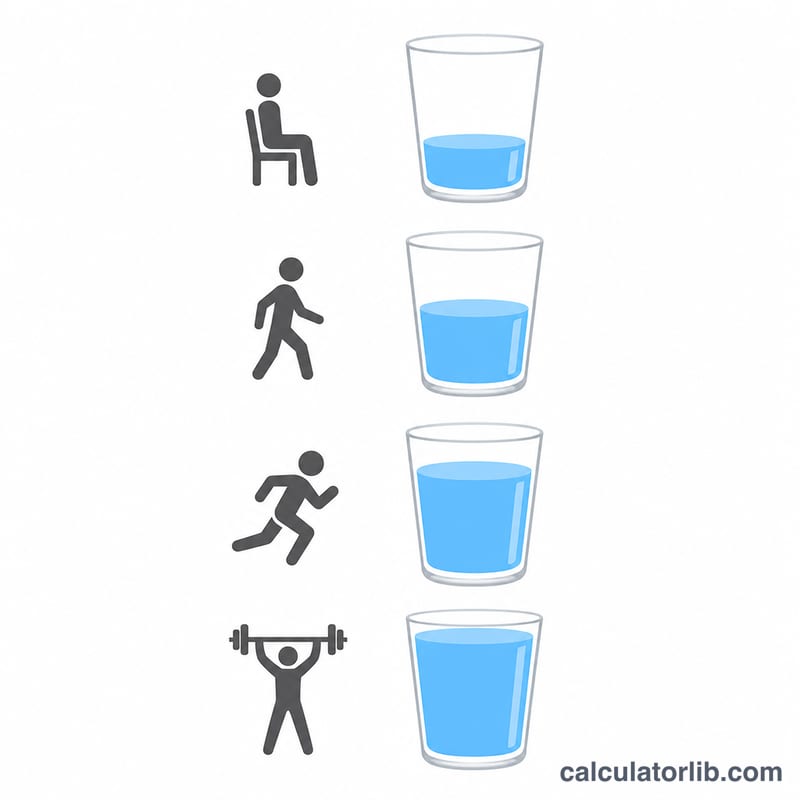
Choose your unit system, enter your body weight, and pick an activity level. Select "Sedentary / light" for a typical day or "Active / exercises often" if you train regularly or sweat a lot. The calculator instantly shows your target daily water intake in several handy units.
The Formula Explained
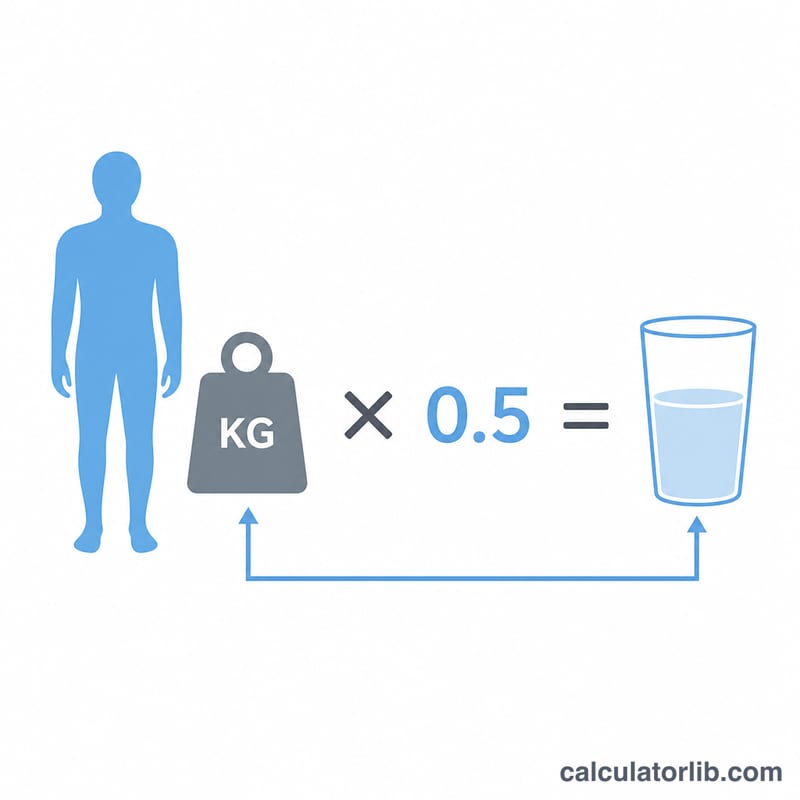
Two common rules of thumb power this calculator. With pounds, a widely used guideline is to drink half your body weight in ounces (and up to two-thirds if you are active): $$\text{ounces} = \text{pounds} \times 0.5$$. With kilograms, nutrition guidelines suggest roughly 30–35 ml per kilogram of body weight: $$\text{ml} = \text{kg} \times 30$$ (or \(\times 35\) when active). Ounces are converted to milliliters using \(1\ \text{fl oz} = 29.5735\ \text{ml}\), and cups assume 8 oz each.
Worked Example
Suppose you weigh 150 lb and live a sedentary lifestyle. Using the pounds rule: $$150 \times 0.5 = 75 \text{ fluid ounces per day.}$$ That converts to about 2,218 ml (≈ 2.2 liters) or roughly 9.4 eight-ounce cups. If you were active, the calculation would use \(\tfrac{2}{3}\), giving 100 oz per day.
FAQ
Is this a strict medical recommendation? No. It is a practical estimate. Climate, illness, pregnancy, and individual health can change your needs—consult a doctor for precise guidance.
Do food and other drinks count? Water-rich foods and beverages do contribute to total fluid intake, so you may not need to drink the entire amount as plain water.
Why does activity matter? Exercise increases water loss through sweat and breathing, so active people are advised to drink toward the higher end of the range.