
What this calculator does
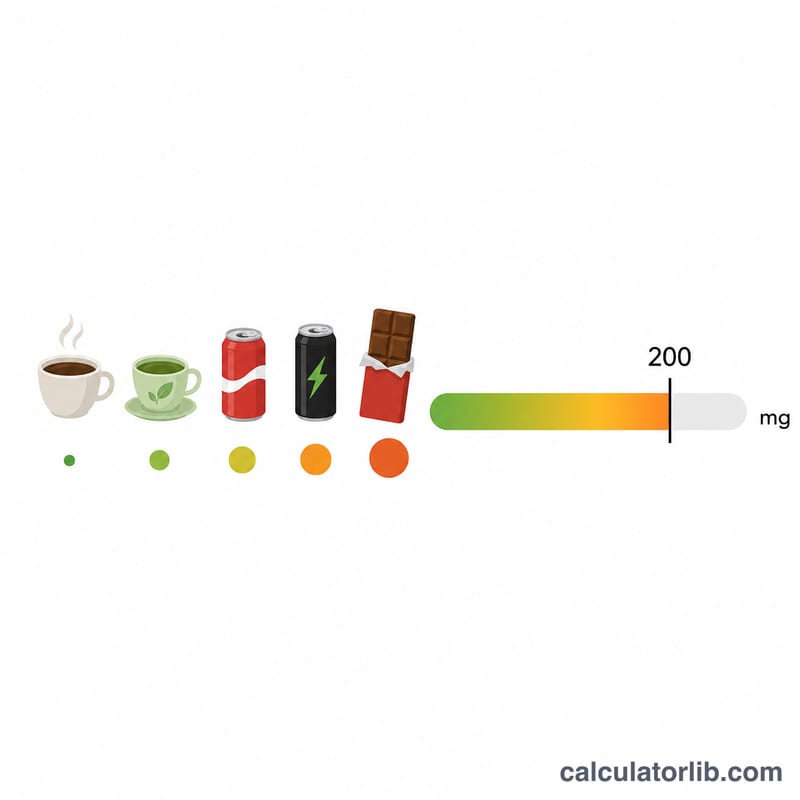
Major health bodies (including ACOG in the US and the NHS in the UK) advise that pregnant women keep caffeine intake under about 200 mg per day. This calculator adds up the caffeine in the drinks and chocolate you list and shows how much of that 200 mg allowance remains. It is an educational estimate — always follow your own healthcare provider's advice.
How to use it
Enter how many servings you've had of each item. The tool uses typical caffeine values: brewed coffee ~95 mg per 8 oz cup, espresso ~63 mg per shot, black tea ~47 mg per cup, cola/soda ~34 mg per can, energy drinks ~80 mg per 8 oz, and dark chocolate ~24 mg per ounce. Actual caffeine varies by brand and brew strength, so treat the result as a guide.
The formula
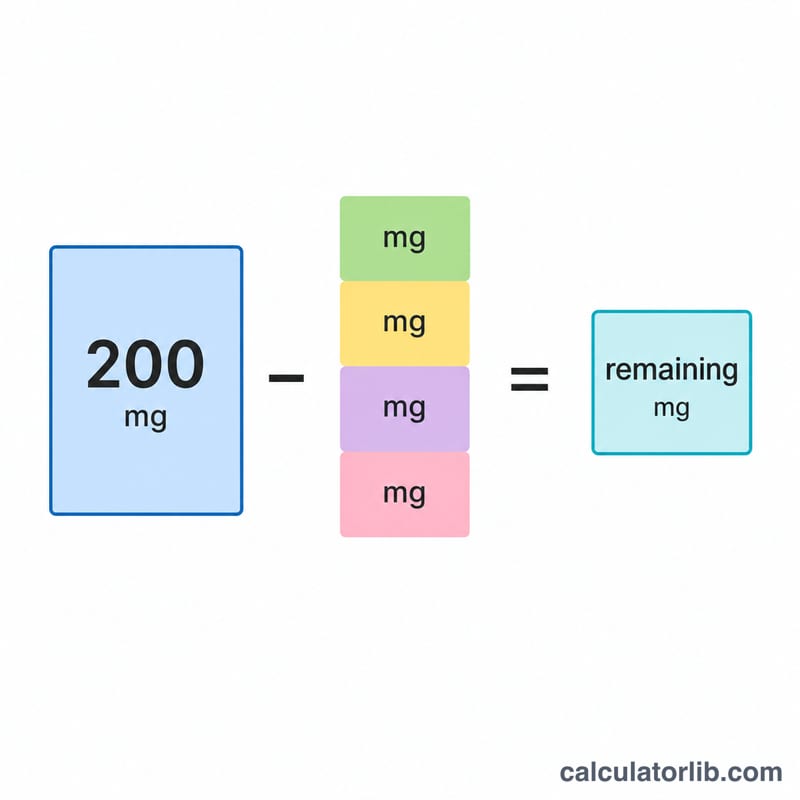
Total caffeine is the sum of each item's servings multiplied by its caffeine content. The remaining allowance is simply 200 mg minus that total. If the total exceeds 200 mg, the remaining value is negative and the status flag is set to "over the limit."
$$\text{Total} = 95\,\text{Coffee} + 63\,\text{Espresso} + 47\,\text{Tea} + 34\,\text{Soda} + 80\,\text{Energy} + 24\,\text{Chocolate}$$
$$\begin{aligned} \text{Remaining} &= 200 - \text{Total} \\ \text{Percent} &= \frac{\text{Total}}{200} \times 100\% \end{aligned}$$
Worked example
Suppose you have 1 cup of coffee (95 mg) and 1 can of soda (34 mg). Total = \(95 + 34 = 129\) mg. Remaining = \(200 - 129 = 71\) mg, which is within the limit. Percent used = \(129 / 200 \times 100 = 64.5\%\).
FAQ
Is 200 mg a safe target? It is the commonly recommended upper limit during pregnancy, not a goal to reach. Less is generally considered better.
Does decaf count? Decaf still contains a small amount of caffeine (often 2–5 mg per cup); this tool does not list it separately, so add it manually if you wish.
What about chocolate and medications? Chocolate is included here, but some pain relievers and supplements also contain caffeine — check labels and talk to your doctor.