
What is the BPM to Milliseconds Calculator?
This tool converts a musical tempo expressed in beats per minute (BPM) into the duration of a single beat in milliseconds (ms). It is widely used by music producers, audio engineers and synth players to set delay times, reverb pre-delay, LFO rates, and arpeggiator timing so they sync perfectly to the track tempo. Because timing is universal, this calculator works for any genre, DAW or hardware.
How to use it
Enter your song's tempo in BPM and press calculate. The hero number is the quarter-note duration — the length of one beat. The table below breaks the beat down into whole, half, dotted, triplet, eighth and sixteenth note durations so you can dial in delays and modulation precisely.
The formula explained
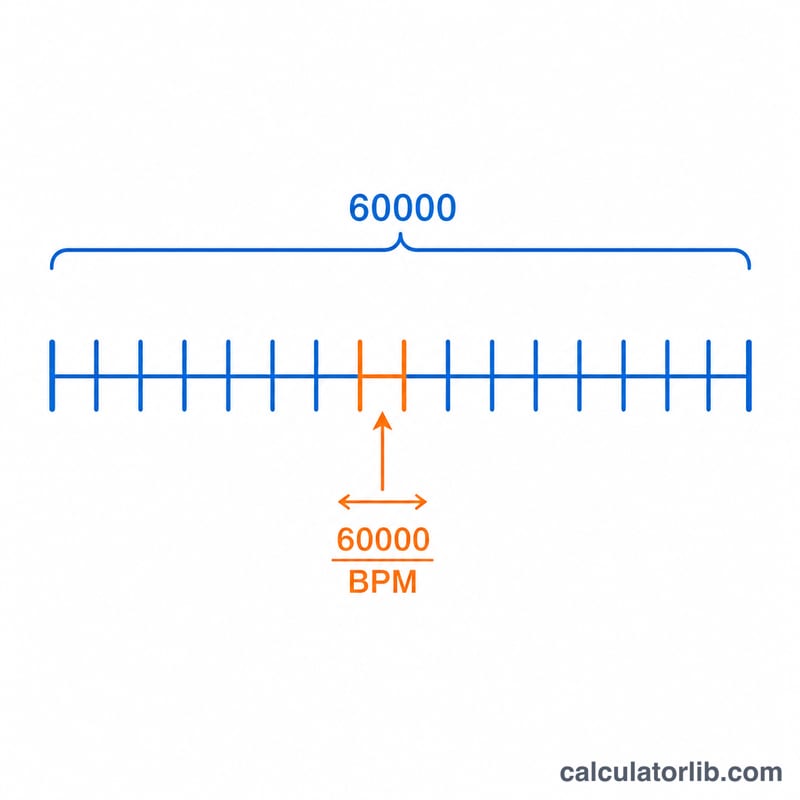
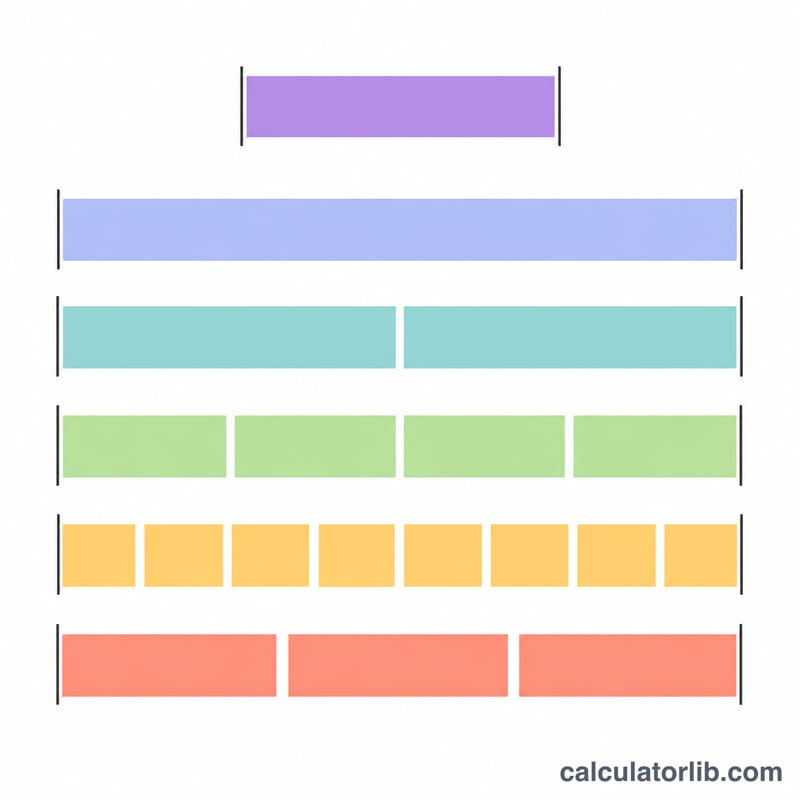
One minute contains 60,000 milliseconds. A quarter note (one beat in common 4/4 time) therefore lasts $$t_{\text{quarter}} = \frac{60000}{\text{Tempo (BPM)}}\ \text{ms}$$ milliseconds. Longer notes multiply this value (a half note is \(\times 2\), a whole note is \(\times 4\)) while shorter notes divide it (an eighth is \(\div 2\), a sixteenth \(\div 4\)). A dotted note adds half its value (\(\times 1.5\)) and a triplet divides the beat into three (\(\div 3\)).
Worked example
At 120 BPM: quarter note = $$60000 \div 120 = 500\ \text{ms}$$ . From there, a half note = 1000 ms, a whole note = 2000 ms, an eighth note = 250 ms, a sixteenth = 125 ms, a dotted quarter = 750 ms, and a quarter triplet \(\approx 166.67\) ms. Set your delay to 250 ms for a tight eighth-note echo.
Beat Duration by Tempo (ms)
The quarter-note duration (the standard "beat" in 4/4 time) is found from the tempo with \(t_{\text{quarter}} = \frac{60000}{\text{BPM}}\ \text{ms}\). Every other note value is a simple multiple of that beat: an eighth is half, a sixteenth is a quarter, a dotted-eighth is three-quarters, and an eighth-note triplet is one-third of the beat. Values below are rounded to two decimals.
| BPM | Quarter (ms) | Eighth (ms) | Sixteenth (ms) | Dotted-8th (ms) | 8th Triplet (ms) |
|---|---|---|---|---|---|
| 60 | 1000.00 | 500.00 | 250.00 | 750.00 | 333.33 |
| 70 | 857.14 | 428.57 | 214.29 | 642.86 | 285.71 |
| 80 | 750.00 | 375.00 | 187.50 | 562.50 | 250.00 |
| 90 | 666.67 | 333.33 | 166.67 | 500.00 | 222.22 |
| 100 | 600.00 | 300.00 | 150.00 | 450.00 | 200.00 |
| 110 | 545.45 | 272.73 | 136.36 | 409.09 | 181.82 |
| 120 | 500.00 | 250.00 | 125.00 | 375.00 | 166.67 |
| 128 | 468.75 | 234.38 | 117.19 | 351.56 | 156.25 |
| 140 | 428.57 | 214.29 | 107.14 | 321.43 | 142.86 |
| 160 | 375.00 | 187.50 | 93.75 | 281.25 | 125.00 |
| 174 | 344.83 | 172.41 | 86.21 | 258.62 | 114.94 |
Tip: the quarter-note beat also corresponds to a beat frequency of \(f = \text{BPM}/60\) Hz — for example 120 BPM is 2 Hz.
Note Value Multipliers
To find any note duration, take the quarter-note beat \(t_{\text{quarter}} = 60000/\text{BPM}\) and multiply by the factor below. A dot adds half the note's value (×1.5), and a triplet divides the equivalent straight value into three equal parts (×2/3 of the next-shorter pair, i.e. divide the base by 3 for a triplet of the same family).
| Note Value | Multiplier (× quarter beat) | Formula |
|---|---|---|
| Whole note | ×4 | \(240000/\text{BPM}\) |
| Dotted half | ×3 | \(180000/\text{BPM}\) |
| Half note | ×2 | \(120000/\text{BPM}\) |
| Dotted quarter | ×1.5 | \(90000/\text{BPM}\) |
| Quarter note | ×1 | \(60000/\text{BPM}\) |
| Quarter triplet | ×2/3 | \(40000/\text{BPM}\) |
| Dotted eighth | ×0.75 | \(45000/\text{BPM}\) |
| Eighth note | ×1/2 | \(30000/\text{BPM}\) |
| Eighth triplet | ×1/3 | \(20000/\text{BPM}\) |
| Dotted sixteenth | ×0.375 | \(22500/\text{BPM}\) |
| Sixteenth note | ×1/4 | \(15000/\text{BPM}\) |
| Sixteenth triplet | ×1/6 | \(10000/\text{BPM}\) |
| Thirty-second note | ×1/8 | \(7500/\text{BPM}\) |
Key Terms Explained
- BPM (beats per minute)
- The tempo of a piece of music, equal to the number of beats occurring in 60 seconds. Higher BPM means a faster tempo and shorter beat durations.
- Beat
- The basic rhythmic pulse of music. In common 4/4 time the beat is usually the quarter note, so "one beat" and "one quarter note" are equivalent.
- Quarter note
- A note lasting one beat in 4/4 time. Its duration in milliseconds is \(60000/\text{BPM}\) — the reference value all other note durations are derived from.
- Dotted note
- A note followed by a dot, which extends its duration by half. A dotted note lasts 1.5× the plain note (e.g. a dotted eighth = an eighth plus a sixteenth).
- Triplet
- Three notes played in the time normally occupied by two of the same value, so each triplet note is one-third of its parent beat rather than one-half.
- LFO rate
- The speed of a Low-Frequency Oscillator used to modulate sound. Setting an LFO period to a note duration (in ms) — or its frequency \(f = 1000/t_{ms}\) — syncs the modulation to the song tempo.
- Delay time
- The time between the original signal and its echo in a delay effect. Matching it to a note value (e.g. a dotted-eighth delay) keeps echoes rhythmically in time with the track.
- Reverb pre-delay
- The short gap between the dry sound and the onset of its reverb tail. Tuning pre-delay to a small note value (such as a sixteenth or thirty-second) can add clarity while staying tempo-locked.
- Millisecond (ms)
- One thousandth of a second. Audio delay, note durations and modulation timing are commonly expressed in milliseconds because of the fine precision required.
FAQ
What delay time should I use for a "ping-pong" feel? Try a dotted eighth: \(\text{quarter} \div 2 \times 1.5\). At 120 BPM that is 375 ms.
Does the time signature matter? The calculator assumes the beat equals a quarter note (4/4, 3/4, etc.). In 6/8 where the beat is a dotted quarter, use the dotted-quarter row.
Can I enter decimal BPM? Yes — tempos like 128.5 BPM are supported for fine syncing.