
What is a BPM Calculator?
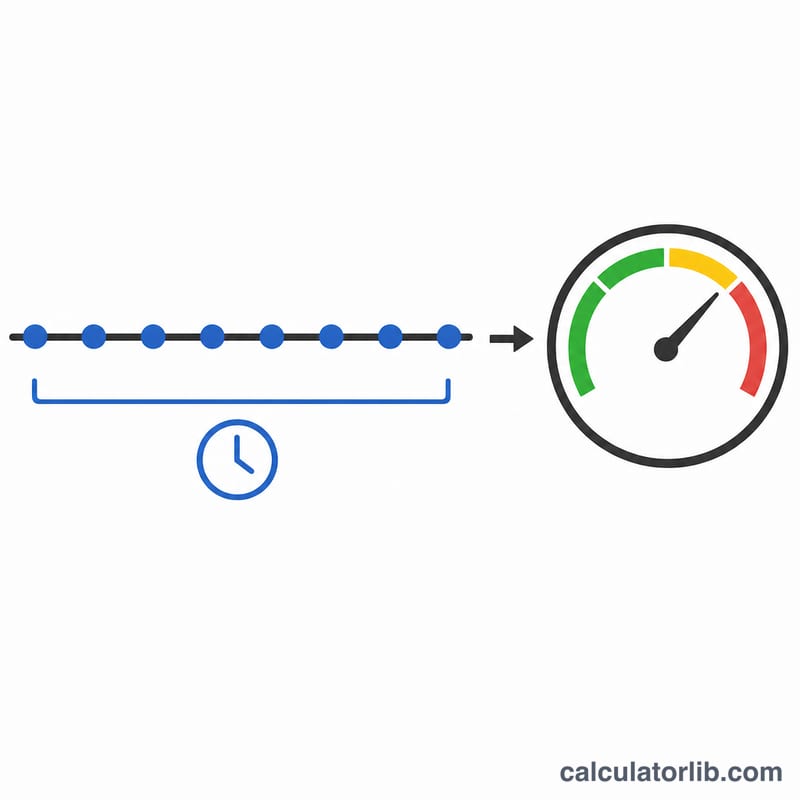
BPM stands for beats per minute, a universal measure of rhythm and rate. This calculator converts a number of beats you count over any time window into a standardized per-minute figure. It is handy for musicians estimating a song's tempo by tapping along, for finding your pulse (heart rate) by counting beats over 15 or 30 seconds, or for any situation where you measure something rhythmic and want a per-minute rate.
How to Use It
Count how many beats occur during a fixed amount of time and enter both numbers. For a heart rate, count your pulse for 15 seconds. For a song's tempo, tap along for several seconds and count your taps. The calculator divides beats by seconds and multiplies by 60 to give the equivalent rate over a full minute. Using a longer window (15–30 seconds) gives a more accurate result than a very short one.
The Formula Explained
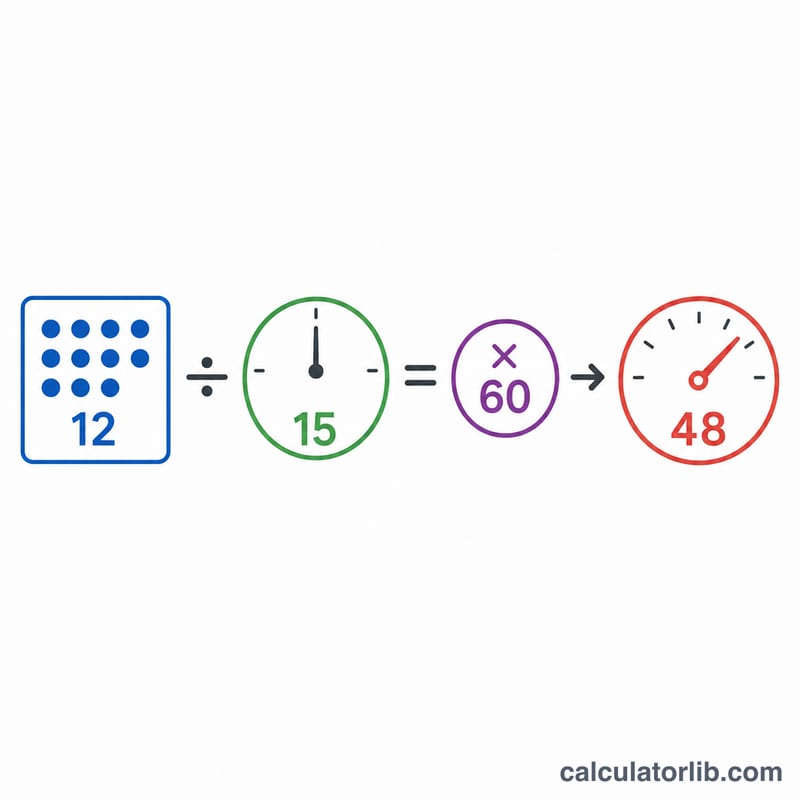
The equation is simply BPM = (beats ÷ seconds) × 60. Dividing beats by seconds gives the beats-per-second rate; multiplying by 60 converts that into beats per minute, because there are 60 seconds in a minute.
Worked Example
Suppose you count 30 beats in 15 seconds. The beats-per-second rate is 30 ÷ 15 = 2. Multiply by 60 to get 2 × 60 = 120 BPM. That matches a moderate dance-music tempo or a calm-to-active heart rate.
Common BPM Reference Values
Beats per minute (BPM) describes how many beats occur in one minute. The two most common contexts are musical tempo and pulse rate. The tables below list widely used reference ranges.
Musical Tempo Markings
| Italian Term | Character | Approx. BPM |
|---|---|---|
| Largo | Very slow, broad | 40–60 |
| Adagio | Slow, stately | 66–76 |
| Andante | Walking pace | 76–108 |
| Moderato | Moderate | 108–120 |
| Allegro | Fast, lively | 120–168 |
| Presto | Very fast | 168–200 |
Resting Heart Rate Categories (Adults)
| Category | Resting BPM |
|---|---|
| Well-trained athlete | 40–60 |
| Typical adult | 60–100 |
| Elevated | 100+ |
These ranges overlap because slow tempos and athletic resting pulses occupy the same numeric region; context determines which interpretation applies.
BPM Across Different Count Scenarios
Using the formula \(\text{BPM} = \dfrac{\text{Beats}}{\text{Time (s)}} \times 60\), the same count produces different tempos depending on the interval. A common technique is to count beats over 15 seconds and multiply by 4 (equivalent to \(\times 60 \div 15\)).
| Beats | Time (s) | Computed BPM |
|---|---|---|
| 15 | 15 | 60 |
| 20 | 15 | 80 |
| 25 | 15 | 100 |
| 30 | 15 | 120 |
| 40 | 15 | 160 |
| 60 | 60 | 60 |
| 30 | 30 | 60 |
Notice that 60 beats in 60 seconds, 30 beats in 30 seconds, and 15 beats in 15 seconds all yield the same 60 BPM — the ratio of beats to seconds is what matters, not the raw counts.
Interpreting Your BPM Result
Once you have a BPM value, what it means depends on what you were counting.
As a Music Tempo
Compare your result to the tempo table above. For example, a result of 100 BPM falls within the Andante range (walking pace), while 160 BPM sits in Allegro (fast and lively). Digital metronomes and DAWs express tempo in this same unit, so a tapped value can be entered directly as a project tempo.
As a Resting Pulse
The American Heart Association states that a normal resting heart rate for adults ranges from 60 to 100 BPM. Values below 60 BPM (bradycardia) are common and often normal in physically active people and athletes, whose efficient hearts pump more blood per beat. Values consistently above 100 BPM at rest (tachycardia) fall outside the typical resting range.
A tapped count of, for example, 25 beats over 15 seconds gives 100 BPM, the upper edge of the AHA normal resting band. Heart rate naturally rises with activity, caffeine, stress, temperature, and many other factors, so a single reading is only a snapshot.
This is general information, not medical advice. For concerns about your heart rate or any health condition, consult a qualified healthcare professional.
FAQ
How long should I count? 15 seconds is a common compromise between speed and accuracy. For more precise heart rates, count a full 30 or 60 seconds.
Can I use it for music tempo? Yes. Tap your foot or finger to the beat, count the taps over a few seconds, and the calculator returns the song's BPM.
Why multiply by 60? Because BPM is a per-minute measure, and one minute contains 60 seconds. Scaling your shorter measurement up to 60 seconds standardizes the result.