
What Is the Milliseconds to Seconds Calculator?
This tool converts a duration expressed in milliseconds (ms) into seconds (s). A millisecond is one thousandth of a second, so 1,000 milliseconds equals exactly 1 second. This conversion is common in programming, performance benchmarking, web analytics, audio/video timing, and physics, where timers and timestamps are frequently recorded in milliseconds.
How to Use It
Enter the time value in milliseconds in the input field and the calculator instantly returns the equivalent number of seconds. You can enter whole numbers or decimals — for example, 2,500 ms or 750.5 ms — and the result updates accordingly.
The Formula Explained
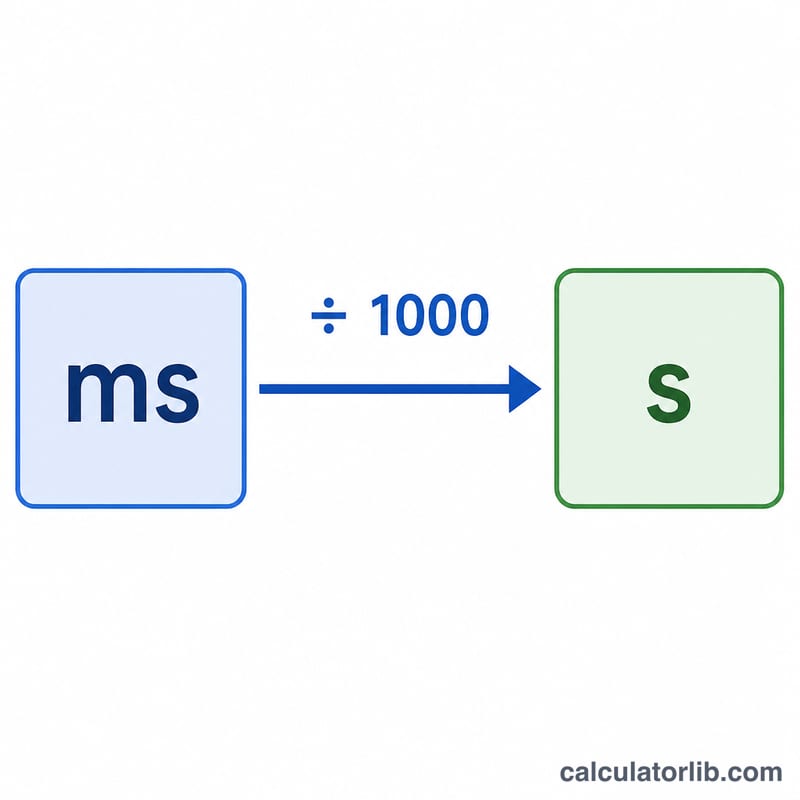
The conversion relies on a single fixed relationship between the two units:
$$\text{Seconds (s)} = \frac{\text{Milliseconds (ms)}}{1000}$$
Because there are exactly 1,000 milliseconds in one second, dividing by 1,000 scales the value down to seconds. To go the other direction, multiply seconds by 1,000.
Worked Example
Suppose a web page took 3,500 milliseconds to load. Dividing by 1,000 gives $$3500 \div 1000 = 3.5 \text{ seconds}.$$ Likewise, \(250 \text{ ms} = 250 \div 1000 = 0.25\) seconds, and \(60{,}000 \text{ ms} = 60\) seconds (one minute).
FAQ
How many milliseconds are in a second? Exactly 1,000 milliseconds make up one second.
How do I convert seconds back to milliseconds? Multiply the number of seconds by 1,000. For example, \(4 \text{ seconds} = 4{,}000 \text{ ms}\).
Can I enter decimal milliseconds? Yes. The calculator accepts decimal values such as 1,234.56 ms and returns the precise number of seconds.