
What is the Days to Months Calculator?
This tool converts a span of days into the equivalent number of months. Because months vary in length (28–31 days), it uses the average month length of 30.4375 days, derived from the average year of 365.25 days divided by 12. This gives a consistent, accurate conversion that accounts for leap years over the long run.
How to use it
Enter the number of days you want to convert and the calculator instantly returns the equivalent in months. It works for any value — whether you are estimating a project timeline, a billing period, a baby's age, or a loan term.
The formula explained
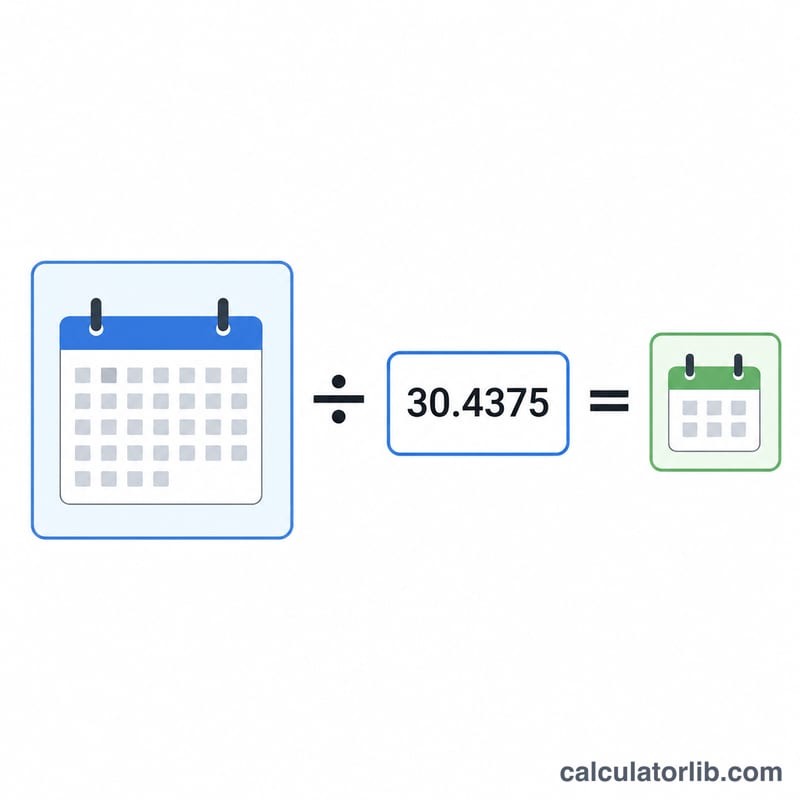
The conversion divides days by the average days per month:
$$\text{months} = \frac{\text{days}}{30.4375}$$
The figure 30.4375 comes from \(365.25 \div 12\). Using 365.25 (instead of 365) builds in the extra quarter-day per year that leap years correct, so conversions stay accurate across multi-year periods.
Worked example
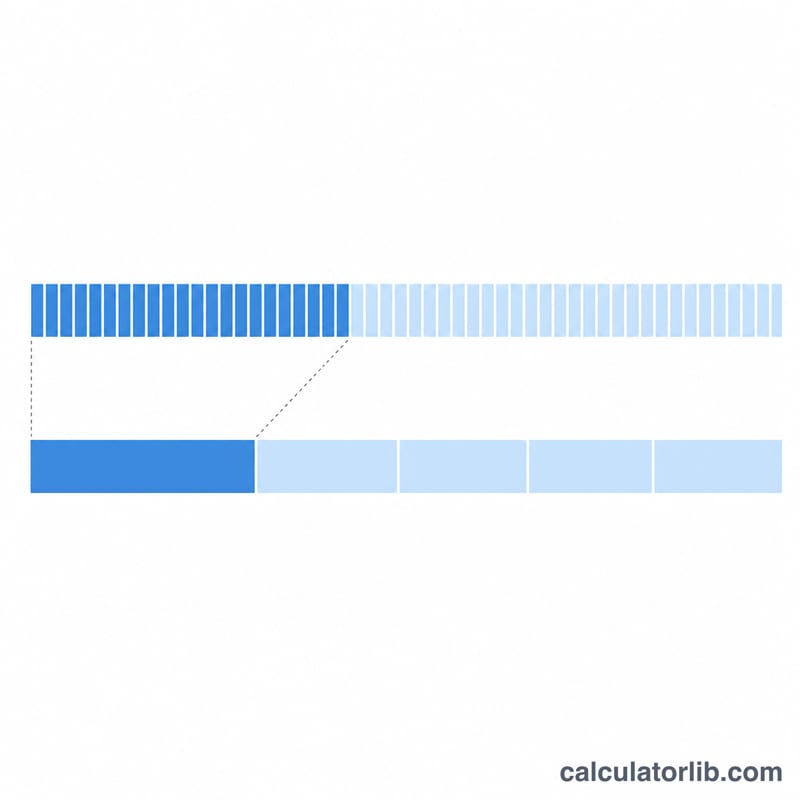
Suppose you have 90 days. Divide by the average month length:
$$90 \div 30.4375 \approx 2.96 \text{ months}$$
So 90 days is just under 3 months — which matches intuition, since three average months total about 91.3 days.
FAQ
Why use 30.4375 instead of 30? Using 30 ignores the fact that the year averages 365.25 days. 30.4375 spreads the year evenly across 12 months and stays accurate for long spans.
Can I convert months back to days? Yes — just multiply the months by 30.4375 to get the approximate number of days.
Is this exact for a specific calendar range? No. For exact calendar differences (e.g., a particular date to date), the actual month lengths matter. This calculator uses the average for a quick, reliable estimate.