What is the Days to Weeks Calculator?
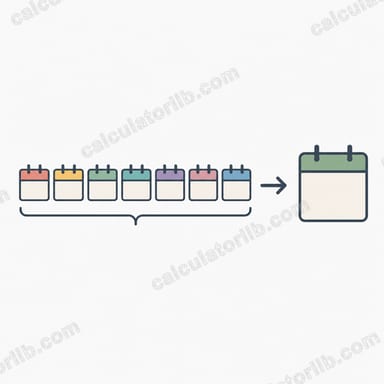
The Days to Weeks Calculator converts any number of days into weeks. Since one week equals exactly seven days, the conversion is a simple division: \(\text{weeks} = \text{days} \div 7\). This tool is handy for project planning, pregnancy tracking, rental periods, course schedules, and any situation where you need to express a span of days in weeks.
How to use it
Enter the number of days you want to convert and the calculator instantly shows the result. You get three values: the exact number of weeks (which may include a decimal), the number of whole completed weeks, and the leftover days that do not make up a full week.
The formula explained
The core formula is $$\text{weeks} = \frac{\text{days}}{7}$$. To split this into whole weeks and remaining days, take the integer part of the division for whole weeks, then subtract \(\text{whole weeks} \times 7\) from the original days to find the remainder. For example, 7 days is exactly 1 week, while 10 days is about 1.43 weeks — that is 1 whole week plus 3 remaining days.

Worked example
Suppose you have 30 days. Dividing by 7 gives $$30 \div 7 \approx 4.29 \text{ weeks}$$ The whole-week part is 4, and the remainder is \(30 - (4 \times 7) = 30 - 28 = 2\) days. So 30 days equals 4 weeks and 2 days.

Common Days to Weeks Conversions
One week is exactly 7 days, so the exact number of weeks is \(\text{Weeks} = \frac{\text{Days}}{7}\). To split the result into whole weeks and leftover days, take the whole number of 7s that fit into the days, then subtract: \(\text{Remaining days} = \text{Days} - 7 \times \text{Whole weeks}\).
| Days | Exact weeks (2 decimals) | Whole weeks + remaining days |
|---|---|---|
| 7 | 1.00 | 1 w 0 d |
| 14 | 2.00 | 2 w 0 d |
| 21 | 3.00 | 3 w 0 d |
| 28 | 4.00 | 4 w 0 d |
| 30 | 4.29 | 4 w 2 d |
| 60 | 8.57 | 8 w 4 d |
| 90 | 12.86 | 12 w 6 d |
| 100 | 14.29 | 14 w 2 d |
| 180 | 25.71 | 25 w 5 d |
| 365 | 52.14 | 52 w 1 d |
Example: for 30 days, \(30 \div 7 = 4.2857\ldots\), so 4 whole weeks, and \(30 - 7 \times 4 = 2\) days remain.
Real-World Day Spans Expressed in Weeks
| Scenario | Days | Weeks | Whole weeks + days |
|---|---|---|---|
| Return window (14 days) | 14 | 2.00 | 2 w 0 d |
| Notice period (30 days) | 30 | 4.29 | 4 w 2 d |
| Probation period (90 days) | 90 | 12.86 | 12 w 6 d |
| Project (100 days) | 100 | 14.29 | 14 w 2 d |
| Full-term pregnancy (280 days) | 280 | 40 | 40 w 0 d |
| One common year (365 days) | 365 | 52.14 | 52 w 1 d |
Check for the pregnancy row: \(280 \div 7 = 40\) exactly. By common convention, a full-term pregnancy is counted as 40 weeks (280 days) from the first day of the last menstrual period. This is general information, not medical advice. The 365-day year leaves 1 extra day beyond 52 weeks (\(365 - 7 \times 52 = 1\)), which is why calendar dates shift by one weekday from year to year (two in leap years).
Note that legal and contractual periods such as return windows, notice periods and probation vary by country and agreement, and some count calendar days while others count business days. Check the exact terms that apply to you.
FAQ
How many weeks is 365 days? \(365 \div 7 \approx 52.14\) weeks, which is 52 whole weeks and 1 remaining day.
Can I enter a decimal number of days? Yes. The calculator accepts fractional days, so 3.5 days returns 0.5 weeks.
Why is one week 7 days? The seven-day week is a long-standing calendar convention used worldwide, so the conversion factor of 7 is fixed and universal.