
What Is the Liters to Pounds Calculator?
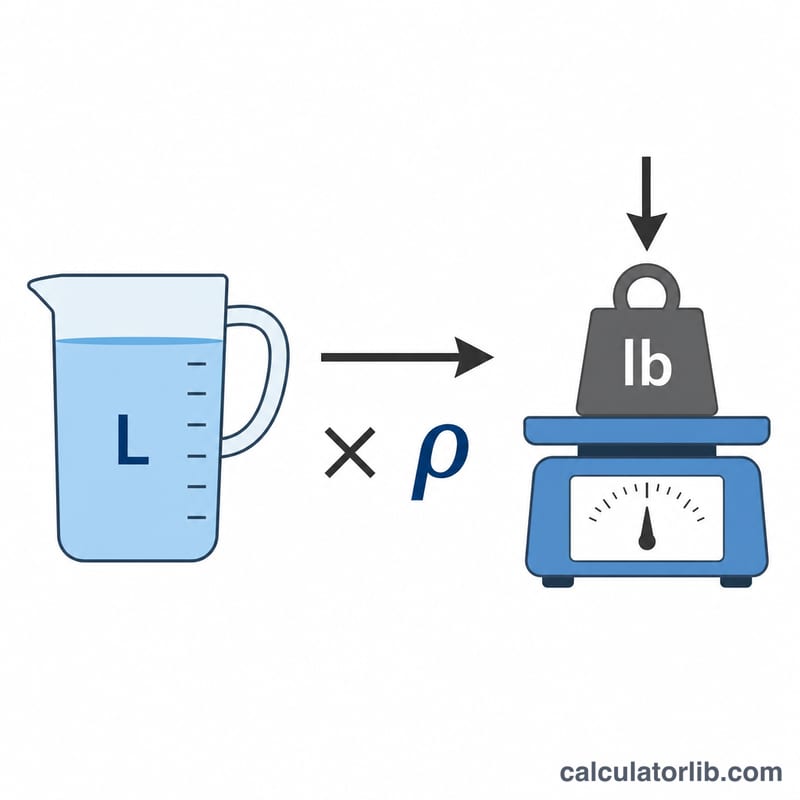
Liters measure volume while pounds measure weight, so you cannot convert between them without knowing the substance's density. This calculator multiplies your volume in liters by the density (in kilograms per liter) to find the mass in kilograms, then converts that mass to pounds. It works for water, milk, oil, fuel, or any liquid as long as you supply the right density.
How to Use It
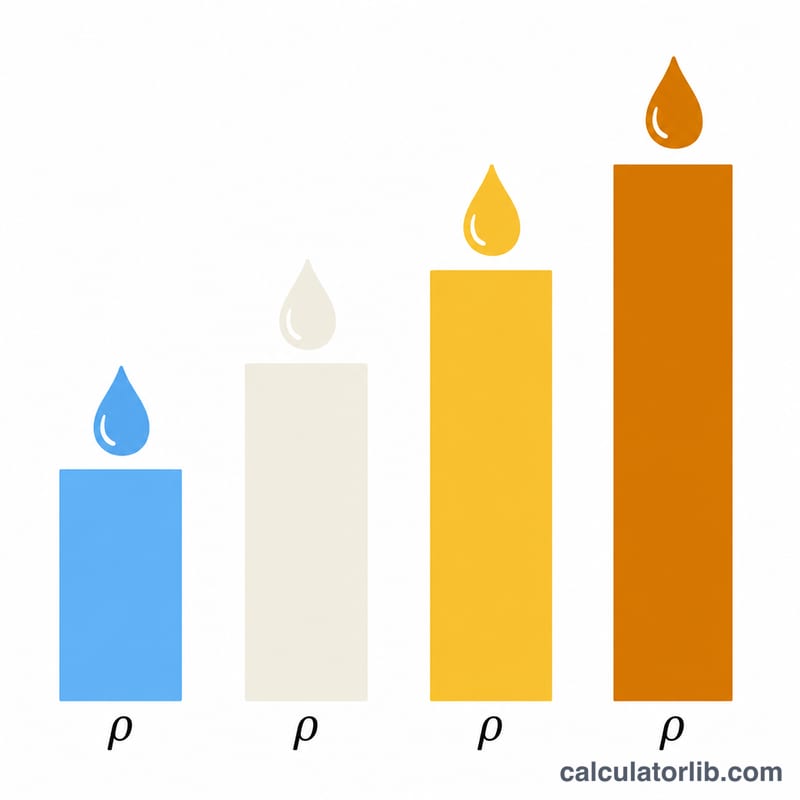
Enter the volume in liters, then enter the density of your liquid in kg/L. Pure water has a density of 1.0 kg/L, so 1 liter of water weighs about 2.2 pounds. Common values: milk ≈ 1.03, gasoline ≈ 0.74, olive oil ≈ 0.92, and seawater ≈ 1.025. The result shows both pounds and the intermediate mass in kilograms.
The Formula Explained
The conversion is:
$$\text{Pounds} = \text{Volume (L)} \times \text{Density (kg/L)} \times 2.20462$$First, liters \times density gives mass in kilograms. Then we multiply by \(2.20462\) because one kilogram equals \(2.20462\) pounds. Density is the key bridge between volume and weight.
Worked Example
Suppose you have 5 liters of olive oil with a density of 0.92 kg/L. Mass = \(5 \times 0.92 = 4.6\) kg. Weight in pounds:
$$4.6 \times 2.20462 = 10.14 \text{ lb}$$So 5 liters of olive oil weighs about 10.14 pounds.
FAQ
How much does 1 liter of water weigh in pounds? About 2.2046 pounds, since water's density is 1.0 kg/L.
Why do I need to enter density? Because different liquids have different weights for the same volume — a liter of oil is lighter than a liter of water.
Where do I find a liquid's density? Density is often listed on product safety data sheets or reference tables, usually in kg/L or g/mL (which are numerically equal).