What is the Minutes to Days Calculator?
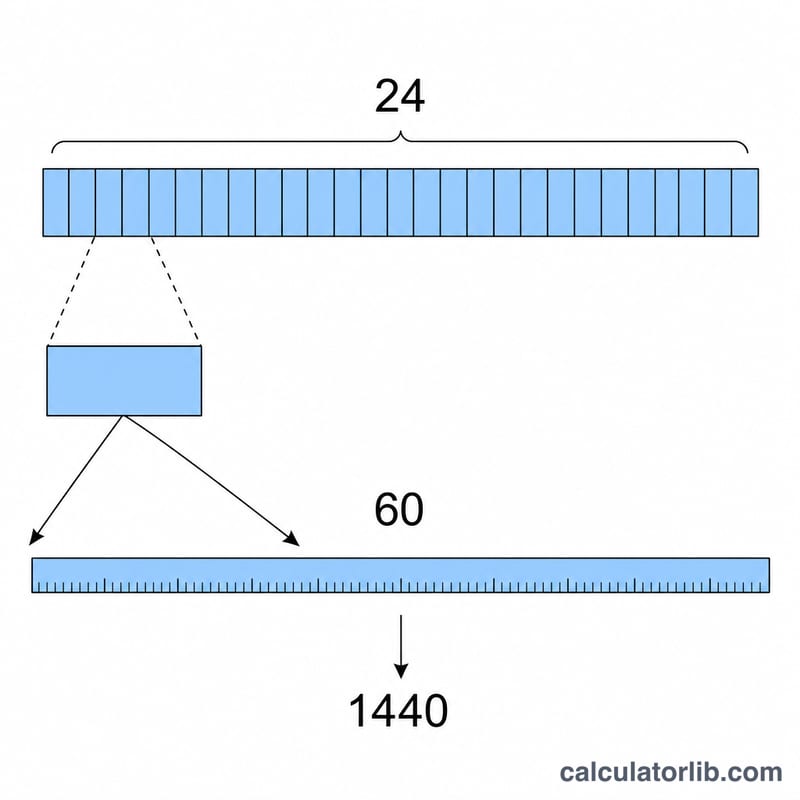
The Minutes to Days Calculator converts any number of minutes into the equivalent number of days. Because there are 24 hours in a day and 60 minutes in an hour, a single day contains \(24 \times 60 = 1{,}440\) minutes. This tool is handy whenever you have a duration recorded in minutes — such as task logs, machine runtime, or streaming totals — and you want to express it in days.
How to use it
Enter the total number of minutes into the input field and the calculator instantly returns the equivalent days. It also shows the same duration in hours so you can sanity-check the result. Decimal results are shown when the minutes do not divide evenly into whole days.
The formula explained
The conversion uses a simple division: $$\text{days} = \frac{\text{minutes}}{1440}$$ The constant 1,440 is the number of minutes in one full day. Likewise, hours are found with $$\text{hours} = \frac{\text{minutes}}{60}$$ These are exact conversions and apply universally regardless of country or calendar.
Worked example
Suppose you have 4,320 minutes. Dividing by 1,440 gives $$4{,}320 \div 1{,}440 = 3 \text{ days}$$ In hours, that is \(4{,}320 \div 60 = 72\) hours, which confirms the result since 72 hours equals exactly 3 days.
How to Convert Minutes to Days by Hand
A day contains 24 hours of 60 minutes each, so \(24 \times 60 = 1440\) minutes per day. Dividing by that single constant converts any minute count into days.
- Start with the total minutes. Make sure everything is in minutes first — if you have hours and minutes, convert the hours with \(\text{hours} \times 60\) and add them in.
- Divide by 1,440 to get the answer in decimal days: $$\text{Days} = \frac{\text{Minutes}}{1440}$$
- Take the whole-number part of that result — those are the complete days.
- Multiply the fractional part by 24 to turn the leftover day fraction into hours; the whole-number part of that is the leftover hours.
- Multiply the remaining hour fraction by 60 to get the leftover minutes.
- Verify by rebuilding the original figure: \(\text{days} \times 1440 + \text{hours} \times 60 + \text{minutes}\) should return your starting number.
Worked example: 5,000 minutes
Step 2 — divide by the minutes-per-day constant:
$$\text{Days} = \frac{5000}{1440} = 3.4722\ \text{days}$$So 5,000 minutes is about 3.4722 days.
Step 3 — the whole part is 3 full days.
Step 4 — convert the fraction 0.4722 of a day into hours:
$$0.4722 \times 24 = 11.333\ \text{hours} \rightarrow 11\ \text{whole hours}$$Step 5 — convert the remaining 0.333 hour into minutes:
$$0.333 \times 60 = 20\ \text{minutes}$$Result: 5,000 minutes = 3 days, 11 hours, 20 minutes.
Step 6 — check the answer by converting back:
$$3 \times 1440 + 11 \times 60 + 20 = 4320 + 660 + 20 = 5000\ \text{minutes}$$The check reproduces the original 5,000 minutes, so the breakdown is correct. If your verification misses by a small amount, you almost certainly rounded the decimal days too early — carry four or more decimal places, or work with exact fractions: \(5000/1440 = 25/7.2\), and the leftover is exactly \(5000 - 3 \times 1440 = 680\) minutes, which is 11 hours and 20 minutes.
Time Conversion Constants
Every minutes-to-days conversion rests on a handful of fixed civil-time relationships. These are the values the calculator uses:
- 1 minute = 60 seconds
- 1 hour = 60 minutes = 3,600 seconds
- 1 day = 24 hours = 1,440 minutes = 86,400 seconds
- 1 week = 7 days = 168 hours = 10,080 minutes
- 1 common year = 365 days = 525,600 minutes
- 1 leap year = 366 days = 527,040 minutes
- Average Gregorian year = 365.2425 days = 525,949.2 minutes
The average Gregorian year follows from the calendar's leap rule — a leap year every 4 years, except century years, except again every 400 years — which gives 97 leap years per 400-year cycle:
$$\frac{400 \times 365 + 97}{400} = 365.2425\ \text{days}$$Multiplying by 1,440 minutes per day gives \(365.2425 \times 1440 = 525{,}949.2\) minutes.
What these constants assume
These are conventional SI and civil-time values, and they deliberately ignore two real-world irregularities:
- Leap seconds. UTC occasionally inserts a leap second to stay aligned with Earth's rotation, making that particular minute 61 seconds long and that day 86,401 seconds. The 86,400-second day is the nominal figure used in arithmetic, not a guarantee about any specific UTC day.
- Daylight-saving transitions. In regions that observe a seasonal clock change (much of North America and Europe, among others), the changeover day has 23 or 25 hours of local time — 1,380 or 1,500 minutes — rather than 1,440. Regions without daylight saving are unaffected.
For ordinary purposes — timesheets, machine runtimes, project durations, cooking or incubation times — the 1,440-minute day is the correct and expected basis. If you are computing an exact elapsed interval across a daylight-saving boundary or a leap second, use a calendar-aware date/time tool rather than a plain division.
Note also that the Gregorian calendar itself is a specific convention; lunar, lunisolar and other calendars define years of different lengths, so the 525,600- and 527,040-minute year figures apply to Gregorian common and leap years only.
FAQ
How many minutes are in a day? There are 1,440 minutes in one day.
What if my minutes don't make a whole number of days? The calculator returns a decimal — for example, 720 minutes equals 0.5 days.
Does this account for leap seconds or daylight saving? No. It uses the standard 1,440-minute day, which is the conventional and exact value for everyday conversions.