
What is detention time?
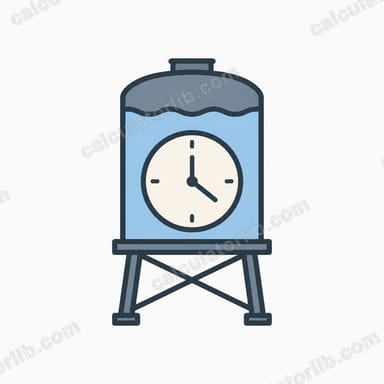
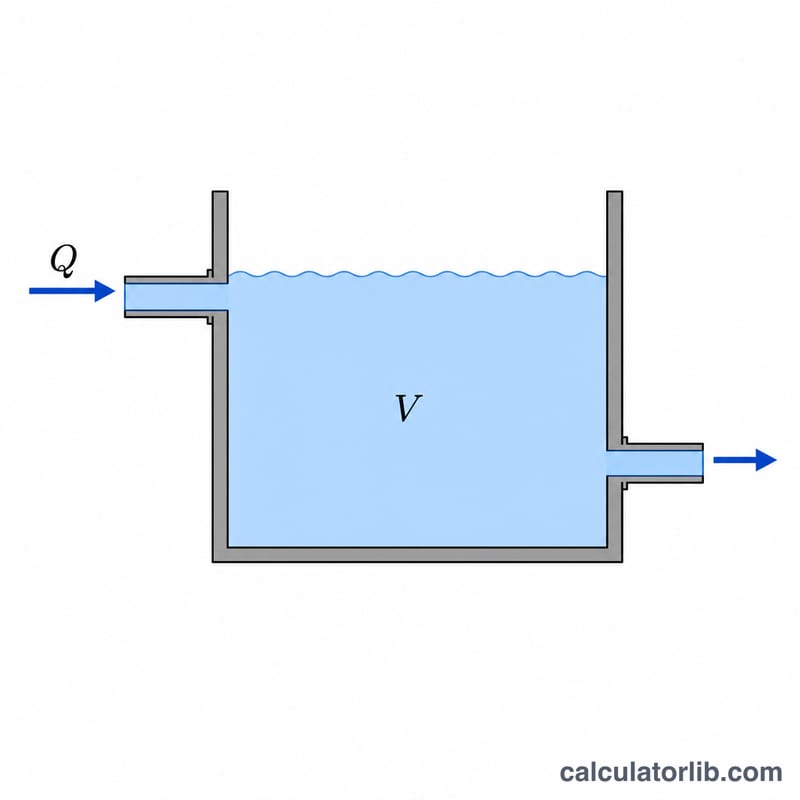
Detention time (also called retention time or hydraulic retention time) is the average length of time a unit of water remains inside a tank, basin, or vessel. It is a fundamental parameter in water and wastewater treatment, used to size sedimentation basins, flocculation tanks, chlorine contact chambers, and clarifiers. The basic relationship is simple: divide the volume of the vessel by the rate at which water flows through it.
How to use this calculator
Enter the tank volume and choose its unit (gallons, cubic meters, liters, or cubic feet). Then enter the flow rate and select its unit. The calculator converts everything to a common basis and reports the detention time in hours, with minutes and days shown for convenience.
The formula explained
The governing equation is \(t = V / Q\), where \(t\) is detention time, \(V\) is the tank volume, and \(Q\) is the volumetric flow rate. Both must be expressed in compatible units before dividing. For example, a volume in gallons and a flow in gallons per minute yield a time in minutes. This tool handles the unit conversions for you.
$$t = \frac{V_{L}}{Q_{L/h}}$$where
$$\begin{aligned} V_{L} &= \text{Tank Volume} \times \text{(to L)} \\ Q_{L/h} &= \text{Flow Rate} \times \text{(to L/h)} \end{aligned}$$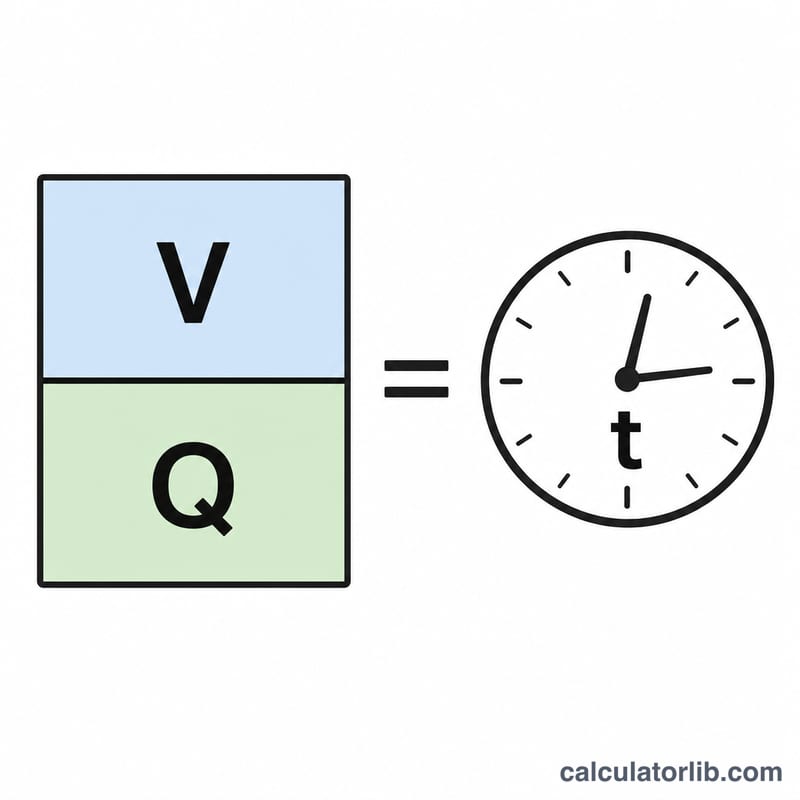
Worked example
Suppose a tank holds 100,000 gallons and water flows in at 500 gallons per minute. Detention time $$= 100{,}000 \div 500 = 200 \text{ minutes}$$ which equals \(3.33\) hours or about \(0.139\) days. This tells operators how long the water is held for treatment or settling.
FAQ
Is detention time the same as residence time? Yes — hydraulic detention time, retention time, and residence time all refer to \(V/Q\).
Why does detention time matter? It determines whether processes such as settling or disinfection have enough contact time to be effective.
What if my flow rate is zero? Detention time is undefined (infinite) at zero flow; enter a positive flow rate.