

What Are Miller Indices?
Miller indices are a set of three integers (h k l) used in crystallography to describe the orientation of a plane within a crystal lattice. They provide a compact, dimensionless notation that is independent of the actual size of the unit cell, making them essential for X-ray diffraction analysis, materials science, and solid-state physics.
How to Use This Calculator
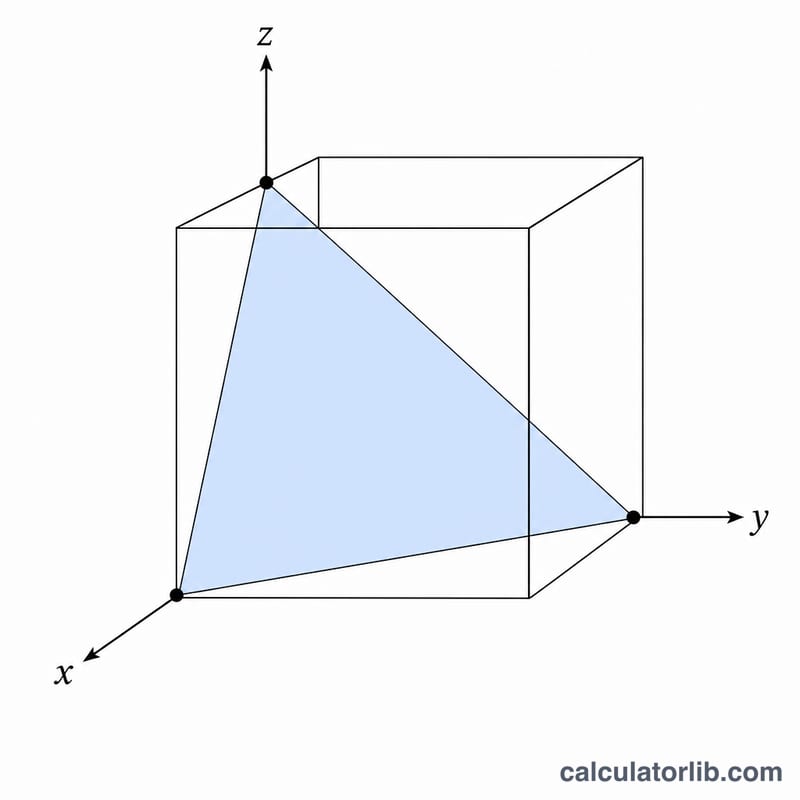
Enter the intercepts the plane makes with the x, y, and z crystallographic axes, measured in units of the lattice constants a, b, and c. For a plane that runs parallel to an axis (its intercept is at infinity), enter 0 — the calculator treats this as an index of 0. The tool then takes reciprocals, clears any fractions, and reduces the result to the smallest set of integers.
The Formula Explained
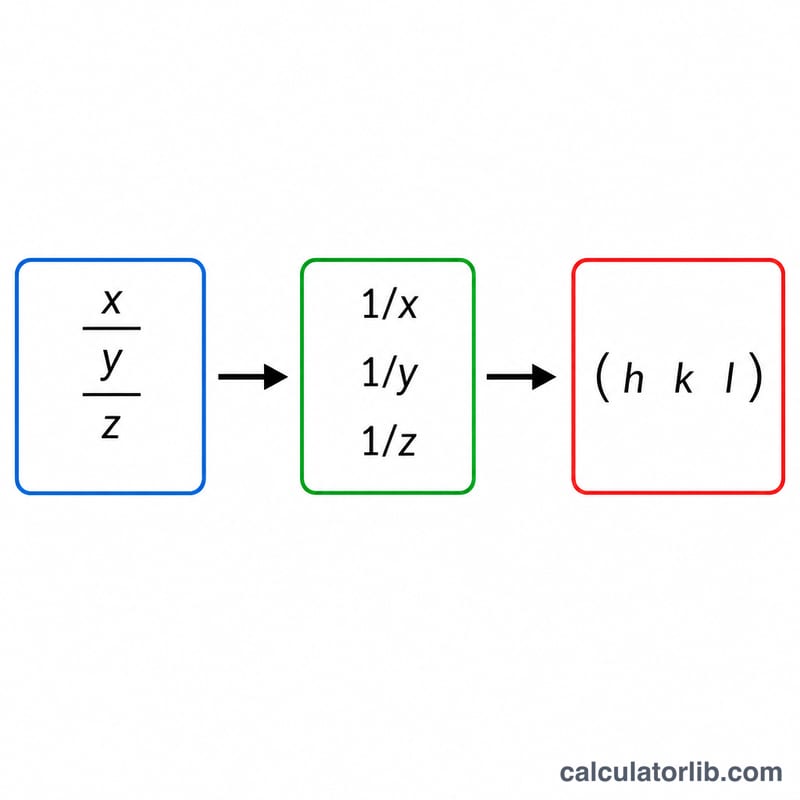
The procedure has three steps:
$$(h\,k\,l) = \frac{m}{\gcd}\left(\dfrac{1}{\text{X intercept}}\;,\;\dfrac{1}{\text{Y intercept}}\;,\;\dfrac{1}{\text{Z intercept}}\right)$$
1. Find the intercepts in lattice units (e.g. 1, 2, 3).
2. Take reciprocals (\(1/1, 1/2, 1/3\)).
3. Clear fractions by multiplying by the least common multiple of the denominators (\(\times 6 \to 6, 3, 2\)) and reduce by any common factor.
The resulting integers (6 3 2) are the Miller indices, written in parentheses without commas.
Worked Example
A plane intercepts the axes at \(x = 1\), \(y = 2\), \(z = 3\). Reciprocals are \(1, 1/2, 1/3\). Multiplying through by 6 gives $$1\times 6,\;\tfrac{1}{2}\times 6,\;\tfrac{1}{3}\times 6 = 6,\;3,\;2.$$ There is no common factor greater than 1, so the Miller indices are (6 3 2).
FAQ
What does a 0 index mean? An index of 0 means the plane is parallel to that axis — its intercept is at infinity, and \(1/\infty = 0\).
What does the bar over a number mean? In full notation a negative index is written with a bar above it (e.g. \(\bar{1}\)). This calculator returns the negative sign for planes intercepting the negative axis direction.
Are (1 1 1) and (2 2 2) the same plane? The reduced form (1 1 1) describes the plane orientation; indices are always reduced to their smallest integer set.