
What This Calculator Does
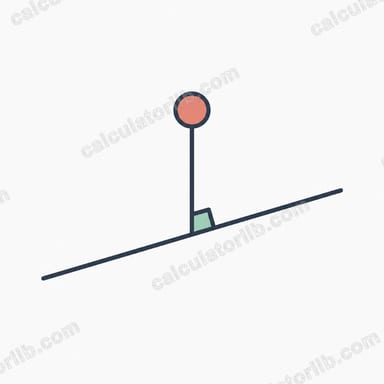
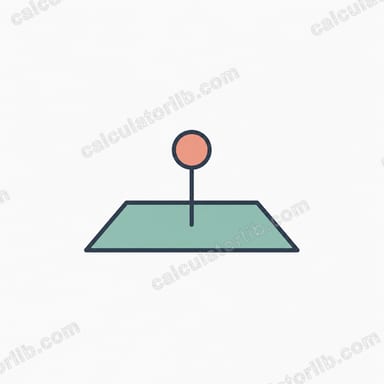
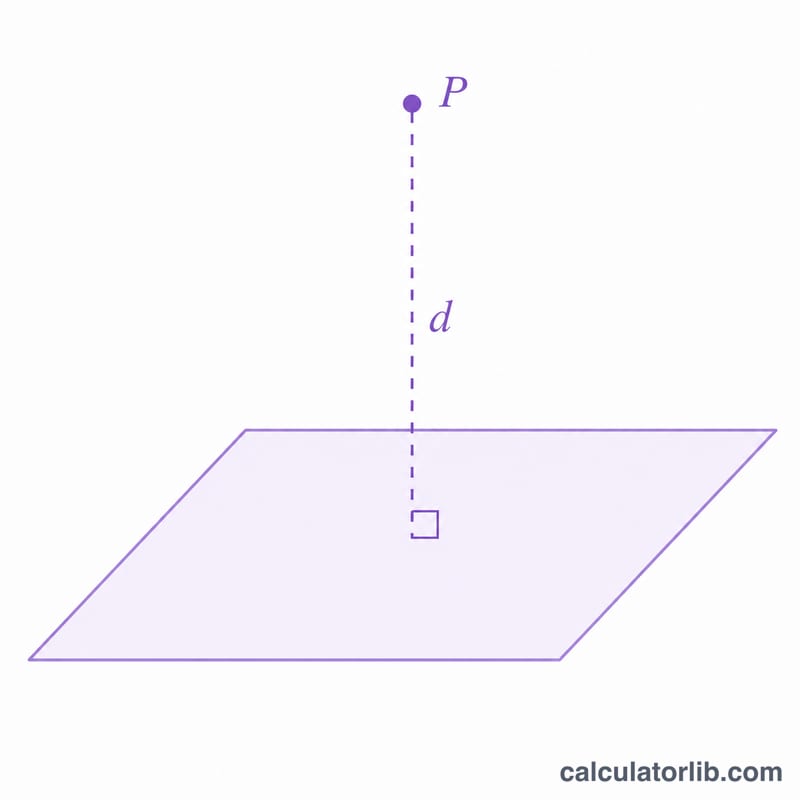
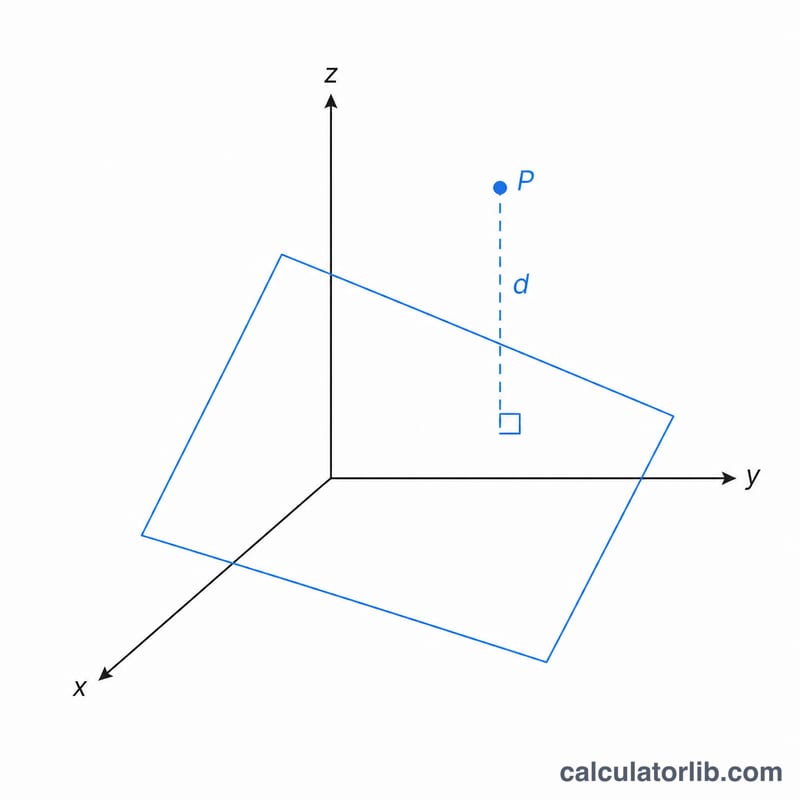
This tool finds the shortest (perpendicular) distance between a point in three-dimensional space and a plane. The plane is given in general form \(ax + by + cz + d = 0\), and the point is given by its coordinates \((x_0, y_0, z_0)\). The result is always a non-negative number representing how far the point lies from the plane.
How to Use It
Enter the four plane coefficients a, b, c and d, then enter the point coordinates x₀, y₀ and z₀. Press calculate to get the distance, along with the signed numerator and the magnitude of the plane's normal vector for reference. If the signed numerator is zero, the point lies exactly on the plane (distance = 0).
The Formula Explained
The vector \((a, b, c)\) is the normal to the plane. The expression \(a\cdot x_0 + b\cdot y_0 + c\cdot z_0 + d\) measures how far the point sits along that normal direction (a signed value). Dividing its absolute value by the normal's length \(\sqrt{a^2+b^2+c^2}\) converts it into a true geometric distance:
$$d = \frac{\left| a\cdot x_0 + b\cdot y_0 + c\cdot z_0 + d \right|}{\sqrt{a^{2}+b^{2}+c^{2}}}$$
Worked Example
Plane: \(x + 2y + 2z - 6 = 0\), point \((1, 1, 1)\). Numerator = \(|1\cdot 1 + 2\cdot 1 + 2\cdot 1 - 6| = |-1| = 1\). Normal magnitude = \(\sqrt{1^2+2^2+2^2} = \sqrt{9} = 3\). So $$d = \frac{1}{3} \approx 0.3333 \text{ units}.$$
FAQ
What if the plane is given as \(ax+by+cz = d\)? Rearrange to \(ax+by+cz - d = 0\), so enter the constant as \(-d\) in this calculator.
Why is the result never negative? Distance is a magnitude, so the absolute value of the numerator is used. The signed value is shown separately to indicate which side of the plane the point is on.
What happens if a, b and c are all zero? Then there is no valid plane (the normal has zero length) and the distance is undefined; this calculator returns 0 in that degenerate case.