
What This Calculator Does
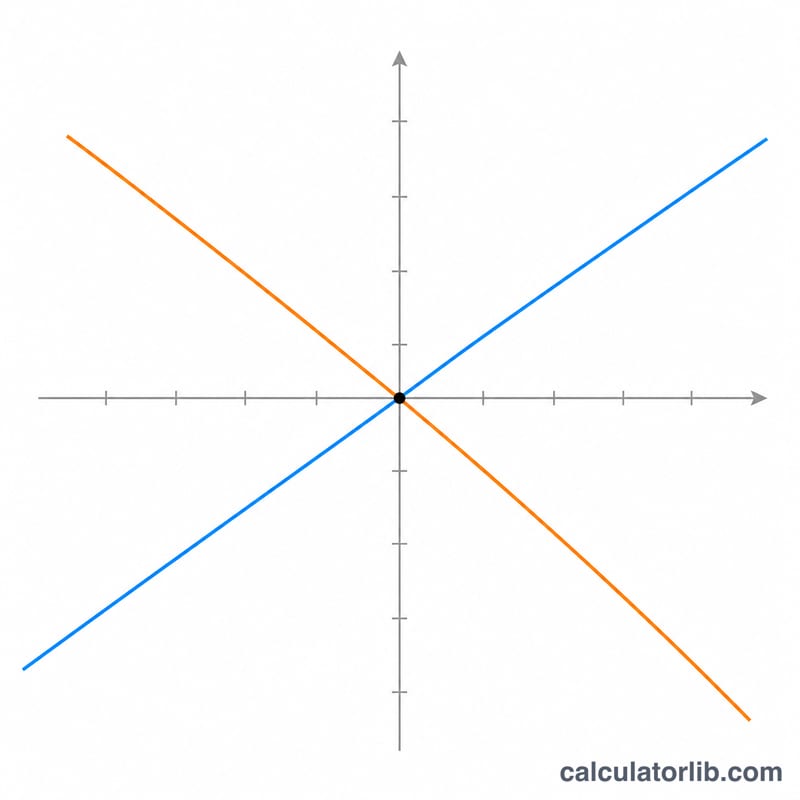
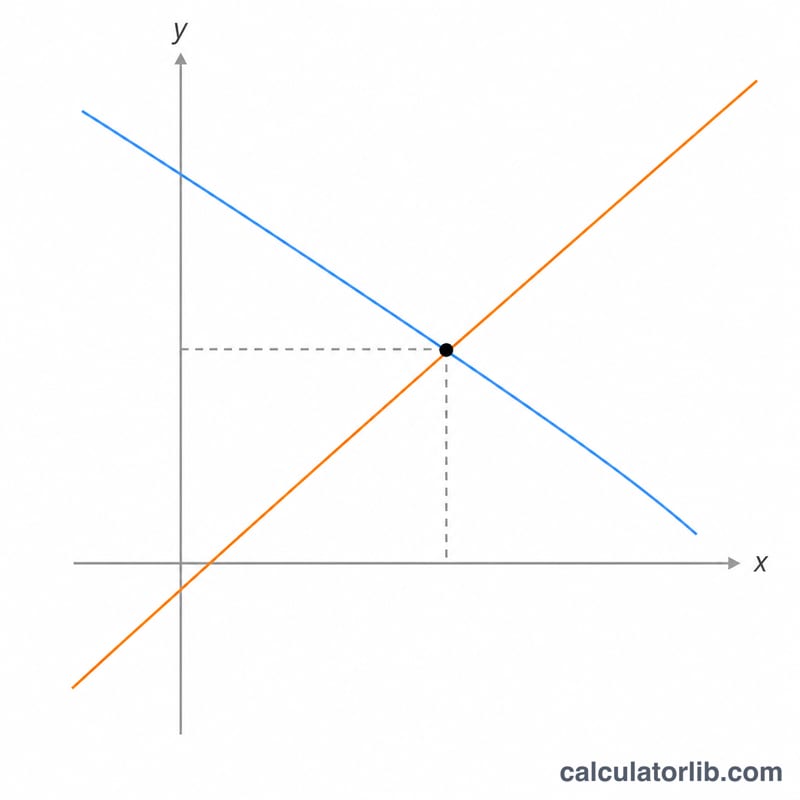
This tool finds the single point (x, y) where two straight lines cross on the coordinate plane. Each line is written in general form: \(a_1 x + b_1 y = c_1\) and \(a_2 x + b_2 y = c_2\). Enter the six coefficients and the calculator solves the system instantly, telling you whether the lines intersect at one point, are parallel (no intersection), or are the same line (infinitely many points).
How to Use It
Rewrite each line in the form \(ax + by = c\). For example, the slope-intercept line \(y = 2x + 1\) becomes \(-2x + 1y = 1\) (so \(a = -2\), \(b = 1\), \(c = 1\)). Type the \(a\), \(b\), and \(c\) values for both lines into the fields and read off the intersection point. Negative and decimal coefficients are fully supported.
The Formula Explained
The system is solved with Cramer's rule. The key quantity is the determinant \(D = a_1 b_2 - a_2 b_1\). When \(D \neq 0\) there is exactly one solution:
$$x = \frac{c_1 b_2 - c_2 b_1}{D}, \quad y = \frac{a_1 c_2 - a_2 c_1}{D}$$When \(D = 0\) the lines have the same slope: if the equations are proportional they coincide, otherwise they are parallel and never meet.
Worked Example
Take Line 1: \(x + y = 5\) and Line 2: \(x - y = 1\). Here \(a_1=1\), \(b_1=1\), \(c_1=5\), \(a_2=1\), \(b_2=-1\), \(c_2=1\). The determinant is
$$(1)(-1) - (1)(1) = -2$$Then
$$x = \frac{5 \cdot (-1) - 1 \cdot 1}{-2} = \frac{-6}{-2} = 3 \quad \text{and} \quad y = \frac{1 \cdot 1 - 1 \cdot 5}{-2} = \frac{-4}{-2} = 2$$The lines cross at (3, 2).
FAQ
What if the lines are parallel? The determinant is zero and the equations are not proportional, so there is no intersection point — the calculator reports "parallel."
What does coincident mean? Both equations describe the same line, so every point on it is an intersection. The determinant and the secondary determinants are all zero.
Can I use slope-intercept form? Yes — just convert \(y = mx + b\) to \(-mx + y = b\), giving \(a = -m\), \(b = 1\), \(c = b\).