What this calculator does
This tool tells you how many years you have been married as of the current calendar year and gives the traditional anniversary name (such as silver wedding, gold wedding, or diamond wedding) along with an example gift material. The anniversary-name list follows the widely used Western and international tradition, so the result is universal. Only the optional Japanese imperial era input is region specific.
How to use it
Pick how you want to enter the wedding year. Choose "Western (CE/AD)" to type the Gregorian year directly (for example 1979). If you know the year only as a Japanese imperial era such as Meiji, Taisho, Showa, Heisei or Reiwa, select that era and enter the era year number. The calculator converts it to the Gregorian year automatically and then compares it with the current year.
The formula explained
First the wedding year is converted to the Gregorian calendar: \(\text{gregorianWeddingYear} = \text{eraOffset} + \text{weddingYear}\), where the offset is 0 for Western input. Then \(\text{yearsMarried} = \text{currentYear} - \text{gregorianWeddingYear}\). That year count is looked up in the traditional table to find the anniversary name and a gift idea. If the count has no traditional name, the result shows "(no traditional name)".
$$\text{Years Married} = \text{Current Year} - \text{Wedding Year}$$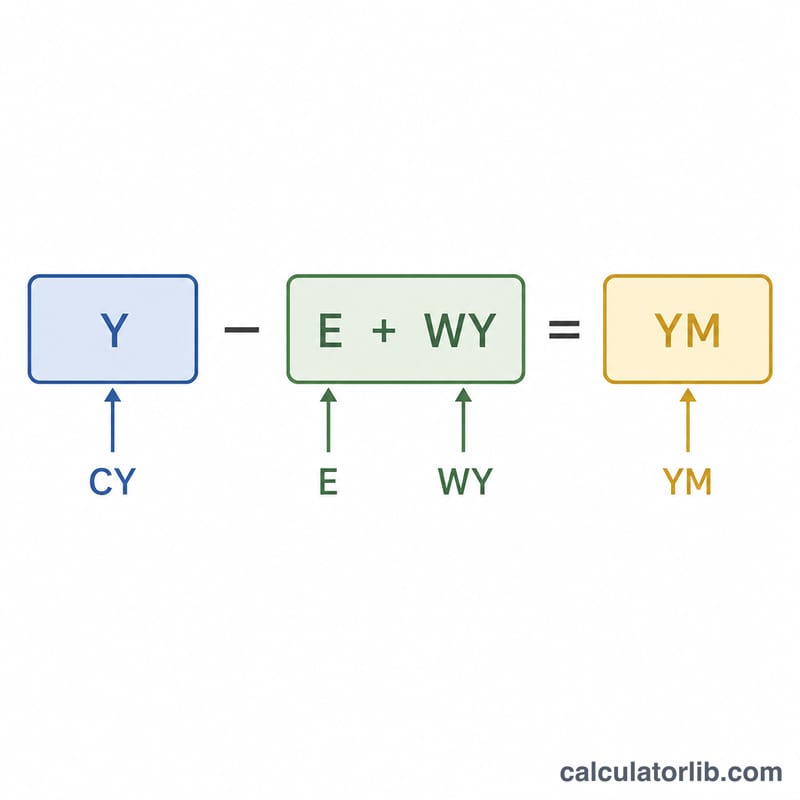
Worked example
Suppose the current year is 2026 and the wedding was in 1979 (Western). Then \(\text{gregorianWeddingYear} = 1979\) and $$\text{yearsMarried} = 2026 - 1979 = 47 \text{ years}.$$ Forty-seven is not in the traditional list, so the name is "(no traditional name)". If the wedding year were 2001 instead, \(\text{yearsMarried} = 25\), which is the silver wedding, with silver items as the example gift.
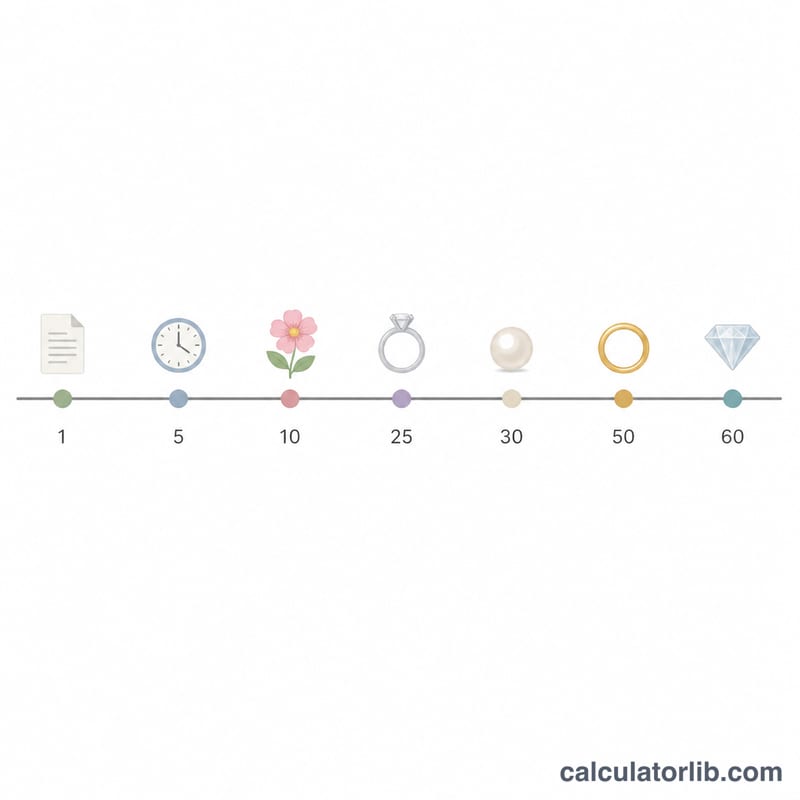
Traditional Anniversary Names and Gifts by Year
Years married are counted as the current year minus the wedding year. The traditional gift for each milestone is listed below. This list follows the common Western (US/UK-style) tradition.
| Years married | Anniversary name / gift material |
|---|---|
| 1 | Paper |
| 2 | Cotton |
| 3 | Leather |
| 4 | Fruit / Flowers |
| 5 | Wood |
| 6 | Sugar / Iron |
| 7 | Wool / Copper |
| 8 | Bronze |
| 9 | Pottery |
| 10 | Tin / Aluminum |
| 11 | Steel |
| 12 | Silk |
| 13 | Lace |
| 14 | Ivory |
| 15 | Crystal |
| 20 | China |
| 25 | Silver |
| 30 | Pearl |
| 35 | Coral / Jade |
| 40 | Ruby |
| 45 | Sapphire |
| 50 | Gold |
| 55 | Emerald |
| 60 | Diamond |
| 70 | Platinum |
Note: Anniversary lists vary by country. The US, the UK and Japan each have their own traditions, and some years have alternative materials (for example, 4 is sometimes linen or silk in other lists). The calculator's own list may differ slightly from the table above, so use the name and gift shown by the tool for your result.
Japanese Imperial Era to Gregorian Year Conversion
To enter a wedding year in the Japanese imperial era format, choose the era and type the year number within that era. The Gregorian year is the era year plus the era's offset:
$$\text{Gregorian year} = \text{Era year} + \text{Offset}$$
| Era | Offset | Gregorian range |
|---|---|---|
| Meiji (明治) | 1867 | 1868–1912 |
| Taisho (大正) | 1911 | 1912–1926 |
| Showa (昭和) | 1925 | 1926–1989 |
| Heisei (平成) | 1988 | 1989–2019 |
| Reiwa (令和) | 2018 | 2019–present |
Important: Reiwa year 1 is 2019, so the Reiwa offset is 2018. The value 1988 is the offset for Heisei, not Reiwa, and should not be used for Reiwa dates.
Sample conversions
- Meiji 30: \(30 + 1867 = 1897\)
- Taisho 10: \(10 + 1911 = 1921\)
- Showa 50: \(50 + 1925 = 1975\)
- Heisei 10: \(10 + 1988 = 1998\)
- Reiwa 5: \(5 + 2018 = 2023\)
Overlapping years: Eras change partway through a calendar year, so the first and last years of adjacent eras share a Gregorian year. For example, 1912 is both Meiji 45 and Taisho 1, 1926 is both Taisho 15 and Showa 1, 1989 is both Showa 64 and Heisei 1, and 2019 is both Heisei 31 and Reiwa 1. Because the tool works with whole years, either era notation gives the same Gregorian year and the same count of years married.
FAQ
How does the Japanese era conversion work? Era year 1 maps to \(\text{offset} + 1\). For example Reiwa uses offset 1988, so Reiwa 1 = 1989 and Showa 54 = \(1925 + 54 = 1979\).
Why does the result change over time? The years married are measured against the current calendar year, so the count increases each new year.
What if I enter a future year? If the wedding year is later than the current year, the calculator reports that you are not yet married for that date.