
What is the comfortable exercise heart rate?
The "comfortable" exercise heart rate is a light-intensity training pace often described as "lightly breaking a sweat but not out of breath." It is a simple age-based heuristic for finding a sustainable aerobic effort that most healthy people can maintain. This is a general guideline, not a personalized heart-rate-reserve formula, and applies universally rather than to any specific country.
How to use this calculator
Enter your age in whole years and press calculate. The tool returns a target heart rate in beats per minute (bpm). Aim to keep your pulse near this value during light cardio such as brisk walking, easy cycling, or gentle jogging. Many health guides suggest that exercising at this comfortable pace for at least 20 minutes per session and at least 180 minutes per week may help reduce the risk of lifestyle-related conditions.
The formula explained
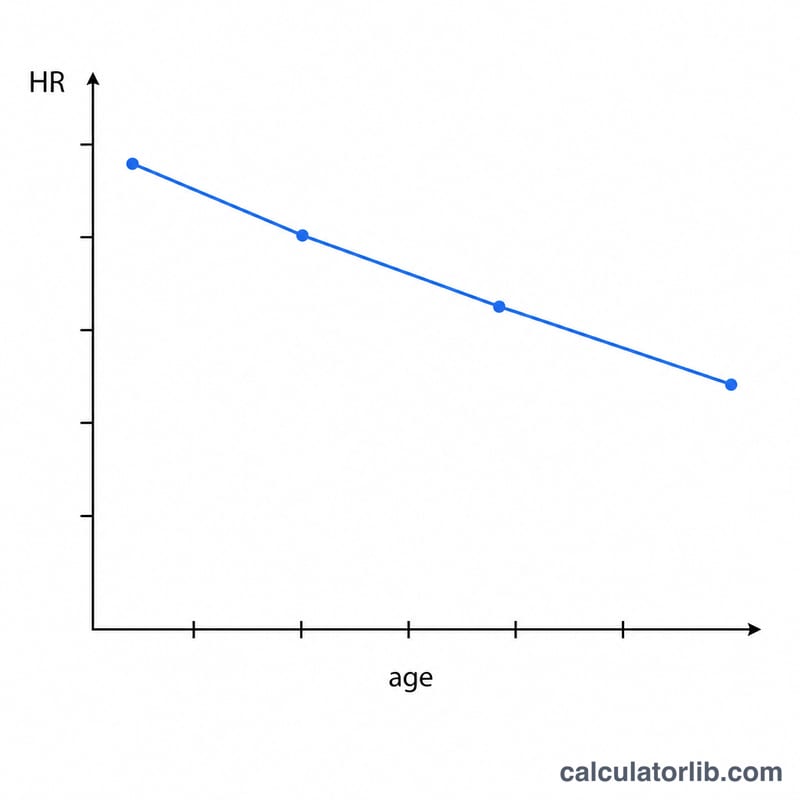
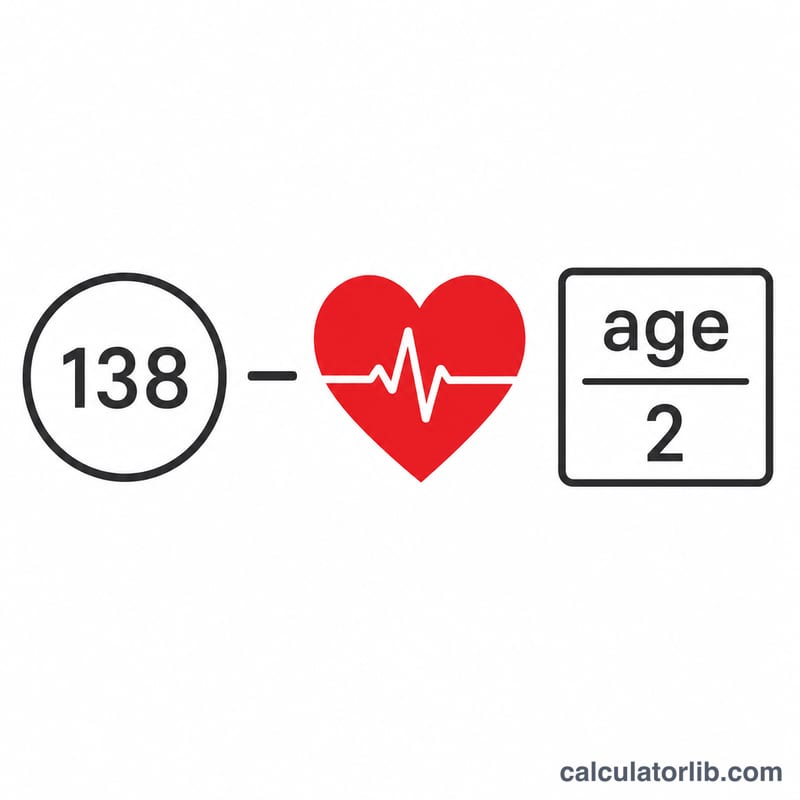
The calculation is a fixed linear rule: $$\text{comfortable heart rate} = 138 - \frac{\text{age}}{2}$$ As age increases, the target heart rate decreases, mirroring the natural decline of maximum heart rate with age. Because it is linear, every extra two years of age lowers the target by about one beat per minute.
Worked example
For a 40-year-old: $$138 - \frac{40}{2} = 138 - 20 = 118 \text{ bpm}$$ For a 65-year-old: $$138 - \frac{65}{2} = 138 - 32.5 = 105.5 \text{ bpm}$$ which rounds to about 106 bpm.
FAQ
Is this medical advice? No. This is general guidance only. Always consult a healthcare professional before beginning or changing an exercise routine, especially if you have a heart condition.
Why does a very old age give a negative number? The formula is purely linear, so extreme or out-of-range ages produce values that are mathematically valid but physiologically meaningless. Keep age within a sensible human range (0-120).
How precise is this? It is a rough heuristic. Individual fitness, medication, and health conditions can shift your ideal training zone significantly, so treat the result as a starting reference, not a strict limit.