
What is the Dog Heart Rate Calculator?
This tool converts the number of heartbeats you count in a 15-second window into a full beats-per-minute (bpm) figure and compares it against the normal resting range for your dog's size. It's a quick way to check whether your dog's pulse looks healthy or warrants a vet visit. The tool is a general guide and is not a substitute for veterinary advice.
How to use it
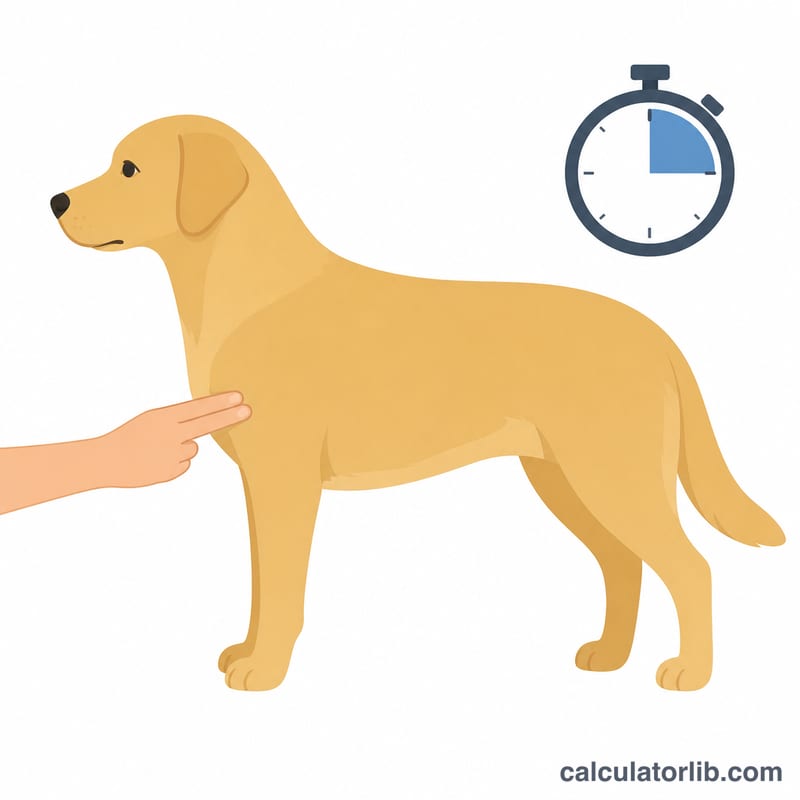
Place your hand over your dog's chest (just behind the front left leg) or feel the femoral artery on the inside of the thigh. Count the beats for exactly 15 seconds while your dog is calm and resting. Enter that count, choose your dog's size category, and the calculator returns the bpm and tells you whether it falls inside the normal band.
The formula explained
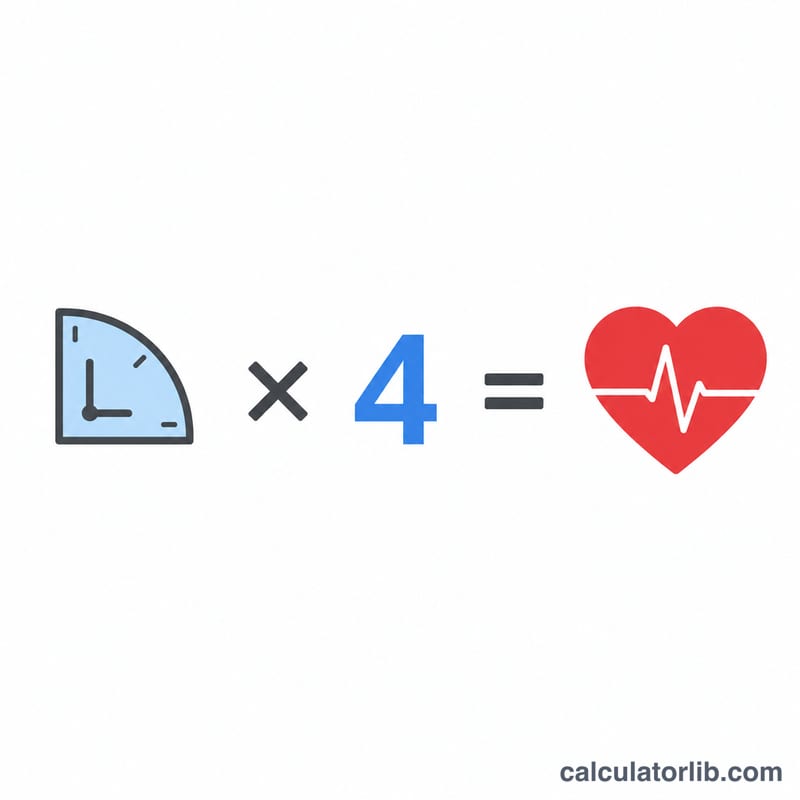
Heart rate in bpm equals the beats counted in 15 seconds multiplied by 4, because there are four 15-second segments in a minute. The result is then checked against size-based normal ranges:
$$\text{BPM} = \text{Beats in 15s} \times 4$$small dogs (under ~30 lb) \(100\text{-}140\) bpm, medium dogs \(70\text{-}120\) bpm, and large dogs (over ~50 lb) \(60\text{-}90\) bpm. Smaller dogs naturally have faster hearts than larger ones.
Worked example
Suppose you count 25 beats in 15 seconds for a medium-sized dog. Multiply:
$$25 \times 4 = 100 \text{ bpm}$$The normal medium range is \(70\text{-}120\) bpm, so \(100\) bpm is comfortably within the normal range.
FAQ
Why count only 15 seconds? Dogs rarely hold still long enough for a full minute, and a 15-second count multiplied by 4 gives a reliable estimate.
What if my dog's bpm is outside the range? A rate slightly outside the band can be caused by excitement, exercise, or stress. A consistently abnormal resting rate should be discussed with your veterinarian.
Do puppies have different rates? Yes. Puppies can have resting heart rates of \(120\text{-}160\) bpm or higher, faster than adult dogs of the same eventual size.